

Quick Answer: What Does a Turnkey Bowling Alley Package Include?
A turnkey bowling alley equipment package generally combines a configured set of bowling equipment with some project-planning and delivery services, but the exact scope varies by supplier and contract. Before comparing proposals, verify the itemized equipment list, layout and site responsibilities, shipping, installation or installation guidance, commissioning, staff training, warranty, and exclusions. Civil works, permits, customs clearance, and on-site installation crews are not automatic inclusions.
What "turnkey" can mean in a bowling project
One supplier may use "turnkey" for equipment supply and layout planning; another may include shipping coordination, technical commissioning, or training. The label alone does not tell you which work is covered. Treat it as a description to clarify, not as a defined scope.
A standard ten-pin equipment package may include lane assemblies, pinsetters, ball returns, scoring hardware, overhead displays, synchronized lighting, balls, and pins. The exact components depend on the selected format and configuration. A commercial bowling alley equipment list can help establish the hardware categories to itemize in a request for quotation (RFQ).
What buyers should verify before comparing quotes
Compare written inclusions, exclusions, assumptions, and responsibilities—not just a total price or the word "turnkey." For broader venue-planning context, review the bowling alley equipment planning fundamentals alongside package proposals.
What Is a Turnkey Bowling Alley Equipment Package?
Equipment package versus project delivery scope
The equipment package is the physical system specified for the venue. Project delivery scope describes the services around it, such as CAD plan review, layout planning, manufacturing, packing, shipping coordination, installation guidance, commissioning, and operational training. These are separate parts of a proposal and should be stated separately.
For example, a supplier may provide an equipment layout but not perform architectural design or construction. Installation guidance is also distinct from supplying an on-site installation crew. The proposal should name the deliverable and responsible party for each service.
Why "turnkey" is not a standard scope
There is no universal package definition in the bowling equipment industry. Services can be contracted as one combined scope or priced and assigned separately. The practical test is whether the contract describes what will be delivered, what must be ready at the venue, and what happens if a dependency is not met.
Typical project parties and responsibilities
Projects often involve the equipment supplier, venue owner or operator, architect or local contractor, freight and customs parties, and local installation resources. Responsibilities should be mapped for site preparation, utilities, access, unloading, local approvals, equipment assembly, commissioning, and staff handover. The owner should confirm local construction and compliance requirements with the relevant professionals and authorities.
For facility constraints and layout terminology, the guide to commercial bowling equipment technical specifications provides related planning context.
How a Bowling Equipment Package Is Planned and Delivered
A well-defined sequence lets the venue team coordinate supplier work with construction, freight, and opening preparations. Confirm the output and approval point at each stage rather than relying on an informal schedule.
Requirements intake and floor-plan review
Start with venue type, project location, available room dimensions, ceiling clearances, columns, entrances and exits, access constraints, lane count, and preferred bowling format. A CAD drawing or dimensioned floor plan is more useful than a room area estimate alone: obstructions and access routes can change how lanes and service areas fit.
Equipment configuration and layout planning
Use the site information to review lane arrangement, equipment footprint, approaches, seating, mechanics, and maintenance access. Confirm the proposed configuration and layout before order finalization. Any changes to lane count, format, or site dimensions after approval should be reviewed for their effect on the equipment list and project dependencies.
Manufacturing, packing, and shipping coordination
Once the equipment configuration is approved, the supplier can define the manufacturing and packing scope. Agree on the shipping arrangement, shipping documents, delivery destination, receiving contact, and who coordinates unloading. If the venue cannot receive or store the shipment when it arrives, that can create a handoff problem even when the equipment order itself is complete.
Installation guidance, commissioning, and staff training
Clarify whether the supplier provides written or remote installation guidance, on-site supervision, installation labor, technical commissioning, or some combination. Commissioning should have an agreed scope and handover record; training should identify which staff will attend and what operational topics will be covered. Define who signs off that the system is ready for the venue's intended use.
What Equipment and Bowling Format Should the Package Cover?
Standard ten-pin package components
A full-size ten-pin package may include lane assemblies, string pinsetters, ball return mechanisms, scoring hardware, overhead displays, lighting, bowling balls, and pins. Ask for each component to be named, with quantities and any selected options. If a specific pinsetter certification or competitive-use requirement matters to the project, verify the exact model and its current documentation rather than assuming that approval applies to the entire package.
Compact medium bowling for space-constrained venues
Medium bowling can be considered for bars, cafés, boutique hotels, shopping malls, and social entertainment venues where a full-size ten-pin arrangement does not suit the available area or operating concept. Medium bowling lanes are customizable between 9.6 m and 18 m in length, with a typical two-lane equipment footprint of approximately 12 m long, 3.05 m wide, and 2.13 m high. The format uses smaller 4-pound and 6-pound bowling balls with two finger holes. However, these dimensions represent only the equipment footprint; the total room must also accommodate approach space, seating, mechanical areas, and maintenance access. Confirm that the proposed accessories, scoring setup, and guest experience match the venue's intended use.
Duckpin for social and family entertainment settings
Duckpin may suit family entertainment centers, hospitality venues, bars, and cinema complexes seeking a compact social activity. The standard lane length is 9.13 m, with a typical two-lane equipment footprint of approximately 9.13 m long, 3.48 m wide, and 2.25 m high. Duckpin uses standard duckpin-sized pins and a 1.25 kg handheld ball. Like medium bowling, these dimensions describe only the equipment; additional space must be calculated for approaches, seating, mechanics, and maintenance aisles. Confirm format-specific components in the quote and do not assume that specifications or certifications for one format apply to another.
Matching format to venue use and available space
Choose the format from the intended audience, operating model, and room plan—not from equipment footprint alone. A published footprint describes the equipment, not the total room requirement. The room layout must also account for approaches, guest seating, mechanics, maintenance clearance, columns, and circulation. For instance, a hotel may be evaluating a compact format for a lounge, while a dedicated center may require full-size ten-pin lanes; each is an application scenario, not a universal recommendation.
Compare Package Scope: Equipment-Only, Supported Delivery, and Broader Project Packages
These are useful comparison categories, not fixed industry tiers. A proposal can combine them in different ways, so request a line-by-line scope rather than assuming that a category guarantees particular services.
| Scope approach | What to look for in the proposal | Buyer implication |
|---|---|---|
| Equipment supply only | Itemized equipment, configuration assumptions, packing, delivery terms, and exclusions. | The owner or appointed contractor coordinates layout implementation, site readiness, installation resources, and local approvals unless separately agreed. |
| Equipment plus layout and delivery coordination | CAD review, proposed layout, equipment configuration, shipping coordination, and defined handoff points. | This supports planning, but does not itself confirm construction, unloading, customs clearance, or installation labor. |
| Equipment with installation or commissioning support | Whether support is guidance, supervision, remote assistance, on-site labor, commissioning, or training—and which party supplies each. | Clarifying the type of support prevents a gap between equipment arrival and operational handover. |
For every approach, assign responsibility for civil or structural work, permits and fire-code approvals, customs clearance, unloading, local installation crews, utilities, and site access. If those items are outside the supplier's contract, name the owner-side or contractor-side party responsible for them.
Buyer Requirements and Specification Checklist
A complete RFQ gives suppliers enough information to propose the same project basis. Use this checklist to reduce assumptions and make quotation differences visible.
Venue and site information
- Project location and venue type, such as a bowling center, family entertainment center, hotel, resort, or bar.
- CAD file or dimensioned floor plan, available room dimensions, and ceiling height or clearance information.
- Columns, entrances, exits, delivery access, and other known constraints that affect the equipment route or layout.
Lane count and preferred format
- Planned lane count and preferred format: standard ten-pin, medium bowling, or duckpin.
- Intended operating model and any project-specific requirements for scoring, displays, lighting, or accessories.
- Any required standards, approvals, or documentation, specifying the exact equipment or model to which the requirement applies.
Equipment and service inclusions
- An itemized list of lane assemblies, pinsetters, ball returns, scoring components, displays, lighting, balls, pins, and format-specific accessories.
- A separate list of planning, shipping coordination, installation guidance or labor, commissioning, and training deliverables.
- Written assumptions, exclusions, site prerequisites, and the party responsible for each unresolved task.
Delivery, acceptance, and post-delivery terms
- Delivery destination, shipping and receiving responsibilities, unloading arrangements, and required documentation.
- Acceptance criteria, commissioning records, handover expectations, and the process for reporting transit damage or shortages.
- Written warranty duration, coverage, exclusions, service process, and support responsibilities for the specified equipment and destination market.
Industry resources can inform the wider venue-planning context: the BPAA Proprietor Resource Center offers resources for bowling proprietors, while IAAPA research and resources cover the attractions sector. Neither defines the scope of an individual supplier's package; use the proposal and contract for that.
Common Buying Mistakes and Project Risks
Comparing quotes with different inclusions
A lower total is not necessarily a like-for-like offer. One proposal may include scoring hardware and commissioning while another lists only core equipment. Normalize format, lane count, components, delivery terms, services, and exclusions before comparing commercial totals.
Treating equipment dimensions as the total room requirement
Equipment dimensions are not a complete architectural plan. If a layout omits approach space, seating, mechanics, or maintenance access, the equipment may fit on paper but conflict with how guests and staff need to use the room. Ask the supplier to state the basis of its proposed layout and have the full venue plan reviewed by the project's appropriate design professionals.
Leaving installation and site work undefined
"Installation support" can mean guidance or actual labor. If the contract does not distinguish these, the owner may discover too late that local crews, site preparation, or commissioning attendance are not covered. Record the responsible party, prerequisites, deliverables, and approval point for each activity.
Overlooking shipping, access, and local compliance responsibilities
Confirm how equipment will reach the site, who receives and unloads it, and whether the venue can provide the required access and storage. Separately assign customs and local compliance tasks; a supplier's coordination of shipment does not by itself establish responsibility for clearance, permits, or fire-code approvals. Resolve those dependencies before placing the order.
How to Evaluate a Bowling Equipment Supplier
Scope transparency and proposal detail
Look for an itemized equipment schedule, clear service descriptions, layout assumptions, exclusions, and owner-side dependencies. A useful proposal makes it possible to identify what is included without interpreting broad labels such as "complete" or "turnkey."
Engineering and layout review process
Ask who reviews the CAD plan, what site information is required, and how columns, ceiling clearances, entrances, exits, and access constraints are incorporated. Confirm that the approved configuration and layout are recorded before the order is finalized.
Delivery and commissioning responsibilities
Ask who manages packing and shipping coordination, who receives and unloads the equipment, what installation support means, and who performs or attends commissioning. Request the expected handover documents and clarify how the team will address a site that is not ready on the planned delivery or installation date.
Warranty, training, and support terms
Check warranty duration and coverage in the written offer for the specific equipment. Also establish the contact route for technical questions, the support process, and the scope of staff training. Where a supplier cites a certification or approval, verify the named product model and its current evidence; do not extend the claim to unrelated equipment.
Questions to ask before purchase
- Which equipment items and accessories are included for this lane count and bowling format?
- Which drawing and site assumptions is the layout based on, and what approvals are required before production?
- Does installation support mean guidance, supervision, or on-site installation labor?
- Who is responsible for shipping coordination, customs, unloading, local permits, and civil works?
- What commissioning, training, acceptance, warranty, and post-delivery support terms will appear in the contract?
Next Steps: Prepare a Comparable Bowling Equipment RFQ
A comparable proposal starts with a clear site basis and a defined division of work. When you contact suppliers, provide the following information to ensure consistent and comparable quotations:
- Project location, venue type, and intended operating model.
- CAD file or dimensioned floor plan with available room dimensions, ceiling height, columns, entrances, exits, and access constraints.
- Planned lane count and preferred bowling format (standard ten-pin, medium bowling, or duckpin).
- Specific requirements for scoring, displays, lighting, or format-specific accessories.
- Requested delivery and installation services, including whether you need layout planning, shipping coordination, installation guidance, on-site installation labor, commissioning, or staff training.
When suppliers respond, require them to provide in writing:
- An itemized equipment list with quantities and model numbers for each component.
- A separate list of planning, logistics, installation, commissioning, and training services, with the responsible party for each.
- Written assumptions about site conditions, utilities, access, and local responsibilities.
- Explicit exclusions, such as civil works, local permits, customs clearance, or on-site installation crews.
- Delivery terms, warranty duration and coverage, and post-delivery support process.
Require suppliers to state assumptions and exclusions clearly rather than relying on the term "turnkey." This approach ensures that you can compare proposals on the same basis and identify which party is responsible for each project component.
Discuss Your Project Requirements
A comparable proposal starts with a clear site basis and a defined division of work. Share your project location, venue type, CAD or floor plan, available dimensions and ceiling height, preferred bowling format, planned lane count, and the services you want suppliers to price.
Discuss a turnkey bowling equipment package for your project
Frequently Asked Questions
References
More Articles

Let’s Build a center Together
Partner With a Trusted Bowling Alley Design, One-Stop Solution Manufacturer.
Flying has successfully built ideal bowling alleys for more than 3,000 customers.

Technical Expert
You may also like our products
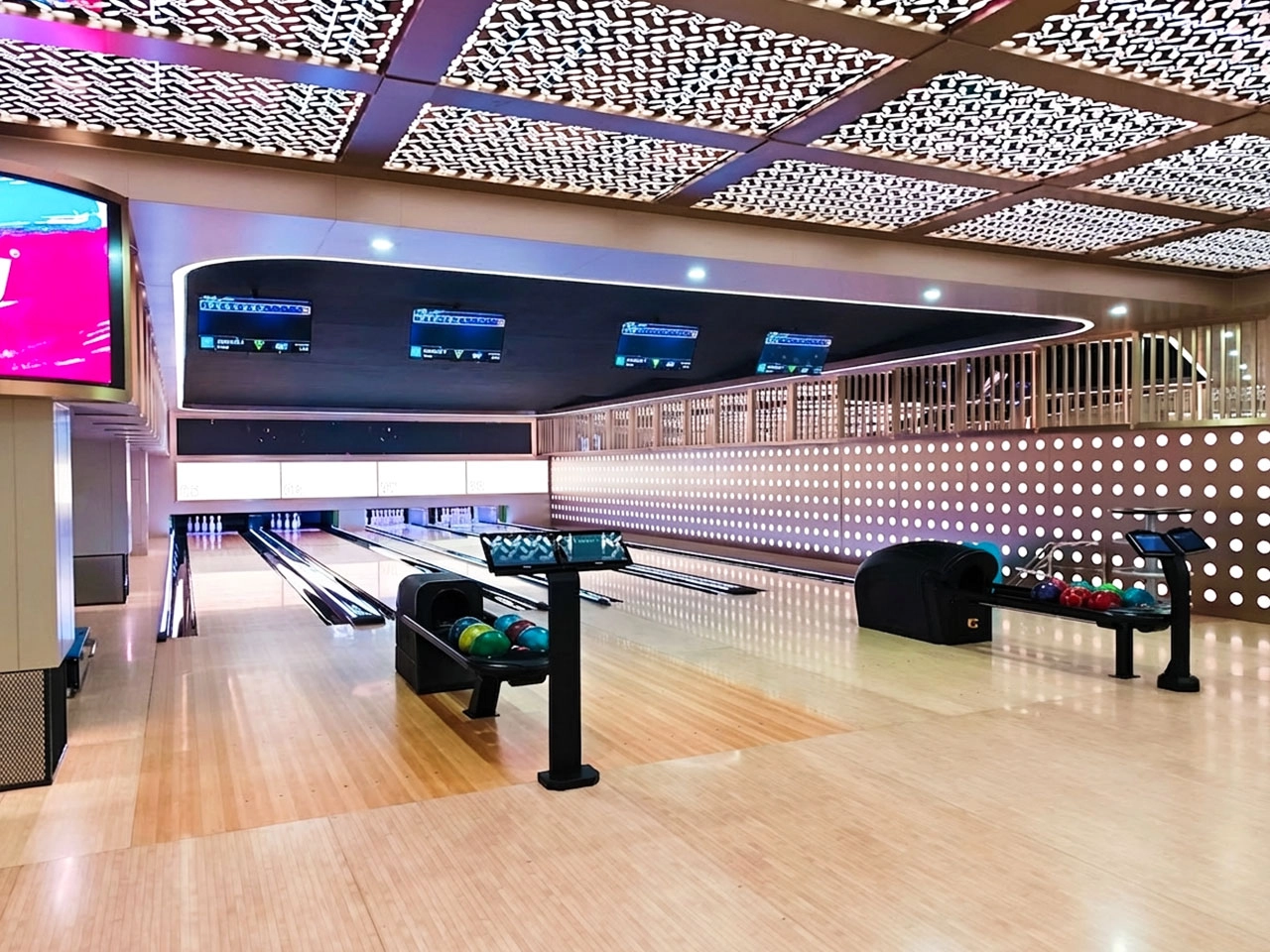
Build a commercial bowling venue with Flying’s complete string pinsetter bowling alley equipment package. The system includes the AEROPIN™ USBC-certified string pinsetter, customizable lanes, automatic scoring, ball return, lane lighting, pins, control hardware, and overseas installation support.
Designed for commercial bowling centers, family entertainment venues, hotels, resorts, bars, and premium private projects, this turnkey bowling system helps operators reduce sourcing complexity and prepare for reliable long-term operation.
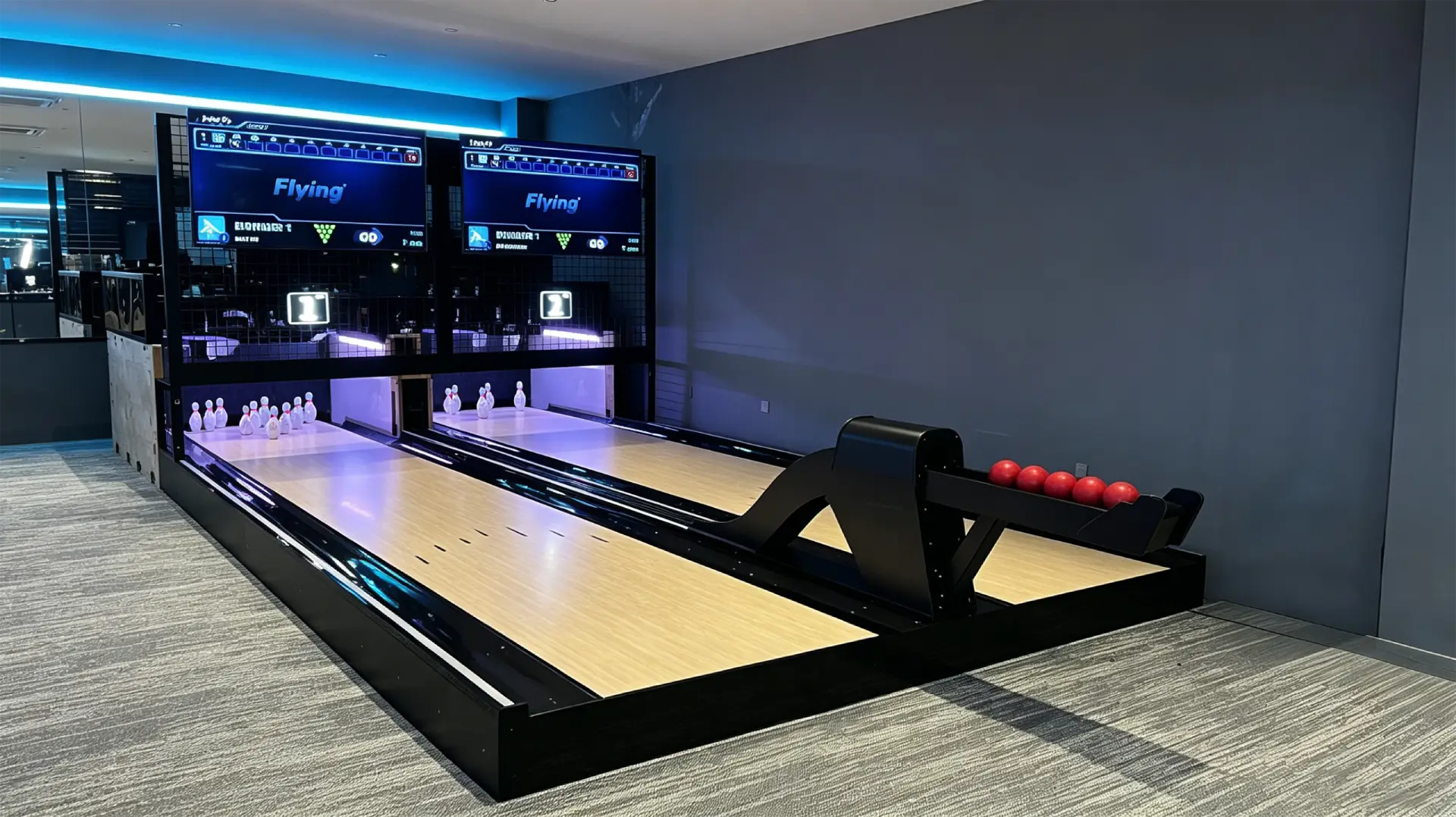
Flying Smart Duckpin Bowling is a compact duckpin bowling equipment system designed for bars, family entertainment centers, hotels, resorts, cinemas, boutique bowling alleys, and social entertainment venues. With a standard 9.13m duckpin bowling lane, 1.25kg lightweight balls, automatic scoring, ball return, LED lighting, and a smart string pinsetter, it creates a fast-paced and easy-to-play bowling experience in a smaller footprint than traditional bowling.
The system is available as a turnkey duckpin bowling package, including lane equipment, a string pinsetter system, scoring hardware, control software, global shipping, installation guidance, and technical support.
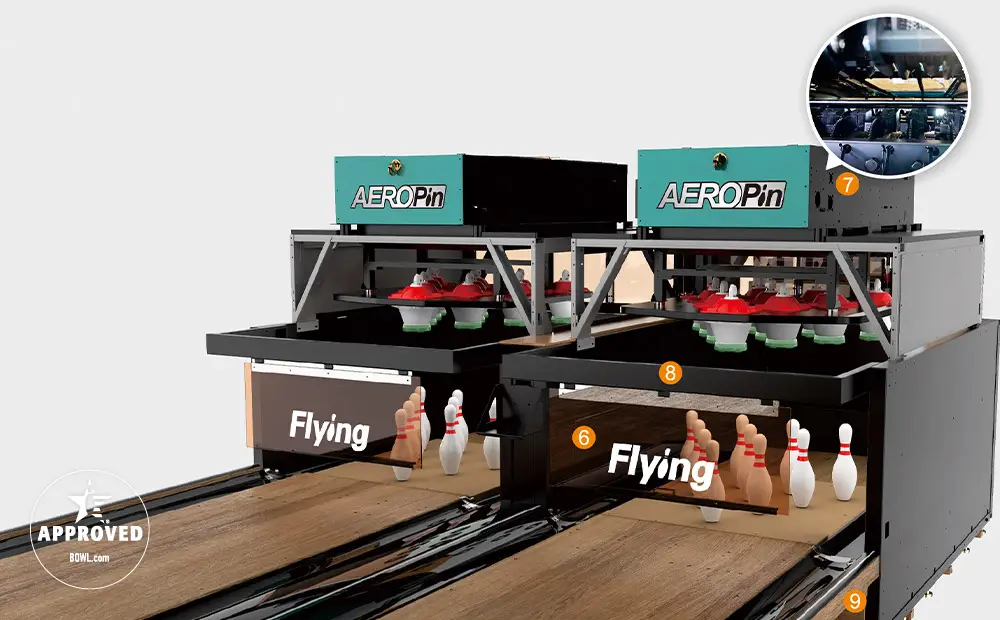
AEROPIN is Flying Bowling’s USBC-certified string pinsetter system for modern commercial bowling centers. Designed for fast pin setting, smooth ball return, low maintenance, and stable daily operation, it helps venue operators build league-ready and entertainment-focused bowling projects with confidence.
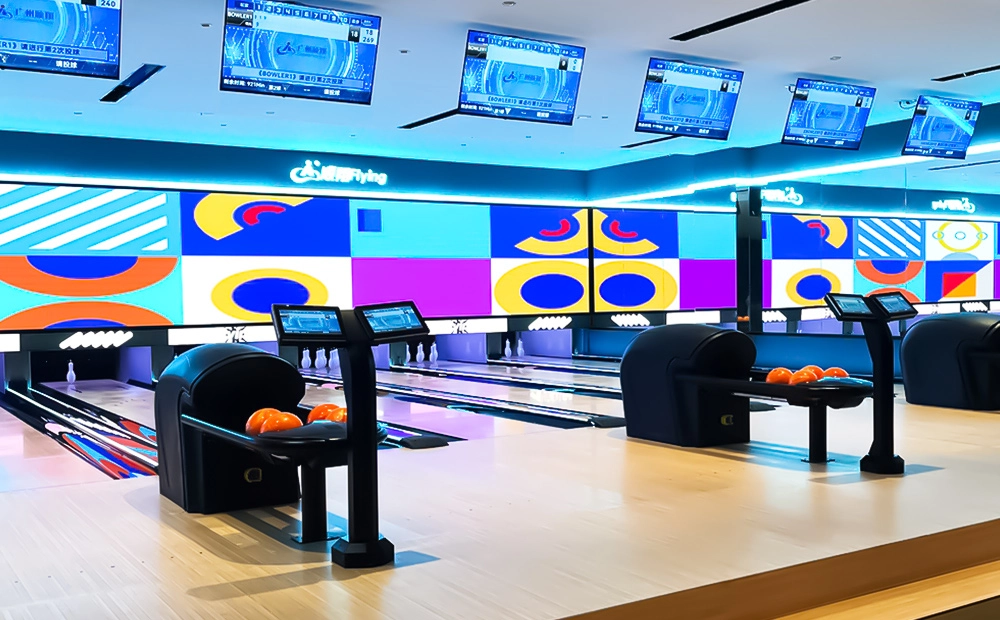
Flying Social Medium Bowling is a compact medium bowling equipment system designed for bars, cafes, family entertainment centers, community leisure venues, hotels, resorts, and small indoor entertainment spaces. With customizable lane lengths from 9.6m to 18m, small balls, lighter pins, string pinsetter technology, ball return, and automatic scoring, it creates an easy-to-play social bowling experience for players of different ages and skill levels.
Compared with full-size standard bowling, medium bowling requires less space and offers a more casual, interactive format. It is a practical choice for venues that want to add a bowling attraction without building a full commercial bowling alley.
Contact Flying
Start Your Custom Bowling Alley Project
If you contact us now for more details, we can provide you with a custom bowling alley service. Our service team will get back to you within 24 hours normally!
© 2026 Flying BOWLING. Designed by gooeyun.
FOLLOW US:

Flying Bowling
Flying Bowling
Flyingbowling
Flyingbowling