


There is no universal published price for a duckpin bowling string pinsetter. The useful buying question is the total project cost, not the equipment line alone. A comparable estimate normally separates equipment supply, engineering and site work, installation and commissioning, logistics and taxes, and maintenance and spare parts. Actual amounts depend on lane quantity, drawings, project location, site readiness, integration scope, and delivery responsibilities.
Quick Answer: What Affects Duckpin Bowling String Pinsetter Cost?
A practical cost model is:
| Cost layer | What it may include | What must be confirmed |
|---|---|---|
| Equipment supply | String pinsetter configuration, controls, lane interfaces, related equipment, tools, and optional spare parts | Complete bill of quantities, standard versus project-specific components, and customer-supplied items |
| Engineering and site work | Drawing review, layout coordination, electrical preparation, access planning, and retrofit adjustments | Latest drawings, site conditions, tolerances, clearances, and responsibility for preparation |
| Installation and commissioning | Installation labor, alignment, interface checks, testing, training, and handover | Included labor, travel, lifting, testing method, acceptance criteria, and corrective-work rules |
| Logistics and taxes | Packaging, freight, insurance, customs, taxes, unloading, storage, and inland delivery | Delivery point, commercial terms, import responsibility, and site unloading arrangements |
| Maintenance and spares | Inspection guidance, consumables, replacement parts, troubleshooting information, and technical support | Maintenance responsibilities, spare-parts list, documentation, warranty, and service escalation process |
For wider venue planning, a string pinsetter budget should be kept separate from construction, furniture, fit-out, technology, and opening expenses. Industry associations such as duckpin bowling alley cost resources, IAAPA research, and BPAA operator resources can help frame broader venue investment questions, but they do not establish a universal duckpin string pinsetter price.
What Is a Duckpin Bowling String Pinsetter?
A string pinsetter is lane-end equipment used to manage the pins after play and return them to the playing position. In a commercial duckpin installation, it is part of a wider system that may include the bowling lane, pin area, ball return, scoring system, operator controls, electrical connections, and service access.
The quotation scope therefore matters. One supplier may price the pinsetter as a standalone item, while another may include controls, related interfaces, installation, testing, documentation, or spare parts. These offers cannot be compared fairly until the buyer maps each item to the lane layout and identifies who is responsible for every interface.
For the relationship between equipment, construction, and opening expenses, buyers may also review this duckpin bowling alley cost breakdown. The present article focuses specifically on string pinsetter ownership and quotation scope.
What Determines the Cost of a Duckpin String Pinsetter?
Lane quantity and project scale
Lane count affects more than the number of pinsetters. It can change the quantity of controls, packaging units, installation activities, commissioning sequence, documentation, and recommended spare parts. A multi-lane project may also require repeatable interfaces and consistent alignment references across lanes.
The quotation should state whether it covers a complete lane quantity, a partial equipment package, or a repeat order based on an existing approved design. Unclear quantities can result in incorrect allowances or later commercial changes.
Configuration and integration scope
Cost may change when the project requires different control arrangements, lane interfaces, ball return equipment, scoring connections, operator controls, guarding, or venue-specific layouts. Buyers should request a clear distinction between standard equipment and project-specific requirements.
If the scoring system, ball return machine, or lane equipment is purchased separately, the RFQ should identify the interface owner. Confirm signal, power, mounting, cabling, and testing responsibilities with the relevant suppliers rather than assuming that adjacent equipment will integrate automatically.
New-build versus retrofit conditions
A new venue can plan lane positions, electrical routes, access openings, storage, and service clearances around the equipment. A retrofit may involve restricted doors, existing wiring, removal of old equipment, limited storage, uneven floors, or adaptation of existing structures.
Provide current information about floor conditions, ceiling clearance, access routes, unloading, working space, and electrical readiness. For a separate view of installation-related responsibilities, see the duckpin bowling equipment installation cost guide.
Location, delivery, and regional requirements
Project location affects freight routes, customs documentation, taxes, insurance, local labor, electrical requirements, and service coordination. Delivery to a port is not the same scope as delivery to a prepared venue with unloading and internal movement included.
State the delivery point and commercial terms in the RFQ. Also identify who handles customs clearance, port or terminal charges, inland transport, storage, unloading, and movement into the installation area.
Key Cost Factors to Review Before Comparing Quotes
Use one quotation template for every supplier. At minimum, separate the following:
- Equipment: pinsetter configuration, controls, electrical components, lane interfaces, tools, cables, and related bowling equipment.
- Engineering: drawing review, layout coordination, tolerances, alignment references, interface confirmation, and design revisions.
- Installation: supervision, labor, alignment, electrical connection, lifting, travel, accommodation, and return visits.
- Commissioning: functional testing, scoring and ball-return interface checks, operator instruction, acceptance records, and defect correction.
- Logistics: export packaging, freight, insurance, delivery point, customs, taxes, unloading, and storage.
- Lifecycle: inspection guidance, cleaning, consumables, spare parts, service access, troubleshooting documents, warranty, and support responsibilities.
Do not treat a general statement such as “standard installation” or “technical support included” as a complete scope. Ask for the evidence that defines what is included, excluded, and assigned to the buyer or local contractor.
Cost Impact Table: Which Factors Can Change the Budget?
The influence levels below are qualitative. They prioritize information that can materially change the quotation; they are not price percentages.
| Cost factor | Likely influence | Information required | Comparison field | Risk if omitted |
|---|---|---|---|---|
| Lane quantity and layout | Very high | Lane count, dimensions, spacing, equipment schedule | Included / excluded / buyer responsibility | Incorrect quantities or change orders |
| Site readiness | High | New-build or retrofit status, access, floor, storage, service space | Site work included? | Unplanned local work and installation delay |
| Electrical and control scope | High | Power information, control locations, wiring routes, scoring interfaces | Who supplies and connects each interface? | Compatibility problems and rework |
| Installation and commissioning | High | Labor model, access, testing, training, acceptance requirements | What evidence will be provided at handover? | Unbudgeted labor or incomplete acceptance |
| Freight, customs, and taxes | High | Country, delivery point, insurance, import responsibility | Delivered to where, under which terms? | Budget gaps at shipment or import |
| Packaging and storage | Medium | Transport route, handling method, storage conditions | What protection and packing list are included? | Damage, repacking, or storage charges |
| Spare parts and maintenance | Medium | Operating model, service access, parts policy, documentation | Which parts and instructions are supplied? | Longer troubleshooting or procurement cycles |
| Documentation and training | Medium | Audience, language, format, delivery timing | What documents and training are included? | Weak handover and operator uncertainty |
| Regional service arrangements | Medium | Local contacts, escalation route, contractor responsibilities | What support is contractual and what is optional? | Unclear fault response responsibilities |
Duckpin String Pinsetter Cost Breakdown by Component and Process
Equipment supply
The equipment line should identify the pinsetter configuration and every included control, lane-related component, ball return or scoring interface, tool, and initial spare part. The buyer should be able to reconcile the list with the lane layout and bill of quantities.
Engineering and design review
Engineering review is where incomplete drawings and unclear interfaces become visible. A drawing that omits service clearance, mounting references, tolerances, or electrical information may require assumptions or later revision. For project-specific components, a DFM review should consider manufacturability, assembly access, repeatability between lanes, material selection, surface finish, alignment, and inspection points.
Site preparation and installation
Separate equipment installation from work performed by the venue contractor. Site preparation may include access clearance, lane positioning, electrical readiness, structural coordination, storage, unloading, lifting, and removal of existing equipment. The quotation should identify the tools, labor, supervision, and site conditions assumed.
Testing, commissioning, and closeout
Define the operating sequence and acceptance evidence before purchase. The commissioning scope may need to address controls, lane interfaces, scoring communication, operator instruction, documentation, and unresolved defects. The buyer should know who witnesses testing, how defects are recorded, and whether corrective work is included.
How Maintenance and Lifecycle Factors Affect Ownership Cost
Lifecycle cost is not only the price of replacement parts. It also includes maintenance labor, service access, troubleshooting time, documentation quality, and the commercial effect of an unavailable lane.
- Identify routine inspection, cleaning, adjustment, and visual-check tasks.
- Confirm which tasks are assigned to venue staff, a local contractor, or the equipment supplier.
- Request parts identification, drawings, troubleshooting guidance, and recommended consumables.
- Check whether service access can be maintained without removing unrelated lane equipment.
- Define technical escalation contacts and the information required to investigate a fault.
- Compare warranty, support, and downtime assumptions only when the suppliers describe equivalent responsibilities.
Do not assume that a string pinsetter has lower maintenance cost, longer life, or faster payback without comparable evidence from the specific configuration and operating environment.
String Pinsetter Versus Traditional Pinsetter Systems: What Should Buyers Compare?
| Comparison area | Questions for both systems | Decision evidence |
|---|---|---|
| Initial scope | Do both quotes include equivalent equipment, controls, interfaces, installation, and testing? | Line-by-line scope and exclusions |
| Building requirements | Which system fits the available layout, access, electrical routes, and service clearances? | Approved drawings and site information |
| Maintenance | What inspection, cleaning, parts, and service access are required? | Maintenance documents and parts list |
| Operations | What training, operator workflow, scoring integration, and fault response are required? | Training and commissioning scope |
| Commercial risk | Which items are allowances, optional, excluded, or dependent on site conditions? | Assumptions and change-control terms |
The appropriate choice depends on the venue concept, building, customer experience objectives, local technical support, operator capability, and complete ownership scope—not on the headline equipment price alone.
How to Get an Accurate Duckpin Bowling String Pinsetter Quote
RFQ information checklist
- Project country, city, venue type, and intended opening scope
- Lane quantity, layout, dimensions, and available service space
- New-build or retrofit status
- 2D or 3D drawings, equipment schedule, and drawing revision
- Electrical information and control requirements
- Ball return, scoring, lane, and other equipment interfaces
- Access doors, unloading route, storage, lifting, and installation workspace
- Installation responsibility and local labor arrangements
- Delivery point, packaging, insurance, customs, taxes, and preferred terms
- Maintenance, spare-parts, training, warranty, and documentation requirements
Commercial fields to require in every quotation
Use the same fields for each supplier: included scope, excluded scope, buyer responsibility, assumptions, evidence required, validity period, payment terms, warranty scope, estimated delivery basis, testing and acceptance method, change-order rules, and treatment of optional items. Estimated delivery information should be confirmed by the supplier for the specific project; it should not be inferred from a general product description.
Common Quoting Mistakes and Their Consequences
- Comparing equipment-only and complete-project quotes. The apparent lower price may exclude engineering, installation, testing, or documentation. Normalize both offers before making a purchasing decision.
- Sending incomplete or outdated drawings. Missing dimensions, service clearance, interfaces, or tolerances force assumptions that can become allowances, revisions, or change orders.
- Leaving site access and unloading undefined. Restricted doors, storage limits, lifting needs, or incomplete building work can create local costs that were not included in the equipment quote.
- Omitting freight, customs, taxes, and delivery responsibility. A port-based price cannot be treated as a delivered venue price without confirming the logistics chain.
- Failing to define testing and acceptance. Different expectations about scoring interfaces, documentation, training, defects, and handover can delay project closeout and create disputes.
Cost Reduction Strategies Without Increasing Project Risk
- Review drawings early. Use DFM-style review to identify unnecessary complexity, inaccessible service points, inconsistent interfaces, or incomplete requirements before production.
- Standardize repeatable requirements. Consistent lane layouts, interface definitions, documents, and spare-parts identification can reduce clarification and installation effort.
- Match materials and finishes to the application. Select them according to exposure, cleaning, appearance, wear, and service conditions rather than adding or removing treatments without technical review.
- Plan packaging with the route. Coordinate the packing list, handling method, storage conditions, and delivery point so that protection is adequate without avoidable repacking or storage work.
- Define spares before opening. Use supplier documentation and the operating model to determine the initial spare-parts requirement; do not rely on unsupported consumption assumptions.
Cost optimization should remove ambiguity and unnecessary complexity, not necessary safety provisions, testing, quality evidence, documentation, or maintainability.
How to Choose the Right Supplier for Cost Optimization
Evaluate the supplier’s ability to document the complete equipment scope rather than relying on a headline price. Relevant evidence may include configuration drawings, interface schedules, installation boundaries, inspection or testing records, packaging details, spare-parts information, warranty terms, and escalation contacts.
Ask whether the supplier can review the lane layout, tolerances, alignment references, materials, surface finish, service access, and maintainability before the quotation is finalized. Also verify whether related bowling equipment—such as ball return machines, scoring systems, or lanes—has a defined interface responsibility.
Flying Bowling Co., Ltd. states that its product scope includes string pinsetters, ball return machines, broader bowling equipment, and design and construction services. Buyers should evaluate the exact configuration, delivery boundary, installation scope, documentation, and regional responsibilities in writing for their own project.
Conclusion and Next Steps: Build a Comparable Cost Review
To evaluate duckpin bowling string pinsetter cost accurately, compare equivalent scopes across five layers: equipment supply, engineering and site work, installation and commissioning, logistics and taxes, and maintenance and spares. A useful quotation is based on current drawings, confirmed lane quantity, project location, site conditions, integration requirements, and clearly assigned responsibilities.
Before requesting final pricing, assemble the RFQ checklist and require each supplier to mark every line as included, excluded, optional, buyer responsibility, or subject to confirmation. This gives procurement, engineering, and venue stakeholders a shared basis for reviewing total ownership cost.
Send Your Drawings for a Cost Review
Provide the available 2D or 3D drawings, lane quantity, project location, material and surface-finish requirements, application details, integration needs, and packaging expectations. The review should identify unresolved assumptions before the quotation is approved.
Frequently Asked Questions About Duckpin Bowling String Pinsetter Cost
More Articles

Let’s Build a center Together
Partner With a Trusted Bowling Alley Design, One-Stop Solution Manufacturer.
Flying has successfully built ideal bowling alleys for more than 3,000 customers.

Technical Expert
You may also like our products
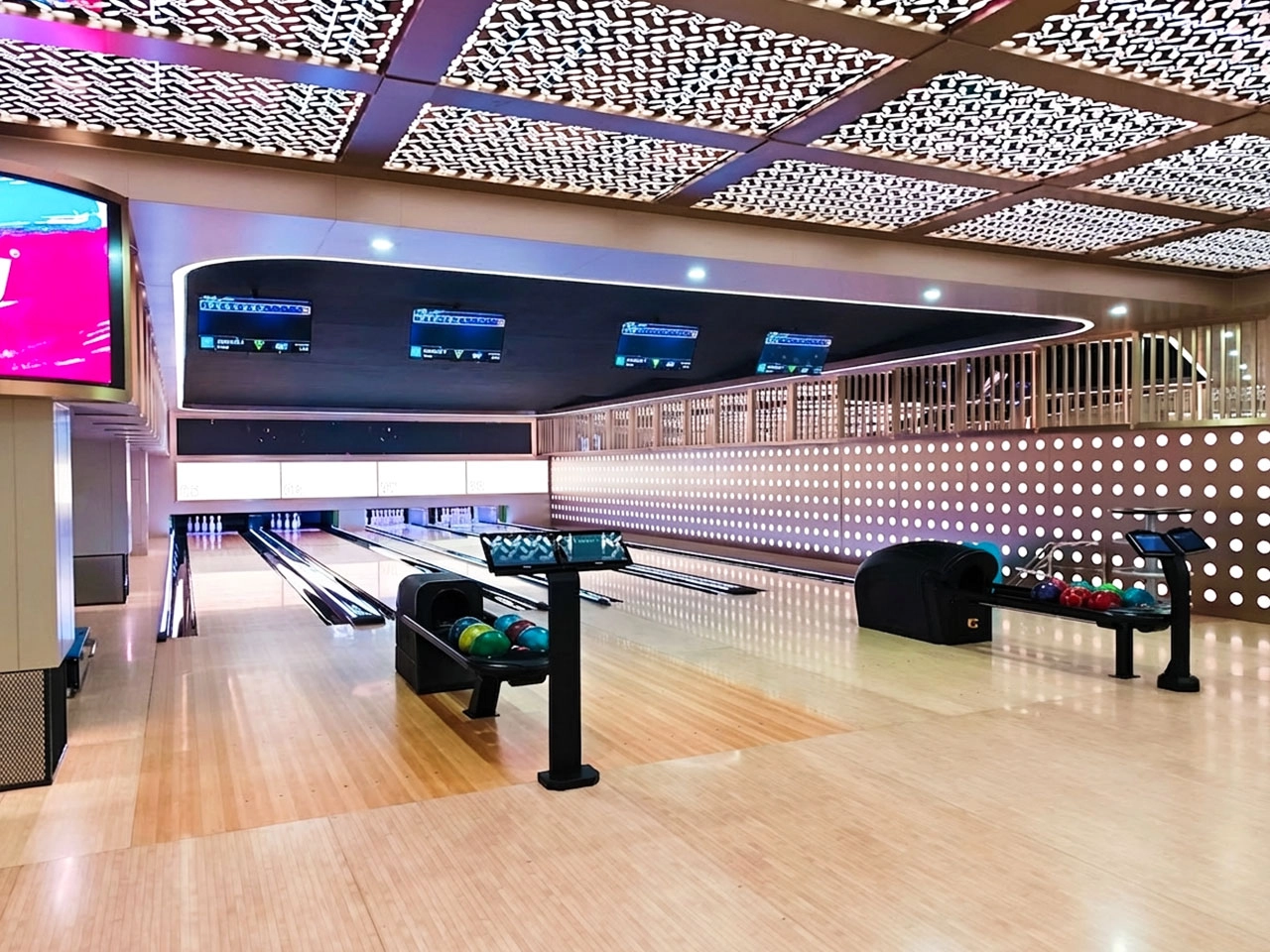
Build a commercial bowling venue with Flying’s complete string pinsetter bowling alley equipment package. The system includes the AEROPIN™ USBC-certified string pinsetter, customizable lanes, automatic scoring, ball return, lane lighting, pins, control hardware, and overseas installation support.
Designed for commercial bowling centers, family entertainment venues, hotels, resorts, bars, and premium private projects, this turnkey bowling system helps operators reduce sourcing complexity and prepare for reliable long-term operation.
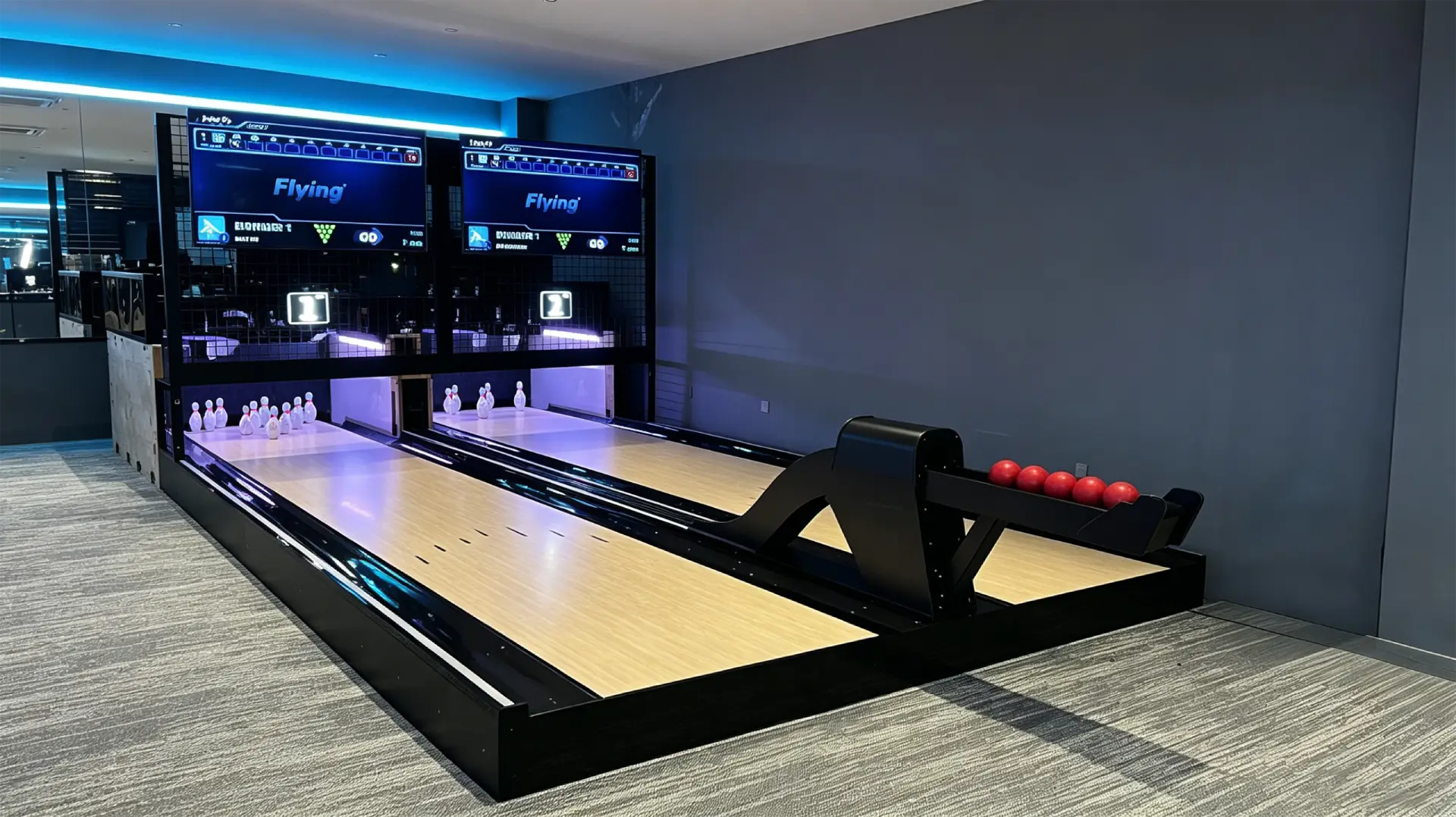
Flying Smart Duckpin Bowling is a compact duckpin bowling equipment system designed for bars, family entertainment centers, hotels, resorts, cinemas, boutique bowling alleys, and social entertainment venues. With a standard 9.13m duckpin bowling lane, 1.25kg lightweight balls, automatic scoring, ball return, LED lighting, and a smart string pinsetter, it creates a fast-paced and easy-to-play bowling experience in a smaller footprint than traditional bowling.
The system is available as a turnkey duckpin bowling package, including lane equipment, a string pinsetter system, scoring hardware, control software, global shipping, installation guidance, and technical support.
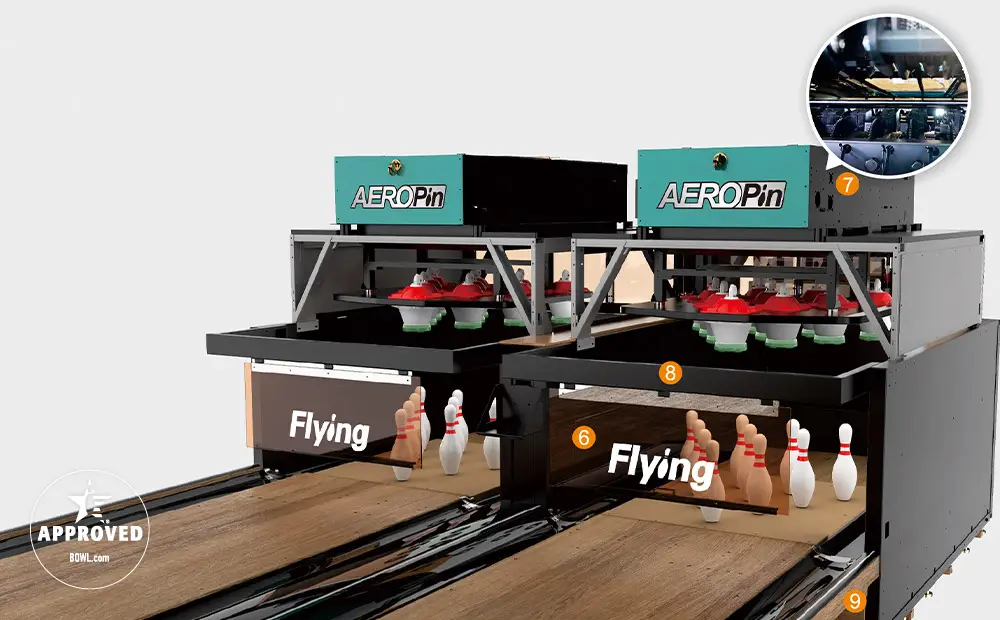
AEROPIN is Flying Bowling’s USBC-certified string pinsetter system for modern commercial bowling centers. Designed for fast pin setting, smooth ball return, low maintenance, and stable daily operation, it helps venue operators build league-ready and entertainment-focused bowling projects with confidence.
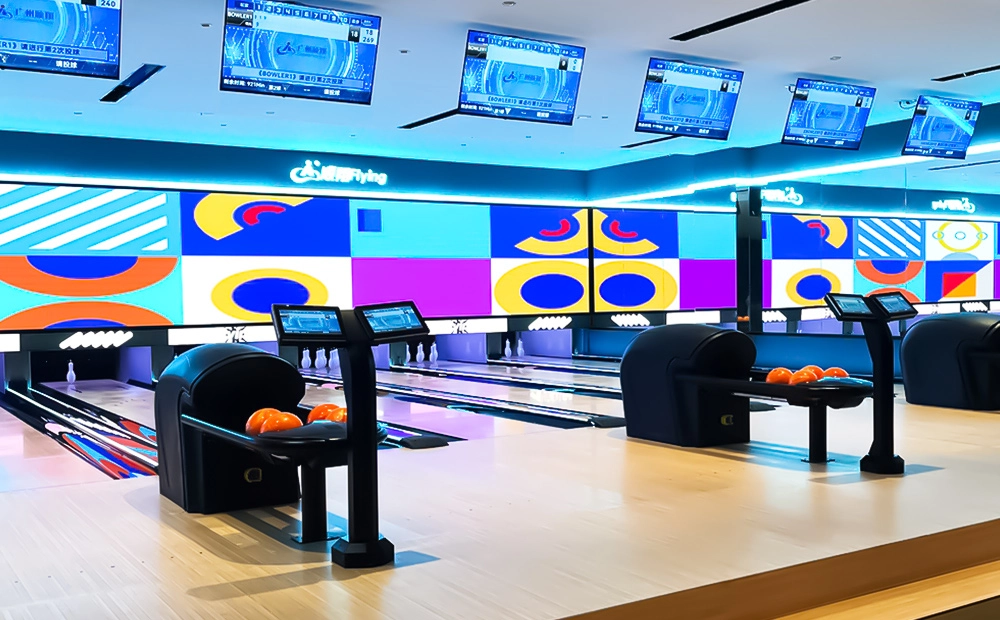
Flying Social Medium Bowling is a compact medium bowling equipment system designed for bars, cafes, family entertainment centers, community leisure venues, hotels, resorts, and small indoor entertainment spaces. With customizable lane lengths from 9.6m to 18m, small balls, lighter pins, string pinsetter technology, ball return, and automatic scoring, it creates an easy-to-play social bowling experience for players of different ages and skill levels.
Compared with full-size standard bowling, medium bowling requires less space and offers a more casual, interactive format. It is a practical choice for venues that want to add a bowling attraction without building a full commercial bowling alley.
Contact Flying
Start Your Custom Bowling Alley Project
If you contact us now for more details, we can provide you with a custom bowling alley service. Our service team will get back to you within 24 hours normally!
© 2026 Flying BOWLING. Designed by gooeyun.
FOLLOW US:
Flying Bowling
Flying Bowling
Flyingbowling
Flyingbowling