Bowling Alley Maintenance Guide: Preventive Maintenance for Equipment & Lanes
Quick Answer
Effective bowling alley maintenance is based on preventive care rather than waiting for equipment to fail. Operators should routinely clean and inspect lanes, pinsetters, ball return systems, scoring equipment, and player-area components while recording recurring faults and replacing worn parts before they cause downtime.
A practical program combines daily inspections, weekly checks, monthly mechanical maintenance, and periodic professional servicing. The exact frequency should be adjusted according to equipment requirements, operating hours, and lane traffic.
Why Preventive Bowling Alley Maintenance Matters
A bowling center combines mechanical equipment, lane surfaces, sensors, electronics, scoring systems, and customer-facing components that must work together throughout the day. A problem in one system can interrupt an entire lane and affect the customer experience.
Preventive maintenance helps identify wear, contamination, loose components, alignment problems, and abnormal equipment behavior before they develop into larger failures. This is particularly important in high-traffic centers, where recurring downtime can quickly increase repair costs and disrupt operations.
Good maintenance also makes equipment management more predictable. When service records show how components wear and fail over time, operators can plan spare parts, technician visits, and equipment budgets instead of reacting to unexpected breakdowns.
Bowling Alley Maintenance Schedule at a Glance
There is no single maintenance interval suitable for every bowling center. Equipment design, operating hours, traffic, environmental conditions, and manufacturer requirements all affect the appropriate schedule.
| Frequency |
Typical Maintenance Focus |
| Daily |
Clean lane surfaces, observe pinsetter operation, check ball returns and scoring, remove visible debris. |
| Weekly |
Inspect return tracks, rollers and sensors, clean equipment areas, investigate abnormal noise or movement. |
| Monthly |
Inspect belts, chains, fasteners and alignment; lubricate approved points where required; perform deeper mechanical and electrical checks. |
| Periodic / Annual |
Conduct comprehensive mechanical inspection, calibration, wear assessment and preventive replacement according to equipment requirements. |
The schedule should not be treated as a fixed calendar. Maintenance frequency should increase when usage, operating conditions, or inspection results indicate faster wear.
Pinsetter Maintenance
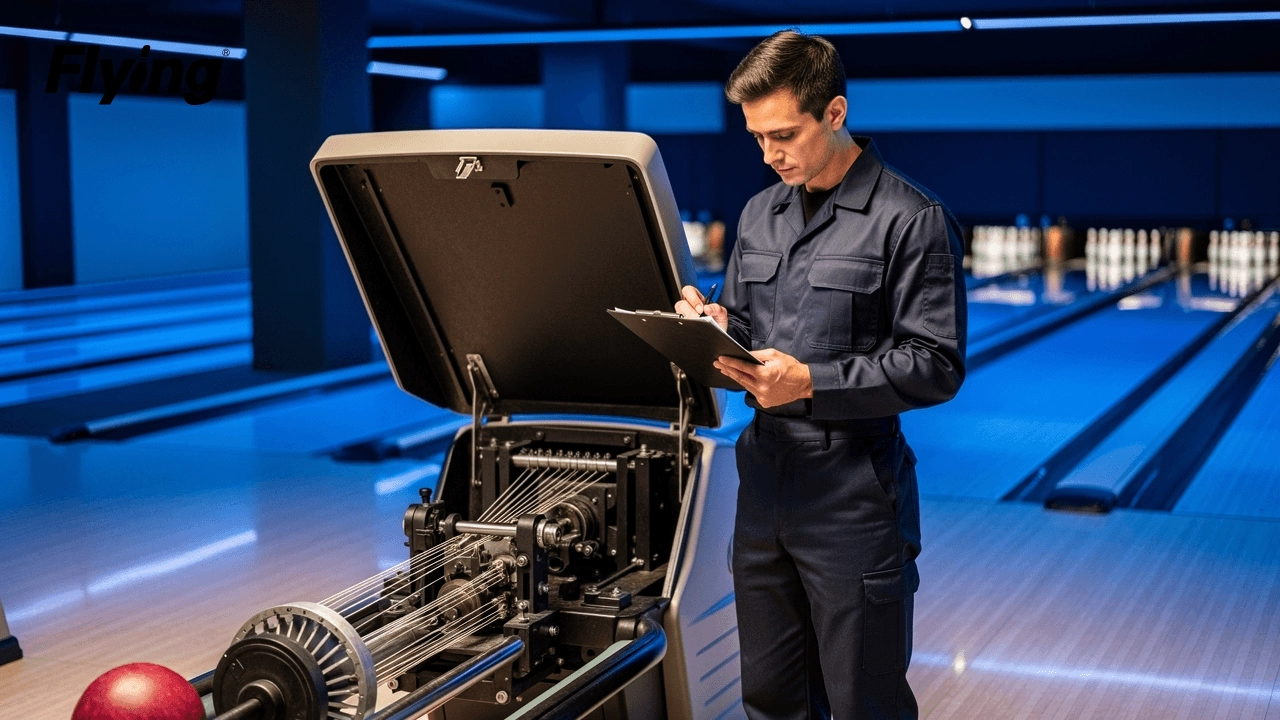
The pinsetter is one of the most important systems in a bowling center. Even minor mechanical or sensor problems can interrupt gameplay, so routine inspection should focus on detecting changes before they become repeated faults.
Daily checks should confirm that the pinsetter cycles smoothly without unusual noises, loose components, visible obstructions, or damaged strings where applicable. Weekly and monthly maintenance can include deeper inspection of belts, chains, fasteners, sensors, moving assemblies, alignment, and specified lubrication points.
Lubrication requires particular care. Too little can accelerate wear, while excessive or incorrectly applied lubricant may attract contamination or interfere with nearby components. Operators should use the specified lubricant and follow the equipment manufacturer's recommended intervals and application points.
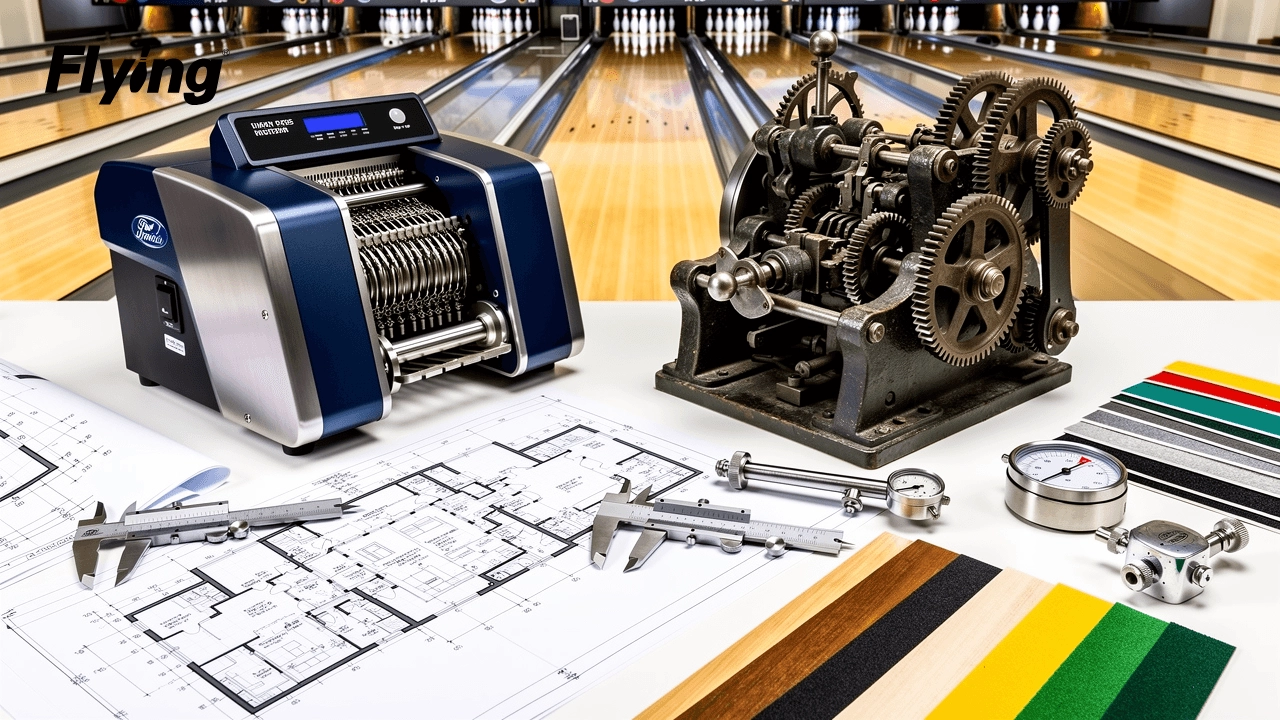
For centers using string pinsetters, maintenance procedures should follow the specific mechanical structure and adjustment requirements of that equipment rather than practices intended for traditional free-fall machines.
Ball Return System Maintenance
A slow, noisy, or unreliable ball return quickly affects the player experience and may indicate developing mechanical wear. Routine maintenance should therefore cover the complete return path rather than simply clearing visible jams.
Operators should inspect accessible tracks or conveyors, rollers, belts, sensors, motor and drive components, and the ball cradle or lift mechanism where applicable. Debris should be removed regularly, while worn, loose, or misaligned components should be addressed before they cause repeated interruptions.
Changes in return speed are useful warning signs. If balls begin returning more slowly, intermittently, or with unusual noise, the cause should be investigated before the system stops completely.
Bowling balls used by the center should also be inspected for cracks, chips, or significant surface damage. Repeated ball return jams should be recorded by lane and location so operators can determine whether the underlying cause is contamination, alignment, component wear, sensing, or another recurring condition.
Bowling Lane Surface Maintenance
Lane condition affects both equipment presentation and consistency of play. Daily maintenance generally includes removing dust, dirt, and accumulated contaminants using products and procedures suitable for the installed lane surface.
Lane oil also requires consistent management. The appropriate cleaning and conditioning program depends on lane construction, traffic volume, desired playing conditions, and the oiling system in use.
Operators should watch for visible wear, grooves, surface damage, inconsistent ball reaction, or areas where normal cleaning no longer restores the expected condition. When routine maintenance is no longer sufficient, professional inspection may be required to determine whether deeper service, repair, or resurfacing is appropriate.
Pin Deck, Gutters and Ball Rack Maintenance
Some bowling alley components receive less attention than pinsetters or lanes but still affect safety, appearance, and daily operation.
The pin deck should be kept clean and inspected for wear, chips, cracks, or other surface damage. Gutters should also be cleaned regularly and checked for visible damage or obstruction so dirt and foreign objects do not accumulate along the ball path.
Ball racks and other player-facing components should be inspected for loose hardware, structural damage, sharp edges, or unstable parts. These are relatively simple checks, but they belong in a complete bowling alley maintenance program.
Scoring Systems, Displays and Electronics Maintenance
Modern bowling centers depend on electronic scoring, lane displays, sensors, control systems, network connections, and communication hardware. A scoring problem may not stop the mechanical equipment, but repeated errors can quickly reduce the quality of the customer experience.
Routine checks should confirm scoring accuracy, stable equipment connections, correct sensor operation, and reliable communication between related systems. Where scoring is integrated with POS or other center-management systems, recurring connectivity problems should also be investigated rather than treated as isolated display faults.
Screens, player terminals, and displays should be cleaned with suitable materials that do not scratch surfaces or introduce excessive moisture around electronic components.
Software and control systems should be maintained according to supplier requirements. Repeated scoring discrepancies, connection failures, or display problems should be diagnosed rather than managed indefinitely through resets.
Warning Signs Your Bowling Equipment Needs Maintenance
Scheduled servicing is important, but equipment behavior often provides the earliest indication of a developing problem.
Increasing pinsetter cycle time, slower or inconsistent ball return speed, repeated scoring discrepancies, unusual mechanical noise, vibration, frequent jams, or increasing manual intervention should all be investigated.
The key is to understand what normal operation looks and sounds like for each system. Once cycle time, sound, movement, or fault frequency begins to change, the equipment should be inspected before the issue develops into an unplanned lane shutdown.
Common Bowling Equipment Maintenance Mistakes
One common mistake is treating maintenance as a response to failure rather than a preventive process. Equipment that appears to operate normally can still have developing wear, contamination, or alignment problems.
Using unsuitable cleaning products, lubricants, or replacement components can create additional problems. Over-lubrication is another risk: more lubricant does not automatically provide better protection and may attract dust or affect nearby components.
Operators should also avoid ignoring unusual sounds simply because the machine continues to run. Changes in noise, vibration, cycle time, or movement often provide early evidence of mechanical changes.
Finally, maintenance without records makes recurring problems much harder to identify.
How to Build a Preventive Bowling Maintenance Program
An effective program begins with clear responsibility. Staff should know which inspections they are expected to perform, when they should perform them, and when a problem needs to be escalated to a technician.
Maintenance records should document the date, lane or equipment involved, observed condition, work performed, replaced components, and unresolved issues. Over time, these records can reveal recurring faults, high-maintenance lanes, and components approaching predictable replacement intervals.
Bowling centers should also maintain an appropriate stock of critical spare parts and consumables. The objective is not to store every possible component, but to prevent unnecessary downtime when common wear items require replacement.
Staff training is equally important. Employees responsible for routine checks should understand what normal equipment operation looks and sounds like so that changes in cycle time, noise, vibration, scoring behavior, or ball return performance are reported early.
How do you know whether the program is working? Track lane closures, repeat faults by lane, and emergency parts orders over time. A decline in these events is a practical indication that preventive maintenance is reducing reactive service demand.
How Maintenance Extends Bowling Equipment Service Life
Equipment lifespan is influenced by operating intensity, equipment design, environment, maintenance quality, and how quickly developing problems are corrected.
Regular cleaning reduces contamination. Correct lubrication reduces unnecessary friction. Timely replacement of worn components can prevent secondary damage, while proper alignment and calibration help equipment continue operating within its intended conditions.
This is why bowling equipment maintenance should be considered part of the complete equipment lifecycle rather than an isolated repair expense. The objective is not simply to keep a machine running as long as possible, but to maintain reliable performance while controlling downtime, repair frequency, and total operating cost.
For bowling center owners, lifecycle planning also makes it easier to distinguish between equipment that should continue to be repaired and equipment that may eventually be more economical to upgrade or replace.
When Should Bowling Equipment Be Repaired, Replaced or Upgraded?
Not every equipment problem requires replacement. If a fault is limited to a worn component and the equipment remains technically suitable for continued operation, repair or preventive part replacement may be the most practical option.
The decision becomes more complicated when failures become frequent, replacement parts are increasingly difficult to obtain, maintenance costs continue to rise, or older equipment creates recurring downtime.
Operators should therefore consider the total operating impact rather than only the immediate repair cost. An upgrade may make sense when newer equipment can reduce maintenance requirements, improve reliability, simplify parts support, or provide operational features the existing system cannot reasonably deliver.
The decision should be based on equipment condition, service history, parts availability, operating requirements, and long-term cost.
When to Call a Professional Bowling Equipment Technician
Routine cleaning and basic visual inspections can often be incorporated into daily staff procedures. More complex mechanical, electrical, calibration, or safety-related work should be handled by personnel with appropriate technical knowledge.
Professional assistance becomes particularly important when a problem repeatedly returns after routine maintenance, equipment requires major adjustment, electrical faults are suspected, or the cause of abnormal operation cannot be identified safely.
Operators should also follow the equipment manufacturer's service recommendations rather than attempting adjustments that may create additional faults.
Bowling Equipment Maintenance, Spare Parts and Lifecycle Support from Flying Bowling
Preventive maintenance becomes easier when operators have access to equipment-specific technical information, compatible replacement parts, and reliable technical support.
Flying Bowling supports bowling center projects beyond initial equipment supply and installation. For centers operating Flying Bowling systems, technical support can assist with equipment-specific maintenance questions, troubleshooting, replacement parts, and ongoing service requirements.
This lifecycle approach is especially important when a bowling center needs to reduce avoidable downtime and maintain consistent equipment performance over years of operation. Rather than waiting for a major failure, operators can combine routine in-house inspection with manufacturer-supported maintenance and timely parts replacement.
Conclusion
Effective bowling alley maintenance is a continuous process built around inspection, cleaning, preventive servicing, accurate records, and timely intervention.
Pinsetters, ball returns, lane surfaces, pin decks, scoring systems, displays, and other components all require attention, but the strongest maintenance programs connect these individual tasks into one planned operating system.
Start with a practical daily, weekly, and monthly schedule, monitor changes in equipment behavior, record recurring faults, follow manufacturer requirements, and involve qualified technicians when problems move beyond routine maintenance.
With consistent preventive care, appropriate spare parts, and reliable technical support, bowling centers can reduce unexpected downtime, improve operational consistency, and manage their equipment more effectively throughout its service life.
Need Bowling Equipment Maintenance or Technical Support?
Flying Bowling provides bowling equipment, compatible spare parts, technical support, and project services for bowling centers. Contact our team if you need support for an existing system or are planning a new bowling center project.
Contact Flying Bowling →





Flying Bowling
Flying Bowling
Flyingbowling
Flyingbowling
Flyingbowling