

Quick Overview
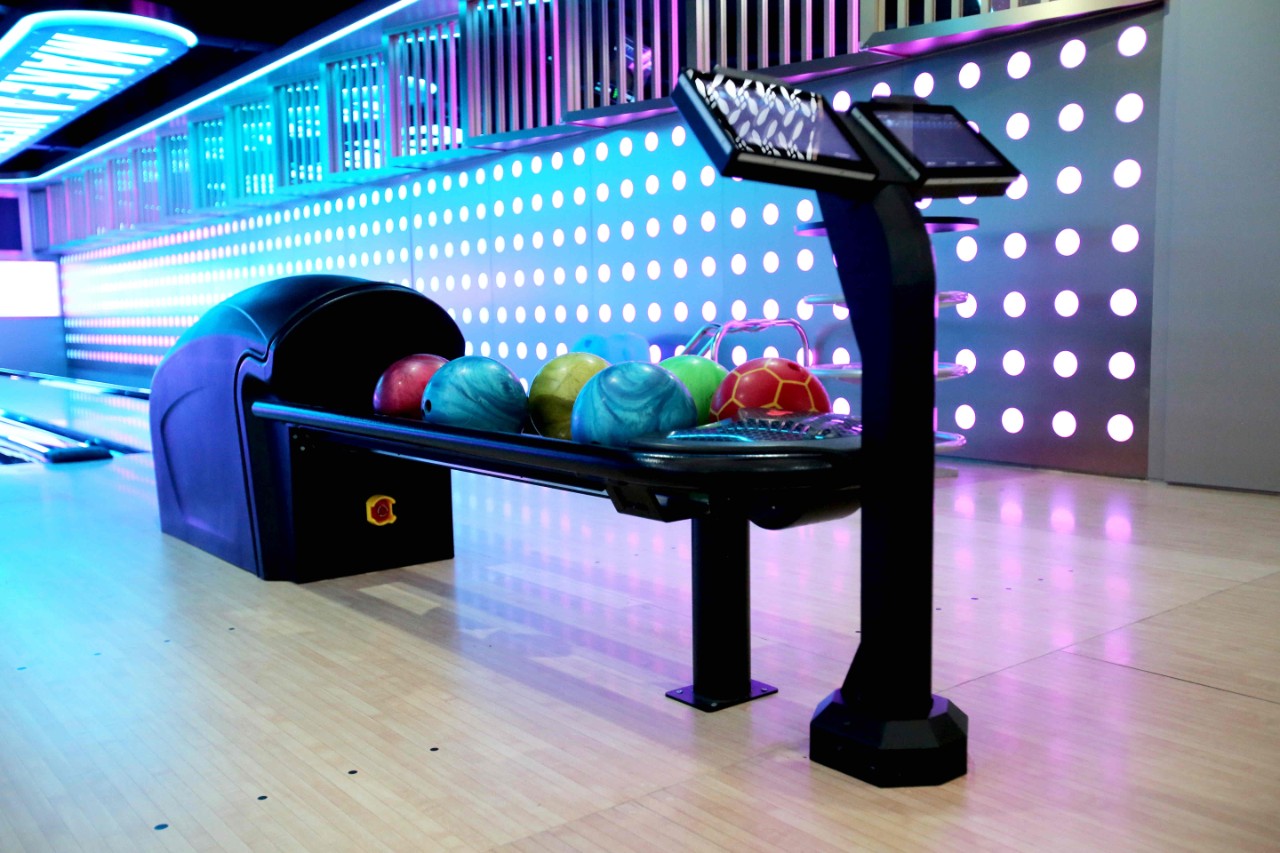
A bowling ball return machine moves the ball from the lane-end pit area back to the bowler through a connected mechanical path that may include a receiving section, ball elevator or lift, rollers or drive components, return track, routing components, and a player-side rack.
Reliable operation depends on the condition of the entire return path—not just the motor. Alignment, track cleanliness, roller or belt condition, lift performance, ball condition, and mechanical wear can all affect return speed, noise, and reliability.
For operators, the most effective maintenance approach is to inspect the return path regularly, keep contact surfaces clean, watch for changes in speed or sound, test the machine after service, record recurring faults, and follow the service manual for the exact equipment installed.
How Does a Bowling Ball Return Machine Work?
The exact mechanism varies by equipment design, but the basic sequence is similar.
After the ball reaches the lane-end area, it enters a receiving or pit section and is separated from the pin-handling process.
A lift, elevator, powered roller, conveyor, or similar transfer mechanism then moves the ball into the return path.
QubicaAMF equipment documentation, for example, describes a ball elevator that returns the ball to the bowler.
The ball then travels along a guided track or channel toward the approach, where it arrives at the player-side rack.
receiving → lift or transfer → drive → return track → routing → ball rack
Brunswick’s own parts structure separates assemblies such as Ball Return, Ball Lift, Power Lift & Ball Rack, and electrical components, reinforcing that the return system is a combination of serviceable subsystems rather than one single mechanism.
Main Mechanical Components
| Component | Main Function |
|---|---|
| Receiving or pit area | Accepts the ball after the shot |
| Ball elevator or lift | Raises or transfers the ball into the return path |
| Rollers, belts, or drive surfaces | Move the ball mechanically |
| Motor and drivetrain | Power applicable moving sections |
| Return track or channel | Guides the ball toward the approach |
| Diverter or routing mechanism | Directs the ball where required |
| Player-side rack | Receives the returning ball |
| Sensors or controls, where fitted | Monitor or coordinate operation |
The exact layout depends on the specific model, so maintenance decisions should be based on the manufacturer’s documentation for that machine.
What Affects Ball Return Speed?
Return speed is not determined by motor power alone.
Track Condition
Debris, contamination, damaged surfaces, or poor alignment can increase resistance and slow the ball.
If a machine gradually becomes slower, the return path should be inspected before assuming the motor is the cause.
Roller, Belt, and Drive Condition
Worn or contaminated drive surfaces can reduce effective contact with the ball.
A motor may still run normally while the ball moves inconsistently because the mechanical contact surfaces are slipping.
Lift or Elevator Performance
The lift is a critical transfer point.
If the ball hesitates or stalls before entering the main return path, the elevator or transfer mechanism should be inspected.
Ball and Lane Condition
The condition of the ball and lane can also affect return performance.
QubicaAMF’s Highway 66 manual states that excessive lane conditioner can make balls slippery and impede their return.
That is an important diagnostic point: not every slow return is caused by the return machine itself.
What Makes a Ball Return Machine Noisy?
A bowling ball return will naturally make mechanical noise, but a noticeable change in sound is often more useful than the absolute noise level.
Possible causes of abnormal sound include loose mounting points, worn rollers, misalignment, worn bearings or drive components, vibration, rough track transitions, or repeated impact at a routing point.
The better maintenance question is not “Is this machine silent?” but “Does it sound different from normal operation?”
A new scraping, knocking, grinding, or repeated impact sound should be investigated according to the service procedure for that machine.
Why Serviceability Matters
A mechanically simple layout can be easier to inspect, but fewer parts do not automatically guarantee reliability.
What matters is whether critical service points can be reached and understood.
A maintainable design should allow operators or technicians to:
Inspect the return path.
Reach common wear components.
Clean rollers or drive surfaces.
Check alignment.
Identify fault locations.
Access service documentation.
The goal is not the fewest components. It is clear access to the components most likely to need inspection or replacement.
Routine Bowling Ball Return Maintenance
Maintenance intervals should follow the service manual for the actual equipment.
Brunswick’s bowling-center procedures explicitly direct operators to the relevant service manual for correct lubrication and maintenance schedules rather than applying one universal schedule.
A practical maintenance routine should include four main areas.
Visual Inspection
Check accessible sections for debris, loose hardware, damaged surfaces, abnormal wear, misalignment, and repeated ball marks.
The objective is to find changes before they become recurring jams or equipment damage.
Cleaning
Keep accessible tracks, rollers, drive surfaces, and transfer areas free from contamination according to the manufacturer’s instructions.
Cleaning is particularly important where lane oil, dust, or debris can affect mechanical contact.
Functional Test
After inspection or maintenance, run the machine through a normal return cycle.
Observe whether the ball enters correctly, moves continuously, stalls, produces unusual noise, follows the correct route, and arrives properly at the rack.
A functional test can reveal problems that are not visible when the machine is stationary.
Mechanical and Electrical Check
Where applicable, inspect belts, rollers, drive surfaces, sensors, wiring, connectors, and controls according to the manufacturer’s procedures.
Electrical or guarded mechanical work should be handled by appropriately qualified personnel.
Common Ball Return Problems
| Symptom | First Areas to Inspect |
|---|---|
| Ball does not return | Obstruction, receiving area, lift, drive, track |
| Ball returns slowly | Track condition, rollers, drive surfaces, contamination |
| Return becomes noisy | Alignment, loose parts, wear, bearings, impact points |
| Ball repeatedly stalls | Transfer point, lift, track, routing mechanism |
| Ball reaches wrong return path | Diverter or routing mechanism |
| Ball develops repeated marks | Protrusions, rough surfaces, slipping or contaminated contact points |
| Operation becomes intermittent | Mechanical obstruction first, then sensors or controls where fitted |
These are starting points, not universal repair instructions.
Repeated faults should be diagnosed rather than repeatedly reset.
How to Reduce Bowling Ball Damage
Repeated scratches, scuffs, or impact marks are useful warning signs.
Inspect the return path for protruding hardware, rough track surfaces, misaligned transitions, debris, worn contact surfaces, or slipping drive components.
The ball itself should also be inspected.
QubicaAMF specifically advises checking balls for cracks because a cracked ball can damage the ball return or lane over time.
That means ball condition and return-machine condition should be checked together rather than treated as separate issues.
Maintenance Safety
Ball return machines contain moving mechanical parts and may include electrical components.
Power isolation and service procedures should follow the manufacturer’s instructions and applicable workplace safety requirements.
Brunswick service documentation explicitly instructs technicians to turn equipment off and lock out power before servicing certain bowling machinery.
Do not reach into or adjust moving machinery while it is energized unless the manufacturer’s approved procedure specifically requires and controls that condition.
Keep a Maintenance Record
A simple maintenance record helps distinguish one-time faults from recurring mechanical problems.
Useful records include inspection date, lane or machine identification, observed symptom, problem location, work performed, parts replaced, and whether the fault returned.
Professional bowling-equipment maintenance is commonly structured around formal inspection rather than purely reactive repair.
Brunswick’s certified service program, for example, uses a 51-point inspection for pinsetter diagnostics and preventive service. That figure applies to its pinsetter program, not directly to ball returns, but it illustrates the value of systematic equipment inspection.
Spare Parts and Preventive Planning
Operators should know which parts are service items for the installed return machine and how those parts are identified.
Brunswick maintains dedicated parts categories for Ball Return, Ball Lift, Power Lift & Ball Rack, among other bowling equipment assemblies.
Before ordering a replacement part, confirm model compatibility, correct part identification, replacement procedure, required tools, and whether adjustment or testing is required afterward.
Do not assume visually similar components are interchangeable.
When Should a Technician Be Called?
Technical inspection is appropriate when the machine shows recurring jams, new or abnormal mechanical noise, repeated ball damage, damaged wiring, failed sensors or controls, abnormal motor or drive behavior, persistent misalignment, or repeated component failure.
If a problem keeps returning after cleaning and basic inspection, the next step should be diagnosis—not repeated resetting.
How Should Ball Return Performance Be Evaluated?
A good ball return should not be judged only by speed.
Reliability: Does the ball return consistently?
Movement quality: Does it travel without repeated stalls or impacts?
Noise behavior: Has the sound changed from normal operation?
Ball protection: Does the return path avoid repeated damage?
Serviceability: Can wear areas be accessed?
Compatibility: Does the machine match the lane, ball format, and related equipment?
Documentation: Are maintenance and parts procedures available?
A fast return that repeatedly jams or damages balls is not performing well.
Conclusion
A bowling ball return machine is a connected mechanical system built around receiving, lifting, driving, guiding, and presenting the ball back to the player.
Return speed and noise can provide useful diagnostic clues, but reliable performance depends on the entire mechanical path.
For operators, the strongest maintenance approach is to keep the return path clean, inspect wear and alignment, monitor changes in sound and movement, test the machine after service, keep maintenance records, and follow the manufacturer’s model-specific procedures.
When a fault becomes repetitive, unusually noisy, electrically related, or begins damaging balls, the priority should be finding the underlying cause rather than repeatedly restarting the machine.
Planning a Bowling Equipment Project?
Explore Flying Bowling’s bowling solutions or discuss your equipment configuration, maintenance planning, and project requirements with our team.
Explore Bowling Solutions Discuss Your Project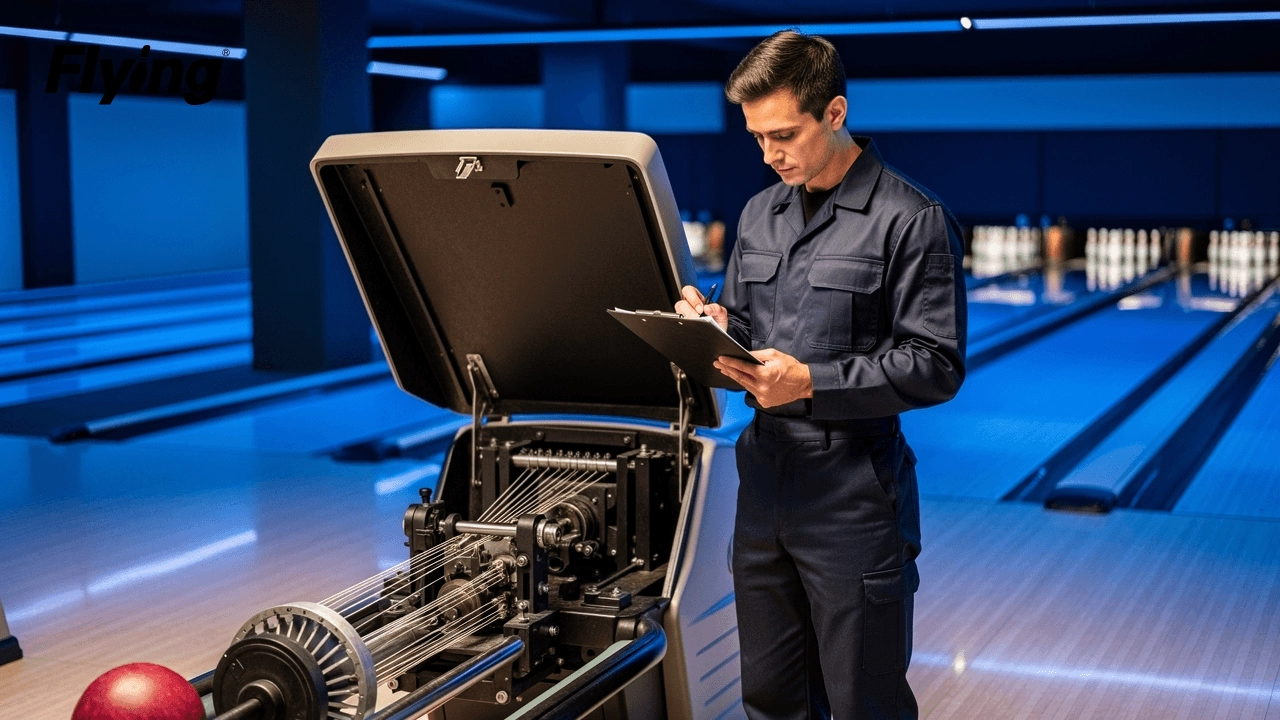


Flying Bowling
Flying Bowling
Flyingbowling
Flyingbowling
Flyingbowling