

Bowling Equipment for Resort Entertainment: Cost and ROI Guide
Resorts and hotels are adding bowling to their amenity mix at a faster rate than at any point in the past two decades — not because bowling is fashionable, but because it solves a persistent operational problem: how to keep guests engaged and spending on-property during the hours between meals, spa visits, and pool time. Bowling equipment for resort entertainment delivers measurable outcomes: longer dwell time, higher F&B attachment, and a differentiated amenity that standalone hotels cannot easily replicate. This guide covers the cost structure, format selection, and ROI model for resort bowling, so operators can make the investment decision with realistic numbers.
Most resort applications call for 2–8 lanes in a compact format — mini bowling (12 m) or medium bowling (adjustable 9.6–18 m) — integrated into an existing entertainment or F&B space. The equipment package includes the lane system, string pinsetter, ball return, scoring system, balls, pins, and shoes. Full-size standard bowling is viable for large resort complexes with dedicated space. Total equipment investment for a 4-lane resort installation typically ranges from $60,000 to $180,000 depending on format and specification.
Planning bowling for your resort? Send us your space dimensions and guest profile for a free layout and equipment proposal →
Why Resorts Are Adding Bowling to Their Entertainment Mix
The case for bowling equipment for resort entertainment is fundamentally economic. Guests who stay on-property longer spend more — on F&B, retail, spa, and activity upgrades. Bowling is one of the few amenities that generates direct per-session revenue (lane fees), drives F&B spend through co-location with bar and lounge areas, and appeals simultaneously to children, adults, and groups — covering the full demographic range of a resort guest profile.
Resort bowling also has practical operational advantages over other entertainment investments. Unlike a pool, it generates revenue in all weather. Unlike a cinema, it is inherently social and shareable. Unlike an arcade, it accommodates multiple spending occasions in a single session — lane hire, food, drinks, and repeat visits from the same guest party across a multi-night stay.
- ›Per-lane or per-game booking fees
- ›F&B spend attached to lane sessions
- ›Private event hire (corporate, weddings, family)
- ›Amenity value supporting higher room rates
- ›All-weather indoor activity — no seasonal closure
- ›Low staff-to-revenue ratio once operational
- ›Minimal ongoing consumable cost vs other attractions
- ›String pinsetter reduces maintenance to venue-manageable tasks
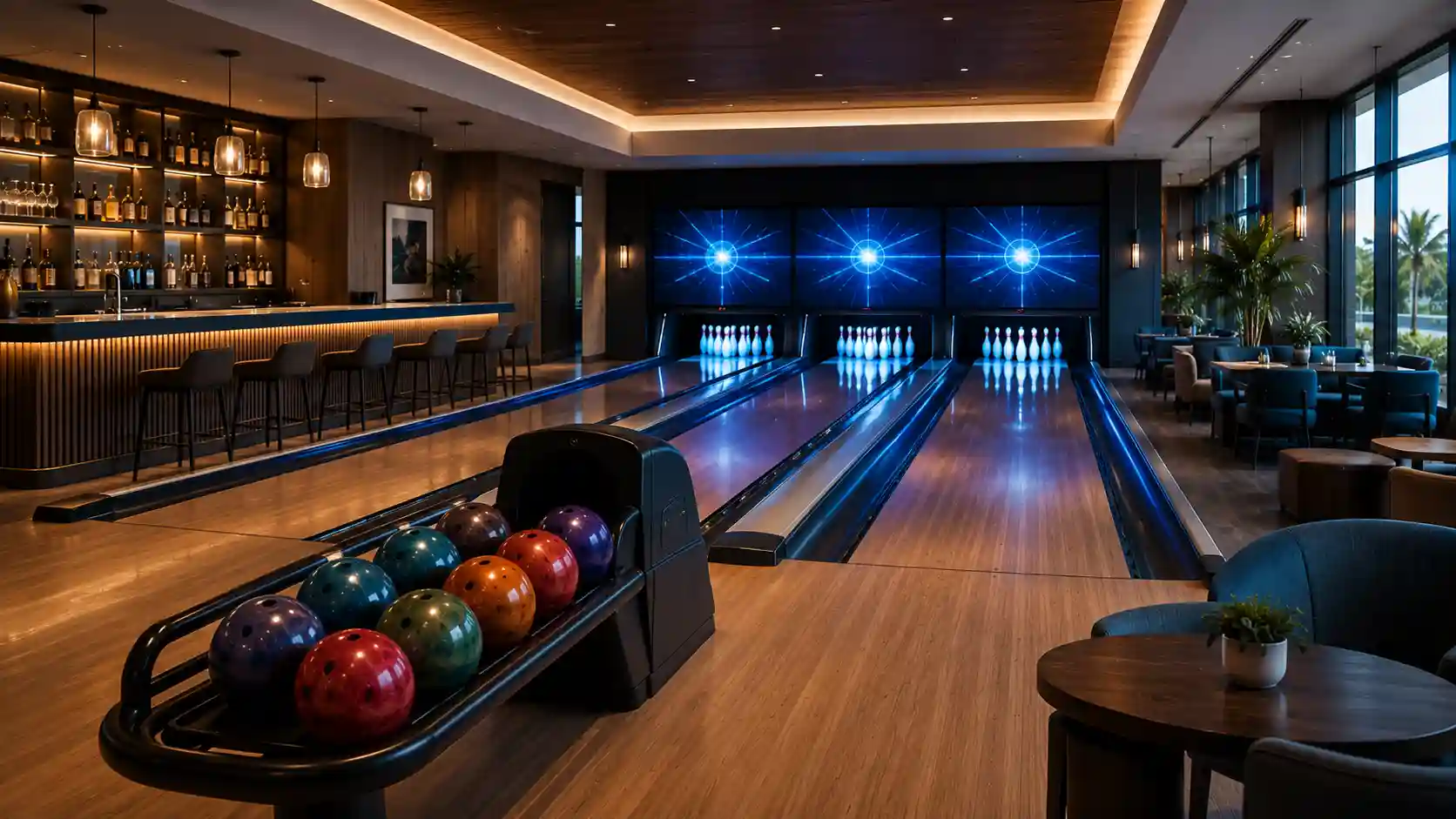
Choosing the Right Resort Bowling Format
Format selection is the most important decision for resort bowling. The wrong format wastes floor space, serves the wrong demographic, or creates a noise and maintenance footprint that disrupts adjacent facilities. Resort bowling is almost never full-size standard bowling — the space requirement and operational complexity are disproportionate to the guest volume a hotel or resort can generate.
| Format | Lane Length | Best Resort Use Case | Space per Lane |
|---|---|---|---|
| Mini bowling (FCMB) | 12 m | Family resorts, beach properties, kids' clubs — child-safe from age 4 | ~16–18 m² per lane |
| Medium bowling (FSMB) | 9.6–18 m | Adult and mixed resorts, hotels with flexible function space | ~20–25 m² per lane |
| Duckpin bowling (FSDB) | ~9.2 m | Boutique hotels, adult leisure venues, bar-integrated entertainment | ~14–16 m² per lane |
| Standard bowling (FCSB) | 18.3 m | Large resort complexes with 1,000+ room capacity and dedicated entertainment buildings | ~35–40 m² per lane |
Space per lane figures are indicative planning references covering the lane surface and approach area. Aisle space, seating, F&B areas, and service zones are additional. Ceiling height minimums and exact footprint requirements vary by model — confirm against your supplier's installation drawings before committing to a space.
For most resort applications, mini bowling and medium bowling deliver the best balance of space efficiency, demographic coverage, and operational simplicity. Buyers evaluating compact bowling equipment options can also review our guide to leading mini bowling equipment manufacturers for a broader supplier comparison.
Bowling Cost: Equipment and Total Project Investment
Equipment Cost by Lane Count
| Installation Size | Format | Equipment Cost (FOB, indicative) | Typical Resort Context |
|---|---|---|---|
| 2–4 lanes | Mini or duckpin | $25,000–$70,000 | Boutique hotel, villa complex, small resort amenity |
| 4–6 lanes | Mini or medium | $60,000–$130,000 | Mid-scale resort, beach hotel, FEC-integrated property |
| 6–10 lanes | Medium or standard | $100,000–$250,000 | Large resort, destination property, convention hotel |
| 10+ lanes | Standard | $200,000–$400,000+ | Mega-resort, integrated entertainment complex |
Equipment cost figures are indicative FOB (factory) pricing references based on Flying Bowling's product range. Landed cost at your property will be higher after international freight, customs duty, and inland logistics. Space per lane figures cover the lane surface and approach area only — seating, service aisles, and F&B areas are additional. Ceiling height and power requirements should be confirmed per format with your equipment supplier. Total project investment typically runs 1.5–2.5× the equipment cost depending on fit-out standard and location. Request an itemised quotation from Flying Bowling based on your specific project scope.
Annual Operating Cost
String pinsetter technology significantly reduces the annual operating cost of resort bowling. Routine maintenance on a string pinsetter system is generally manageable by trained venue staff, with lower specialist servicing requirements than traditional free-fall systems. Indicative annual operating cost components for a 4–6 lane resort installation:
Bowling ROI: How Resort Bowling Pays Back
The bowling ROI calculation for a resort differs from a standalone commercial center because the revenue model combines direct lane revenue with indirect F&B uplift, amenity value on room rates, and private event income. All three should be modelled when evaluating the investment case.
Illustrative ROI Model: 4-Lane Mini Bowling at a Mid-Scale Resort
The table below models three scenarios — conservative, mid-range, and optimistic — based on the same $150,000 total investment. The key variables are utilisation rate and whether F&B is co-located. All figures are illustrative assumptions for planning purposes only; actual results depend on resort occupancy, local pricing, F&B model, and operational management.
| Item | Conservative | Mid-Range | Optimistic |
|---|---|---|---|
| Total investment | ~$150,000 | ~$150,000 | ~$150,000 |
| Utilisation rate | 25% (low resort occupancy, no F&B) | 40% (moderate occupancy, F&B co-located) | 55% (high occupancy, active programming) |
| Lane fee revenue | ~$25,000 | ~$52,000 | ~$80,000 |
| F&B uplift | Minimal (no co-location) | ~$22,000 | ~$45,000 |
| Private events | ~$5,000 | ~$15,000 | ~$30,000 |
| Total annual revenue (est.) | ~$30,000 | ~$89,000 | ~$155,000 |
| Annual operating cost (est.) | ~$15,000 | ~$22,000 | ~$30,000 |
| Annual net contribution (est.) | ~$15,000 | ~$67,000 | ~$125,000 |
| Indicative payback period | 8–10 years | 2.5–4 years | 1.5–2.5 years |
All figures are illustrative planning references only. Revenue assumptions use $25–$35/lane/hr for lane fees and $15–$25 per bowler for F&B uplift — adjust both for your local market pricing. The conservative scenario assumes low resort occupancy and no F&B co-location; the optimistic scenario assumes high occupancy, active event programming, and an integrated bar or lounge. Actual bowling ROI depends on resort occupancy, guest demographics, local pricing levels, and operational management. This model does not account for the indirect amenity value that bowling adds to room rate positioning.
What Drives ROI Higher
- ›F&B integration: resorts that co-locate bowling with a bar or lounge consistently achieve higher per-session revenue than those with bowling as a standalone activity. F&B contribution can exceed lane fee revenue at well-run properties.
- ›Advance reservation system: bowling lanes that can be pre-booked as part of a stay package achieve higher utilisation than walk-in-only operations. Including a bowling credit in room packages increases capture rate.
- ›Evening programming: bowling performs well during evening hours when outdoor activities and pool areas are unavailable. Evening-focused programming with themed events and competitive formats increases both lane utilisation and F&B spend.
- ›Private event pricing: birthday parties, corporate team events, and wedding group activities command premium pricing and generate high per-hour lane revenue. Resorts with event sales infrastructure can significantly improve bowling ROI through targeted event sales.
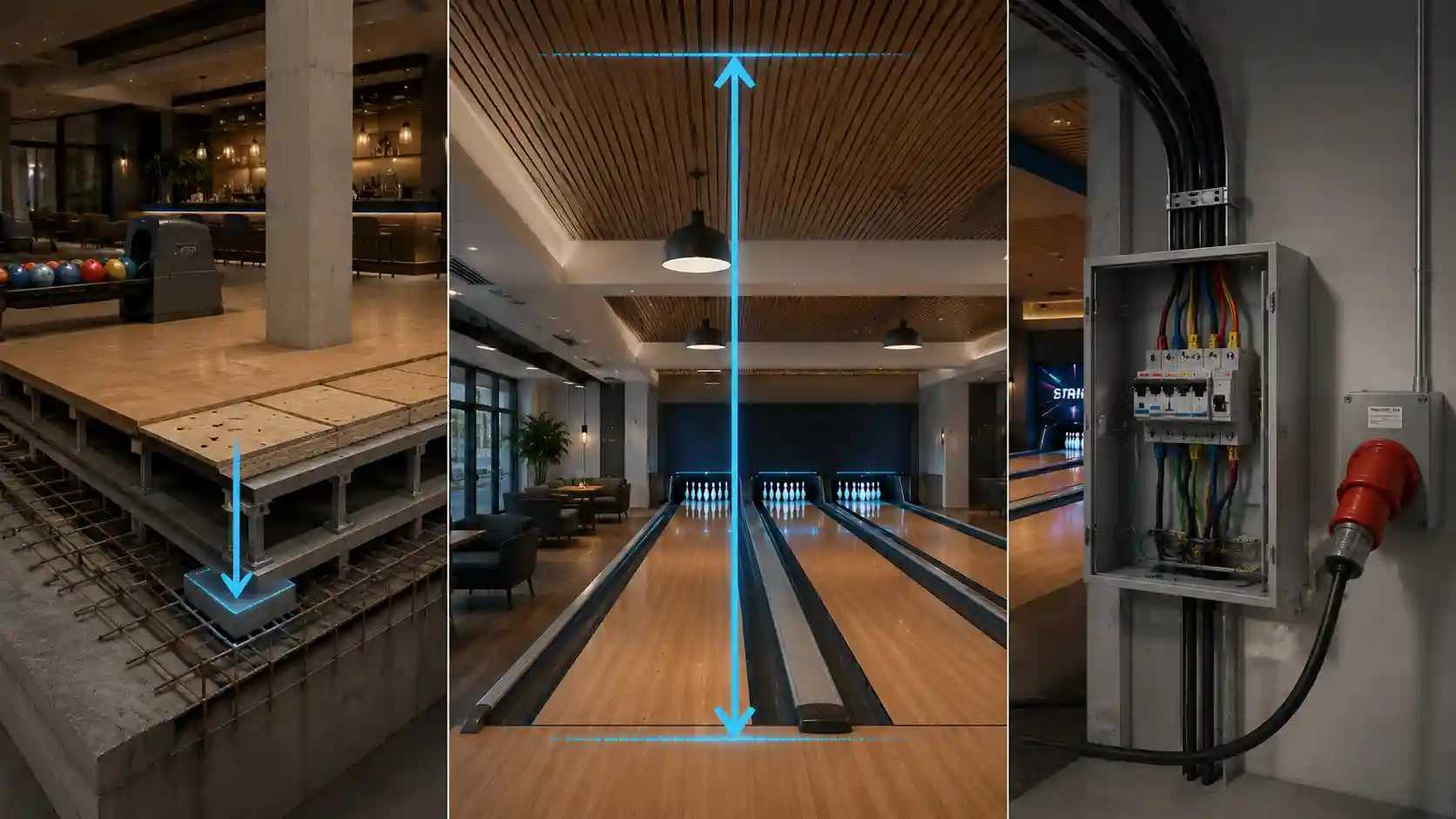
Installation Requirements for Resort Bowling
Successful resort bowling integration requires planning the physical installation alongside the guest experience design. The equipment installation itself is straightforward — Flying Bowling provides on-site installation engineering support — but the surrounding infrastructure must be confirmed before equipment is ordered.
Why Resorts Choose Flying Bowling
Flying Bowling supplies bowling equipment for resort entertainment projects across international markets — from boutique beach properties installing 2-lane mini bowling to large integrated resort complexes with full-size standard lanes. As a direct manufacturer, Flying Bowling provides factory-direct pricing, full layout design support for the planned space, on-site installation engineering, and remote after-sales technical support.
Explore Flying Bowling's resort-suitable product lines:
- ›Flying Cute Mini Bowling (FCMB) — 12 m, child-safe from age 4, ideal for family resorts and hotel amenity rooms
- ›Flying Social Medium Bowling (FSMB) — adjustable lane length, versatile for mixed adult and family resort environments
- ›Flying Smart Duckpin Bowling (FSDB) — compact 9.2 m format, suited for boutique hotels and bar-integrated leisure spaces
- ›View all products — full range including AEROPIN USBC-certified standard bowling for large resort complexes
For resort clients, the key service differentiator is layout design integration — our engineering team works from your floor plan to optimize lane count, orientation, approach zones, seating, and F&B placement before equipment is manufactured. This avoids the common issue of ordering equipment to a generic specification and discovering on installation day that the layout does not fit the available space or serve the guest flow correctly.
Bowling equipment for resort entertainment represents one of the more capital-efficient amenity investments available to hospitality operators. The combination of direct lane revenue, F&B attachment, private event income, and indirect amenity value on room rates creates a multi-channel return that compares favorably to other entertainment investments of similar scale. The key decisions — format selection, lane count, location within the property, and F&B integration model — determine whether resort bowling achieves its full potential or underperforms. Get those decisions right before specifying equipment, and the investment case becomes straightforward.
Plan Your Resort Bowling Installation
Share your resort type, available floor space, target lane count, and guest profile. Flying Bowling's team will prepare format recommendations, a layout plan, equipment specification, and an itemised quotation for your project.
FAQ
Q1: What bowling equipment does a resort need?
Most resort applications require a compact format — mini bowling (12 m lane) or medium bowling (9.6–18 m adjustable) — rather than full-size standard bowling. The core equipment package includes the lane surface system, string pinsetter, ball return system, scoring and display system, house balls in appropriate weights, pins, and rental shoes. For a 4-lane mini bowling installation, the equipment package typically costs $60,000–$130,000 FOB factory. Total project investment including fit-out, freight, installation, and civil works generally runs 1.5–2.5× the equipment cost.
Q2: How much does resort bowling cost to install?
A 2–4 lane boutique installation (mini or duckpin format) typically costs $25,000–$70,000 in equipment, with a total project investment of $80,000–$180,000 including fit-out. A 4–6 lane mid-scale resort installation runs $60,000–$130,000 in equipment and $150,000–$300,000 total. A 6–10 lane large resort installation runs $100,000–$250,000 in equipment and $250,000–$500,000+ total. These are indicative planning references — actual bowling cost depends on format, location, fit-out standard, freight, and customs duty. Request an itemised quotation from your equipment supplier for accurate project budgeting.
Q3: What is the ROI of bowling in a resort?
For an illustrative 4-lane mini bowling installation at a mid-scale resort, annual revenue from lane fees, F&B uplift, and private events can range from approximately $104,000 to $187,000, with annual operating costs of $15,000–$30,000. At a total investment of around $150,000, this implies a payback period of approximately 1–2 years. Actual bowling ROI depends on resort occupancy, local pricing levels, F&B integration, and utilization rate. F&B co-location is the single most impactful factor — resorts with bar or lounge adjacent to bowling lanes consistently achieve higher per-session revenue than standalone bowling operations.
Q4: What bowling format is best for a resort?
Mini bowling (12 m, child-safe from age 4) is the most popular choice for family resorts, beach properties, and hotels with limited space. Medium bowling (9.6–18 m adjustable) suits adult and mixed-demographic resorts with more floor area. Duckpin bowling suits boutique hotels and adult leisure properties where bar integration is the primary use case. Full-size standard bowling (18.3 m) is appropriate only for large resort complexes with dedicated entertainment buildings and sufficient space. For most resort applications, mini or medium format delivers the best balance of space efficiency, demographic coverage, and operational simplicity.
Q5: How much space does resort bowling require?
Mini bowling requires approximately 16–18 m² per lane (lane surface and approach only; seating and service areas are additional). Medium bowling requires approximately 20–25 m² per lane. Duckpin bowling requires approximately 14–16 m² per lane. Standard bowling requires approximately 35–40 m² per lane. Ceiling height must also be confirmed — mini bowling requires a minimum of approximately 3.0–3.5 m clearance; other formats require more. Confirm exact layout requirements with your equipment supplier based on your specific floor plan before committing to a space.
Q6: How noisy is bowling in a resort environment?
String pinsetter technology is significantly quieter than traditional free-fall pinsetter systems — a practical requirement for resorts where bowling may be adjacent to hotel rooms, spa facilities, or dining areas. Flying Bowling's string pinsetters are designed for noise-sensitive environments and are commonly installed in hotels and resorts where acoustic separation from guest facilities is important. Confirm the specific dB specification of your chosen pinsetter model and assess the acoustic separation between the planned bowling space and adjacent noise-sensitive areas before finalising the layout.
More Articles

Let’s Build a center Together
Partner With a Trusted Bowling Alley Design, One-Stop Solution Manufacturer.
Flying has successfully built ideal bowling alleys for more than 3,000 customers.
Technical Expert
You may also like our products
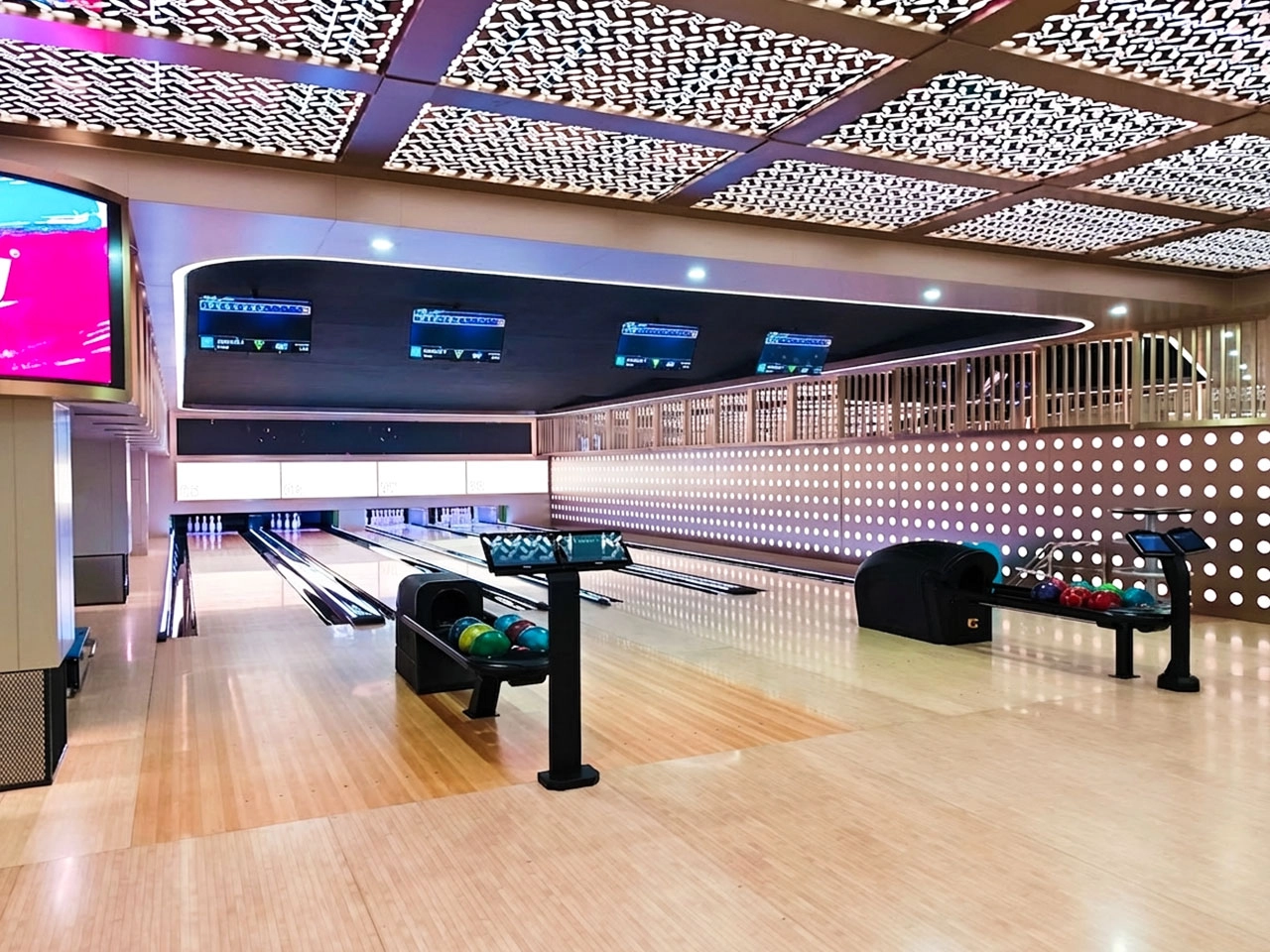
Build a commercial bowling venue with Flying’s complete string pinsetter bowling alley equipment package. The system includes the AEROPIN™ USBC-certified string pinsetter, customizable lanes, automatic scoring, ball return, lane lighting, pins, control hardware, and overseas installation support.
Designed for commercial bowling centers, family entertainment venues, hotels, resorts, bars, and premium private projects, this turnkey bowling system helps operators reduce sourcing complexity and prepare for reliable long-term operation.
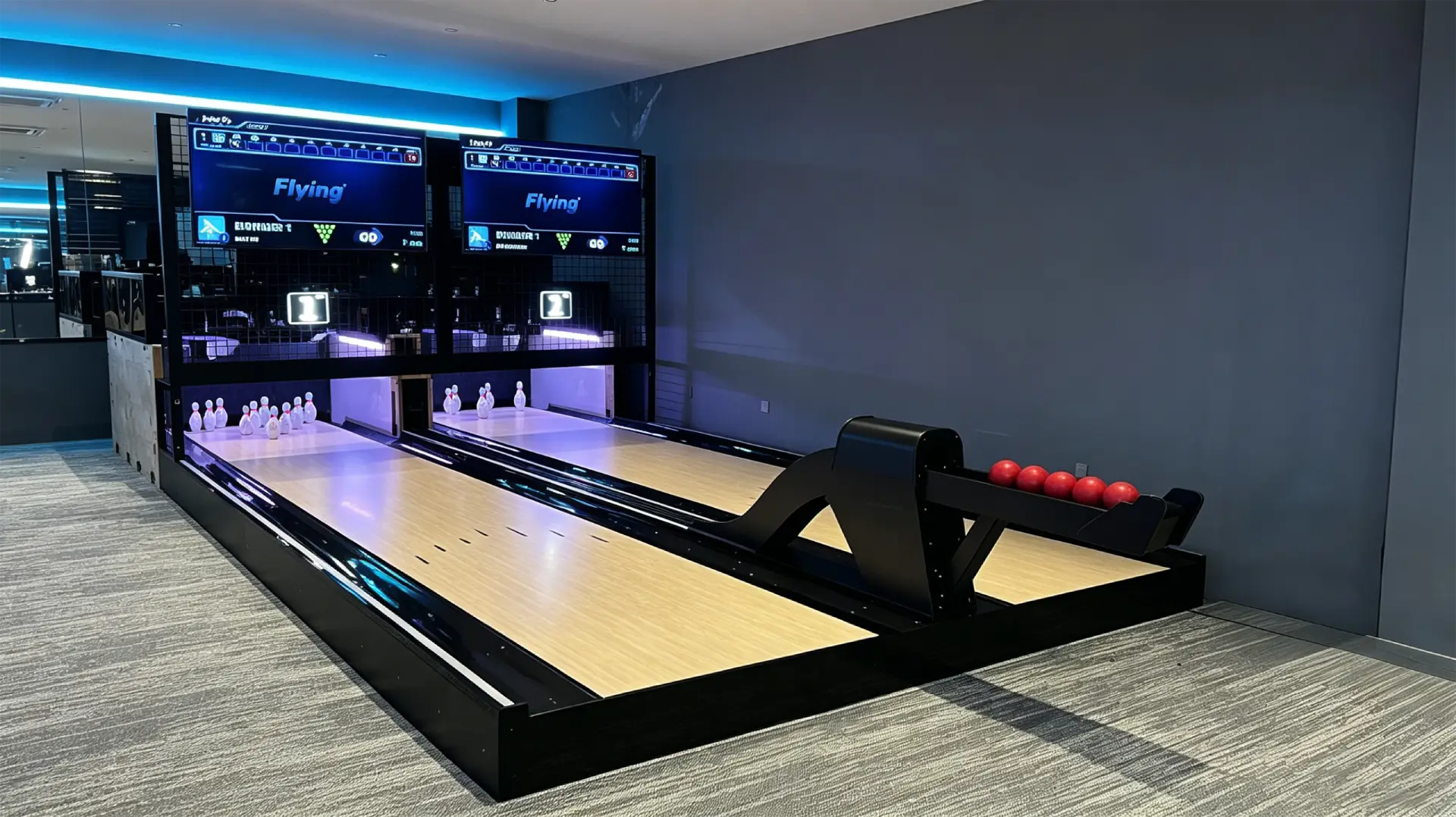
Flying Smart Duckpin Bowling is a compact duckpin bowling equipment system designed for bars, family entertainment centers, hotels, resorts, cinemas, boutique bowling alleys, and social entertainment venues. With a standard 9.13m duckpin bowling lane, 1.25kg lightweight balls, automatic scoring, ball return, LED lighting, and a smart string pinsetter, it creates a fast-paced and easy-to-play bowling experience in a smaller footprint than traditional bowling.
The system is available as a turnkey duckpin bowling package, including lane equipment, a string pinsetter system, scoring hardware, control software, global shipping, installation guidance, and technical support.
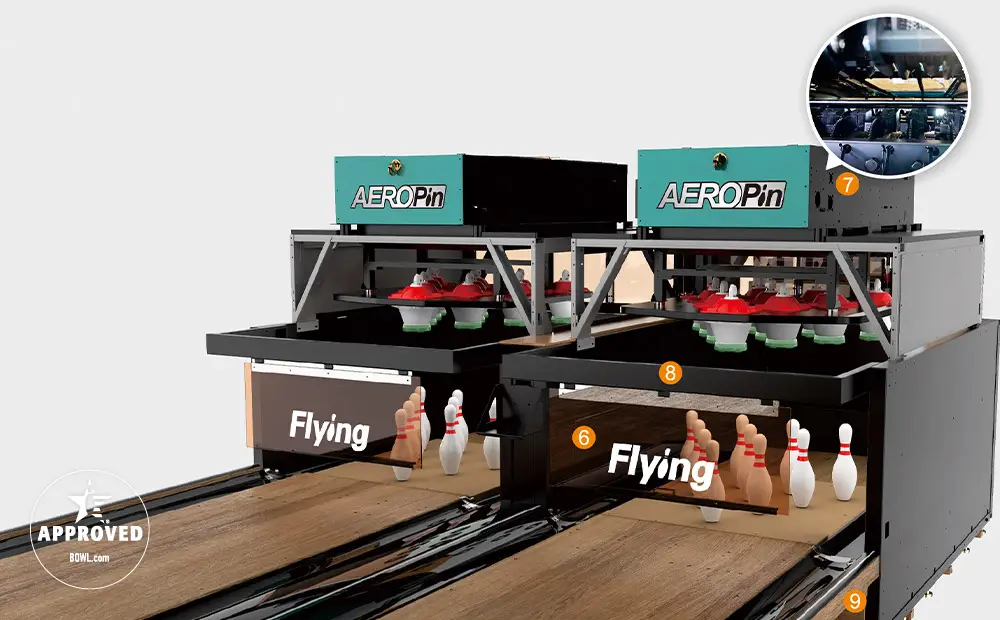
AEROPIN is Flying Bowling’s USBC-certified string pinsetter system for modern commercial bowling centers. Designed for fast pin setting, smooth ball return, low maintenance, and stable daily operation, it helps venue operators build league-ready and entertainment-focused bowling projects with confidence.
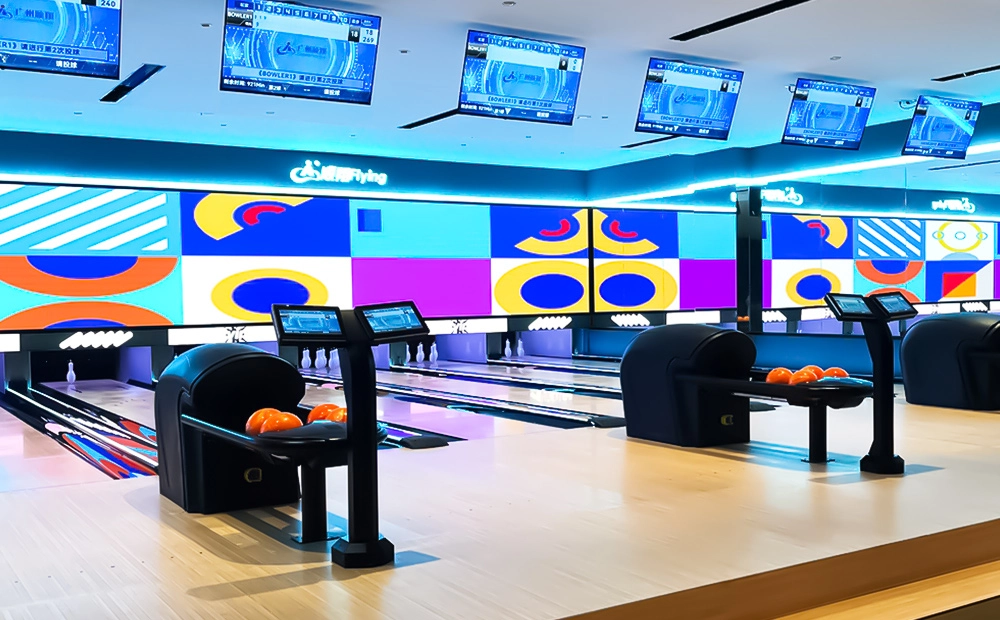
Flying Social Medium Bowling is a compact medium bowling equipment system designed for bars, cafes, family entertainment centers, community leisure venues, hotels, resorts, and small indoor entertainment spaces. With customizable lane lengths from 9.6m to 18m, small balls, lighter pins, string pinsetter technology, ball return, and automatic scoring, it creates an easy-to-play social bowling experience for players of different ages and skill levels.
Compared with full-size standard bowling, medium bowling requires less space and offers a more casual, interactive format. It is a practical choice for venues that want to add a bowling attraction without building a full commercial bowling alley.
Contact Flying
Start Your Custom Bowling Alley Project
If you contact us now for more details, we can provide you with a custom bowling alley service. Our service team will get back to you within 24 hours normally!
© 2026 Flying BOWLING. Designed by gooeyun.
FOLLOW US:

Flying Bowling
Flying Bowling
Flyingbowling
Flyingbowling