

How Much Money to Open a Bowling Alley? 2026 Startup Cost & ROI Guide
Quick Answer: How Much Money to Open a Bowling Alley in 2026?
Opening a bowling alley in 2026 can require anywhere from $120,000 for a compact 2–4 lane add-on to $8,000,000+ for a large commercial center with 20+ lanes. The final number depends on lane count, format, building condition, city, equipment type, and whether F&B and events are included.
| Project Type | Typical Lane Count | Equipment Cost (FOB) | Total Startup Cost Estimate |
|---|---|---|---|
| Compact Add-On (bar, hotel, café) | 2–4 lanes | $22,000–$85,000 | $120,000–$350,000 |
| Boutique Bowling Venue | 4–8 lanes | $60,000–$180,000 | $500,000–$1,200,000 |
| Mid-Size FEC Bowling | 8–16 lanes | $150,000–$400,000 | $1,200,000–$3,000,000 |
| Large Commercial Center | 16–30 lanes | $350,000–$750,000+ | $3,000,000–$8,000,000+ |
What these figures include: equipment, freight and import, construction and fit-out, furniture and lighting, permits and licenses, and pre-opening costs. They do not include land purchase, ongoing rent, staffing, or financing costs.
These are indicative planning estimates based on project experience and supplier data. Actual costs vary by country, city, building condition, contractor pricing, equipment format, and local permit requirements. Verify all cost components with qualified local advisors before committing to a budget.
→ Get a project-specific cost estimate: Contact Flying Bowling
Section 1: What Drives Bowling Alley Startup Cost in 2026?
Three structural factors have changed the cost picture for bowling investment since 2023:
Equipment technology has improved the CAPEX-to-OPEX ratio. Modern string pinsetter systems carry a different cost profile than traditional free-fall mechanical pinsetters. They generally have lower installation complexity, can reduce ongoing electricity consumption, and require less specialist maintenance. For investors, this means the monthly operating cost burden is lower relative to the equipment purchase price than it was five years ago. See: String Pinsetter vs. Free-Fall Pinsetter: Complete Comparison
Smaller formats have expanded the investment entry point. Duckpin bowling (9.2 m lane), medium bowling (9.6–18 m), and mini bowling (12 m fixed) have made bowling viable in spaces that could never accommodate a standard 26-meter tenpin lane. A bar owner can now add 2–4 duckpin lanes for a total project cost under $200,000. The minimum investment threshold can be lower than traditional full-size bowling projects.
F&B and events now drive a larger share of total venue revenue. The bowling-only revenue model — lane fees and shoe rental — is being replaced by multi-revenue venue models where food, drinks, private parties, and corporate events can account for a substantial portion of total income when the venue is designed around group bookings, event packages, and hospitality spending. This changes both the startup cost profile (F&B fit-out adds cost) and the revenue modeling (per-guest spend is higher).
Section 2: 2026 Startup Cost Breakdown
2.1 Building Purchase or Lease
Planning range: $150,000–$800,000+ (purchase) or $24,000–$300,000/year (lease)
Whether to buy or lease depends on capital availability, local property market conditions, and long-term business strategy. Most first-time bowling investors lease rather than buy. Leasing reduces upfront capital requirement but creates ongoing occupancy cost that directly affects monthly P&L.
Before signing any lease, confirm: minimum ceiling height (2.44 m for standard bowling, 2.25 m for duckpin and mini), column-free lane span, subfloor load bearing, electrical capacity, loading access for equipment delivery, and zoning compliance for entertainment use.
Investors frequently underestimate how specific the physical requirements are for bowling equipment. A space that looks suitable on a floor plan may fail on ceiling height, column placement, or slab flatness. Confirm technical feasibility with a bowling equipment supplier before executing a lease.
2.2 Construction and Fit-Out
Planning range: $100,000–$600,000
Construction scope for a commercial bowling venue typically includes:
- Subfloor leveling and structural review
- Dedicated electrical circuits for bowling equipment
- HVAC and ventilation upgrades
- Restrooms, accessibility compliance
- Bar and kitchen build-out (if F&B is included)
- Acoustic treatment and soundproofing
- Interior lighting, branding, and seating
Fit-out costs vary substantially by country, city, and building condition. Converting a warehouse or industrial unit is generally less expensive than fitting out a retail mall unit. A rough planning benchmark: construction and fit-out typically represents 30–50% of total project cost for mid-size commercial venues, excluding equipment.
2.3 Bowling Equipment
Planning range: $22,000–$750,000+ (FOB, depending on format and lane count)
Equipment is usually the single largest controllable cost in a bowling project. Flying Bowling supplies four formats suited to different investment profiles:
| Format | Equipment Line | FOB Per Lane | Best For |
|---|---|---|---|
| Mini Bowling | FCMB | $9,000–$12,000 | Kids' venues, mall FECs, compact family rooms |
| Duckpin Bowling | FSDB | $11,000–$16,000 | Bars, cafés, barcades, boutique lounges |
| Medium Bowling | FSMB | $14,000–$18,000 | Mid-size FECs, hotels, social venues |
| Standard Bowling | FCSB | $18,000–$25,000 | Commercial centers, leagues, large FECs |
All four formats use string pinsetter technology. The FCSB is also available with the USBC-certified AEROPIN™ string pinsetter for competitive league applications.
For a full equipment pricing breakdown including accessories, scoring systems, and ball return configurations, see: Bowling Equipment Cost Guide 2026
2.4 Freight, Import, and Installation
Planning range: 15–25% of FOB equipment value
For international projects, add estimated freight, customs clearance, applicable import duties and taxes, customs broker fees, and inland delivery. Exact figures depend on shipping route, destination country, HS code classification, and local import regulations. Work with a licensed customs broker to estimate landed cost before placing an equipment order.
Installation scope includes lane placement, pinsetter commissioning, scoring system integration, safety testing, and staff operation training. Flying Bowling provides installation guidance and commissioning support for international projects.
2.5 Furniture, Décor, and Lighting
Planning range: $40,000–$200,000
Seating, lounge areas, bar furniture, LED lane lighting, service counters, and interior branding. For boutique social venues, this category can represent a higher proportion of total budget than for traditional bowling centers — atmosphere is a primary driver of social media visibility and repeat bookings.
2.6 Permits, Licenses, and Legal
Planning range: $15,000–$60,000
Common requirements include: business registration, municipal entertainment license, building permit, electrical inspection, fire safety approval, occupancy certificate, food service permit (if F&B is included), and liquor license (if alcohol is served). Requirements vary significantly by country, state, and municipality. Budget more time than money for permitting — delays in approval are a more common project risk than cost overrun in this category.
2.7 Pre-Opening Costs
Planning range: $20,000–$80,000
Staff recruitment and training, pre-opening marketing, POS and reservation systems, security and surveillance, IT and network infrastructure, spare parts inventory, and soft launch events. These costs are frequently omitted from early-stage budgets and create cash shortfalls before the venue reaches steady-state operation.
Section 3: Bowling Equipment Cost Per Lane
For investors comparing formats and evaluating per-lane economics, the table below shows FOB cost per lane and indicative total project cost for common lane configurations:
| Format | FOB Per Lane | 4-Lane FOB Total | 4-Lane Total Project Est. | 8-Lane Total Project Est. |
|---|---|---|---|---|
| Mini Bowling (FCMB) | $9,000–$12,000 | $36,000–$48,000 | $120,000–$250,000 | $200,000–$450,000 |
| Duckpin (FSDB) | $11,000–$16,000 | $44,000–$64,000 | $150,000–$350,000 | $280,000–$600,000 |
| Medium Bowling (FSMB) | $14,000–$18,000 | $56,000–$72,000 | $250,000–$600,000 | $450,000–$1,000,000 |
| Standard Bowling (FCSB) | $18,000–$25,000 | $72,000–$100,000 | $500,000–$1,200,000 | $900,000–$2,500,000 |
Total project estimates include FOB equipment, freight and import, construction and fit-out, permits, furniture, and pre-opening costs. They do not include rent, ongoing staffing, or financing costs.
Section 4: Small vs. Large Bowling Alley — Cost and Strategy Comparison
| Factor | Compact / Boutique (2–8 lanes) | Large Commercial Center (12–30 lanes) |
|---|---|---|
| Total startup cost | $120,000–$1,200,000 | $2,000,000–$8,000,000+ |
| Equipment format | Mini, Duckpin, or Medium Bowling | Standard Bowling (FCSB) |
| Primary audience | Social groups, urban young adults, families | Families, league players, corporate groups |
| Revenue model | F&B and events dominant | Lane rental, leagues, F&B combination |
| Staffing complexity | Lower — often managed by existing hospitality staff | Higher — dedicated bowling operations team |
| Payback speed | Generally faster (planning range 12–48 months) | Generally longer (planning range 36–84 months) |
| Best market | Urban bar/café, hotel amenity, boutique FEC | Suburban family market, anchor entertainment venue |
Neither model is universally superior. The right choice depends on capital availability, available space, local market demographics, and operator experience. Many first-time investors start with a compact duckpin or medium bowling installation to understand the business before committing to a larger project.
For a detailed comparison of business models by ROI profile, see: Bowling Business Models Compared: Equipment, Startup Cost & ROI Breakdown
Section 5: Home vs. Commercial Bowling Alley Cost
A growing number of homeowners, private club operators, and residential developers inquire about home bowling lane installation. The cost structure differs significantly from commercial projects.
| Format | Min. Room Length | Min. Ceiling Height | FOB Equipment (2 lanes) | Complete Home Installation Est. |
|---|---|---|---|---|
| Standard Tenpin | 26–28 m | 2.44 m | $36,000–$50,000 | $120,000–$300,000+ |
| Duckpin Bowling | 12–14 m | 2.25 m | $22,000–$32,000 | $60,000–$150,000+ |
| Mini Bowling | 13–15 m | 2.25 m | $18,000–$24,000 | $50,000–$130,000+ |
For most homes, duckpin or mini bowling is more practical than standard tenpin due to room length constraints. Complete home installation costs include FOB equipment, freight, electrical work, subfloor preparation, and installation labor. Structural feasibility (especially for upper-floor or basement installations) should be confirmed with a structural engineer before ordering equipment.
Section 6: Ongoing Monthly Operating Costs
Startup cost is only one part of the financial picture. Monthly operating costs determine whether the venue reaches profitability and how quickly. The table below uses a 4-lane commercial venue as the planning reference:
| Cost Category | Monthly Planning Range | Notes |
|---|---|---|
| Rent / lease | $3,500–$25,000+ | Largest variable; depends heavily on city and footprint |
| Staff salaries | $8,000–$25,000+ | Varies by operating model, hours, and local wage rates |
| Electricity and utilities | $1,000–$5,000+ | HVAC, lighting, pinsetters, kitchen |
| Equipment maintenance | $400–$2,000+ | Parts, consumables, technical support |
| Insurance and licenses | $400–$2,500+ | Varies by jurisdiction and business type |
| Marketing | $800–$4,000+ | Local advertising, social media, events |
| Total monthly operating cost | $14,000–$60,000+ | Excluding loan repayment and owner compensation |
Equipment selection has a direct and measurable effect on monthly operating costs. String pinsetter systems generally reduce electricity consumption, maintenance labor requirements, and parts inventory compared with traditional free-fall mechanical systems. For operators in markets with high electricity or labor costs, this difference can be significant across the operating life of the venue.
Section 7: Bowling Alley ROI Analysis
What Drives Payback Speed
A bowling alley's payback period is determined by the interaction of four variables: total investment, monthly fixed costs (primarily rent), revenue per visit, and utilization rate. The ROI table below provides indicative planning scenarios — not projected returns. Actual results depend on location, pricing, F&B execution, marketing, staffing model, and local competition.
| ROI Driver | Why It Matters | How to Improve It |
|---|---|---|
| Lane utilization rate | Determines lane-based revenue | League programming, online booking, party packages |
| F&B attachment rate | Raises per-capita spend | Curated menu, package deals, private event upsells |
| Private events and parties | Improves weekday/weekend revenue balance | Corporate packages, birthday party programs |
| Pinsetter uptime | Protects revenue during peak periods | String pinsetter technology, spare parts stock |
| Rent-to-revenue ratio | Controls fixed cost burden | Location selection, lease negotiation, opening-hour optimization |
| Energy and maintenance cost | Affects monthly margin | String pinsetter vs. free-fall comparison |
Indicative Payback Scenarios by Model
| Business Model | Total Investment Est. | Monthly Revenue Planning Range | Indicative Payback Range |
|---|---|---|---|
| Duckpin bar integration (4 lanes) | $150,000–$350,000 | $15,000–$45,000 | 12–30 months |
| Boutique social lounge (6–8 lanes) | $500,000–$1,200,000 | $35,000–$90,000 | 24–48 months |
| Mid-size FEC (8–16 lanes) | $1,200,000–$3,000,000 | $60,000–$150,000 | 36–72 months |
| Commercial league center (12–20 lanes) | $2,000,000–$5,000,000 | $80,000–$200,000 | 48–84 months |
Planning note: Revenue figures above are indicative planning ranges based on supplier-side project experience. They assume favorable location, controlled operating costs, active F&B programming, and strong utilization. Individual venues will perform differently. These scenarios should be used as a starting framework for financial modeling, not as projected returns or guarantees.
String Pinsetter Impact on Operating ROI
String pinsetter systems can affect ROI through three mechanisms: lower electricity consumption (potentially 50–60% less than free-fall systems for pinsetter-related load, depending on configuration and operating hours), faster reset cycles (typically 3–5 seconds vs. 8–12 seconds for free-fall, which can increase throughput at high utilization), and reduced maintenance labor (trained general venue staff can usually manage routine daily operation, while technical support may still be needed for installation, commissioning, troubleshooting, and scheduled maintenance).
The aggregate effect of these savings on payback period depends on utilization, local electricity rates, and labor costs. For venues in markets with high electricity or skilled labor costs, the operating cost advantage of string pinsetter equipment can be meaningful.
Section 8: Bowling Alley Business Plan — Core Sections to Prepare
Investors searching for how to structure a bowling alley business plan should prepare the following components before seeking financing or committing to a lease:
1. Market Analysis Local population demographics, disposable income profile, existing entertainment competition, nearest bowling venues and their pricing, and demand signals (event booking trends, group entertainment spend).
2. Venue Format and Lane Count Format selection (mini, duckpin, medium, or standard bowling), lane count, and supporting attractions (F&B, arcades, events). Justified by the space available and the market analysis.
3. Startup Budget Itemized estimates for property, construction, equipment (FOB + freight + import), fit-out, permits, pre-opening, and contingency (typically 10–15% of total project cost).
4. Revenue Model Projected revenue by stream: lane fees, F&B, birthday parties, corporate events, memberships, shoe rental, arcade. Revenue modeled at conservative, base, and optimistic utilization scenarios.
5. Staffing Plan Roles, headcount, hours, wage rates, and total monthly payroll at launch and at steady-state operation.
6. Monthly Operating Cost Budget Rent, utilities, maintenance, insurance, marketing, and other recurring costs. Presented as monthly totals with assumptions visible.
7. Financing Strategy How the project is capitalized: equity, bank loan, equipment financing, investor partnership, or phased investment. Debt service must be modeled against projected cash flow.
8. Equipment and Maintenance Plan Equipment format, supplier, warranty terms, spare parts strategy, and maintenance schedule. Investors who plan this component in advance face fewer operational surprises.
9. ROI Scenarios Conservative, base, and optimistic payback projections based on different utilization and pricing assumptions. Present as scenarios, not single-point forecasts.
10. Marketing and Launch Plan Pre-opening promotion, Google Business Profile setup, social media, birthday party and corporate event outreach, and any local media or partnership activity.
Section 9: How to Finance a Bowling Alley Startup
| Financing Option | How It Works | Best For |
|---|---|---|
| Bank loan | Fixed or variable rate lending secured against assets or business cash flow | Operators with strong credit history and existing business assets |
| SBA / local small business loan | Government-backed lending programs (varies by country) | First-time business owners in eligible markets |
| Equipment financing | Financing secured against the equipment itself, often from equipment suppliers or specialist lenders | Operators who want to preserve working capital |
| Investor partnership | Equity investment in exchange for ownership stake or revenue share | Operators with strong venue experience but limited capital |
| Phased opening | Launch with fewer lanes or reduced F&B scope; expand as revenue grows | Operators who can generate revenue from Phase 1 before Phase 2 investment |
| Leasehold improvement allowance | Negotiating tenant improvement contributions from landlords in exchange for longer lease terms | Operators in strong lease negotiation positions |
Financing structures vary significantly by country. Investors outside the US should confirm available loan products, interest rates, and collateral requirements with local banks or small business advisors before building a financial plan.
Section 10: Build New vs. Buy an Existing Bowling Alley
Some investors search specifically for bowling alleys for sale, for lease, or as franchise opportunities. The build vs. buy decision involves trade-offs that are worth evaluating explicitly.
Building New
Gives the investor full control over equipment format, layout, branding, and long-term operating cost structure. Better suited to investors who want to design the guest experience from scratch and choose modern equipment.
The main risks are construction delays, permitting complexity, and the time to first revenue (typically 6–12 months from project start for a commercial venue).
Buying an Existing Venue
Can reduce time to first revenue and provide an established customer base. However, investors must carefully inspect: pinsetter age and mechanical condition, lane surface condition, scoring system, ball return equipment, HVAC, electrical systems, lease terms, and any deferred maintenance.
Older free-fall mechanical pinsetter systems may require significant ongoing maintenance cost or full replacement. In some acquisition cases, replacing legacy equipment with string pinsetter systems reduces long-term operating complexity and can justify a lower acquisition price. For a detailed technical and financial comparison, see: String Pinsetter vs. Free-Fall Pinsetter
Franchise
Some bowling brands operate franchise models. Franchise costs add a franchise fee, royalties, and brand-standard fit-out requirements on top of standard project costs. Verify the specific franchise agreement terms and total investment requirements directly with the franchisor.
Section 11: How to Reduce Startup Costs Without Compromising Guest Experience
Choose a compact bowling format first. Duckpin and mini bowling require significantly less floor space per lane than standard tenpin. Reducing the required footprint directly reduces rent, construction, and fit-out cost.
Buy factory-direct. Distributor markups for bowling equipment can add 20–40% to equipment cost in some markets. Purchasing directly from the manufacturer — with technical support, warranty, and shipping coordination included — may reduce the equipment line item and improve cost control.
Prioritize string pinsetter technology. Lower installation complexity, reduced energy draw, and less maintenance labor improve both startup cost and ongoing operating margin compared with traditional free-fall systems.
Convert an existing space rather than building from scratch. Warehouse, industrial, and former retail units often have the ceiling height and column-free spans needed for bowling at lower construction cost than ground-up builds or premium retail fit-outs.
Phase the F&B build-out. Open with a simplified bar or snack service and invest in a full kitchen build-out after the venue has established its customer base and revenue patterns.
Negotiate tenant improvement allowances. In markets where commercial landlords compete for anchor tenants, operators can sometimes negotiate a contribution toward fit-out costs in exchange for a longer lease commitment.
Section 12: How Flying Bowling Supports Investors
Flying Bowling has supported more than 3,000 bowling projects globally since 2005, supplying equipment for commercial centers, FECs, hotels, bars, private clubs, and residential installations across more than 60 countries.
For investors evaluating a bowling project, Flying Bowling provides:
- Floor plan review and lane configuration recommendation based on your space and business model
- Itemized FOB equipment quotation with HS code guidance for import planning
- Shipping coordination and export documentation for international delivery
- Installation guidance and commissioning support
- Staff operation and maintenance training
- Spare parts support and standard warranty service
Whether you are evaluating a 2-lane duckpin installation for a bar or planning a 16-lane commercial entertainment center, the equipment specification is where cost and operating margin are determined. Getting the format, lane count, and pinsetter selection right before signing a lease or committing to a contractor reduces the most common sources of project cost overrun.
Jackson Qin — Flying Bowling Email: jackson@flyingbowling.com WhatsApp: +86 150 1310 7020 Start Your Project Inquiry →
Related Reading
- Bowling Business Models Compared: Equipment, Startup Cost & ROI Breakdown
- Bowling Equipment Cost in 2026: Complete Price Breakdown
- How Much Does a String Pinsetter Cost?
- String Pinsetter vs. Free-Fall Pinsetter: Complete Comparison
- USBC Approved String Pinsetters Guide
- Build a Bowling Center: Planning Guide
- How Much Does It Cost to Build a Bowling Alley in Canada? (2026)
FAQ
How much money do you need to open a bowling alley in 2026?
Total startup cost ranges from approximately $120,000 for a compact 2–4 lane add-on (duckpin or mini bowling in an existing bar or hotel space) to $8,000,000+ for a large 20–30 lane commercial center. A 4–8 lane boutique bowling venue typically requires $500,000–$1,200,000. These are indicative planning estimates; actual costs depend on format, city, building condition, equipment choice, and local construction rates.
What is the biggest startup cost when opening a bowling alley?
For most projects, the building (lease or purchase) and construction/fit-out represent the largest combined cost, typically 40–60% of the total project budget. Bowling equipment is the second largest cost category, but it is also the most directly controllable — format selection and supplier choice have a significant impact on this line item.
How much does bowling equipment cost per lane?
FOB equipment cost per lane ranges from $9,000–$12,000 for mini bowling (FCMB), $11,000–$16,000 for duckpin bowling (FSDB), $14,000–$18,000 for medium bowling (FSMB), and $18,000–$25,000 for standard bowling (FCSB). After freight, import, and installation, landed equipment cost per lane is typically 20–30% higher than the FOB price.
Can I start a bowling business with 2–4 lanes?
Yes. A 2–4 lane duckpin or mini bowling installation is a practical entry point for bar owners, café operators, hotel amenity managers, and small FEC operators. Total project cost for a 2–4 lane compact installation typically ranges from $120,000 to $350,000, depending on format, space condition, and local construction costs.
How much does it cost to open a boutique bowling lounge?
A 4–8 lane boutique social bowling venue with a full bar and event capability typically requires $500,000–$1,200,000 in total project investment. F&B fit-out often represents a significant portion of the total, as the kitchen and bar infrastructure can cost as much as the bowling equipment itself in upscale concepts.
Is a bowling alley a profitable business?
A bowling alley can be financially viable when site selection, equipment choice, F&B programming, and operating costs are well managed. Profitability depends on the rent-to-revenue ratio, lane utilization, F&B margin, staffing efficiency, and local competition. Venues that combine bowling with food, drinks, and private events generally outperform lane-rental-only concepts on per-capita spend and total revenue.
How long does it take to recover the investment in a bowling alley?
Payback period varies widely by model. In planning scenarios for compact duckpin bar installations with strong foot traffic, payback may be estimated at 12–30 months. For larger FEC projects, planning scenarios often model 36–72 months to breakeven. These are planning ranges, not projections — actual results depend on revenue performance, cost control, and market conditions.
Is it better to build a new bowling alley or buy an existing one?
Building new gives full control over equipment, layout, and guest experience design. Buying an existing venue can reduce time to first revenue but requires careful due diligence on equipment condition, lease terms, and deferred maintenance. The better option depends on available capital, local market conditions, and whether a suitable acquisition target exists at a reasonable price relative to new-build cost.
What are the hidden costs that bowling alley investors often miss?
Commonly underestimated costs include POS and reservation systems, security and surveillance infrastructure, spare parts inventory, IT and network build-out, pre-opening marketing and staffing, parking lot upgrades, and the time cost of permitting delays. A 10–15% project contingency budget is advisable.
What information should I provide to get a bowling alley equipment quotation?
To receive an accurate equipment quotation from Flying Bowling, prepare: project city and country, available floor plan or room dimensions (length, width, ceiling height), preferred bowling format (mini, duckpin, medium, or standard), planned lane count, photos of the space and delivery access, and a brief description of the business model (bar, FEC, hotel, commercial center, or home installation). Flying Bowling can also provide a remote layout feasibility review before quotation.
More Articles

Let’s Build a center Together
Partner With a Trusted Bowling Alley Design, One-Stop Solution Manufacturer.
Flying has successfully built ideal bowling alleys for more than 3,000 customers.

Technical Expert
You may also like our products
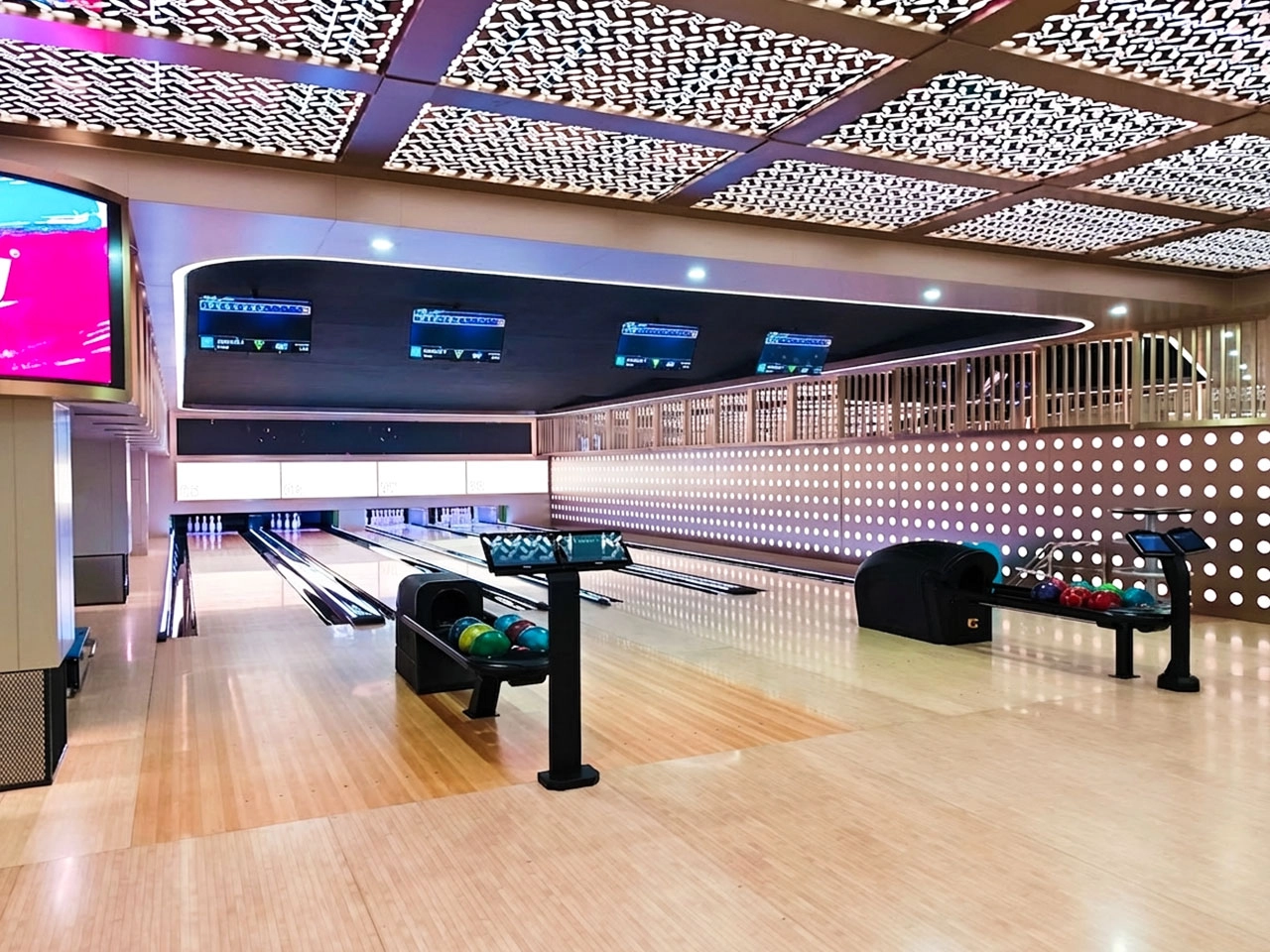
Build a commercial bowling venue with Flying’s complete string pinsetter bowling alley equipment package. The system includes the AEROPIN™ USBC-certified string pinsetter, customizable lanes, automatic scoring, ball return, lane lighting, pins, control hardware, and overseas installation support.
Designed for commercial bowling centers, family entertainment venues, hotels, resorts, bars, and premium private projects, this turnkey bowling system helps operators reduce sourcing complexity and prepare for reliable long-term operation.
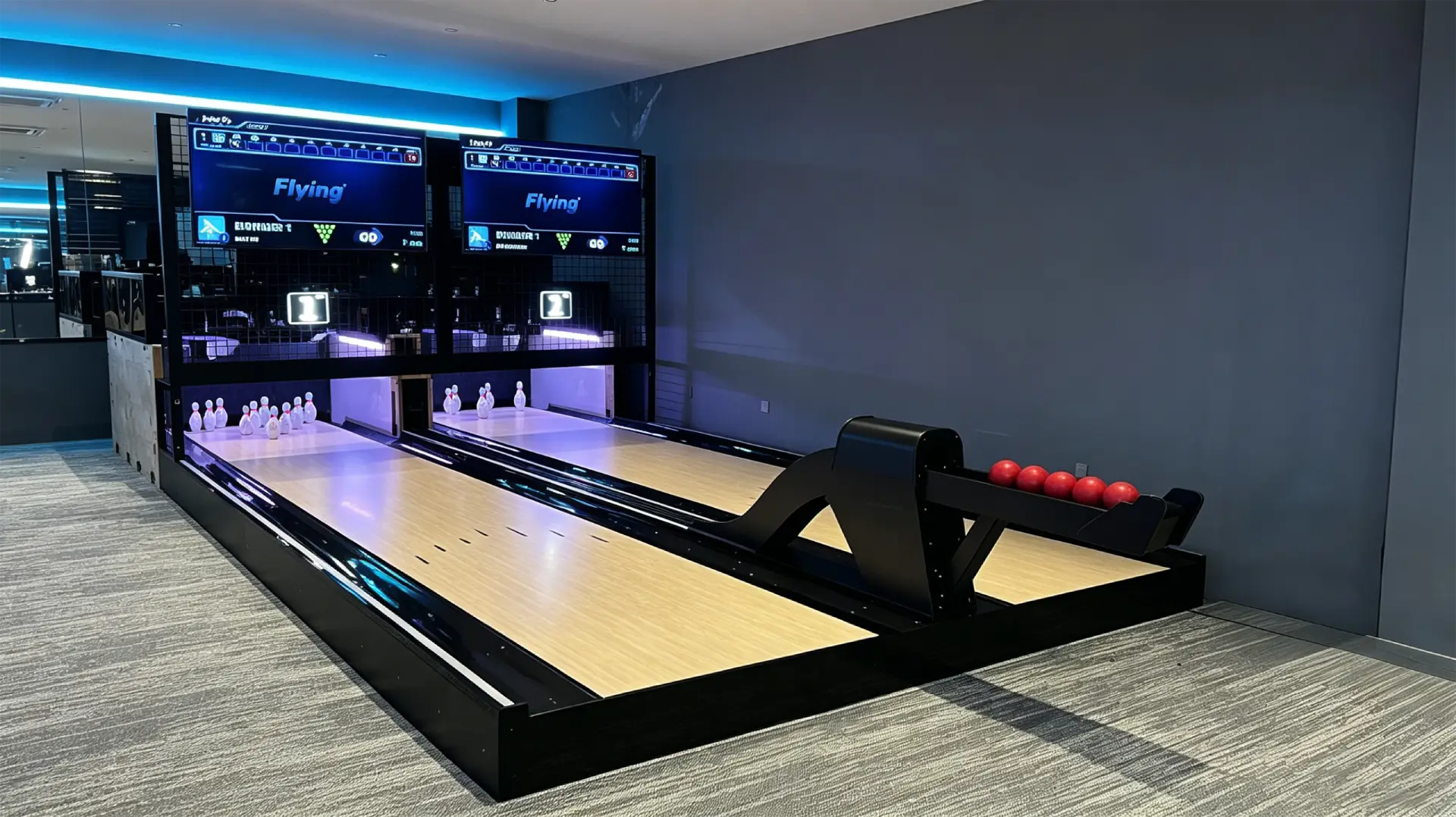
Flying Smart Duckpin Bowling is a compact duckpin bowling equipment system designed for bars, family entertainment centers, hotels, resorts, cinemas, boutique bowling alleys, and social entertainment venues. With a standard 9.13m duckpin bowling lane, 1.25kg lightweight balls, automatic scoring, ball return, LED lighting, and a smart string pinsetter, it creates a fast-paced and easy-to-play bowling experience in a smaller footprint than traditional bowling.
The system is available as a turnkey duckpin bowling package, including lane equipment, a string pinsetter system, scoring hardware, control software, global shipping, installation guidance, and technical support.
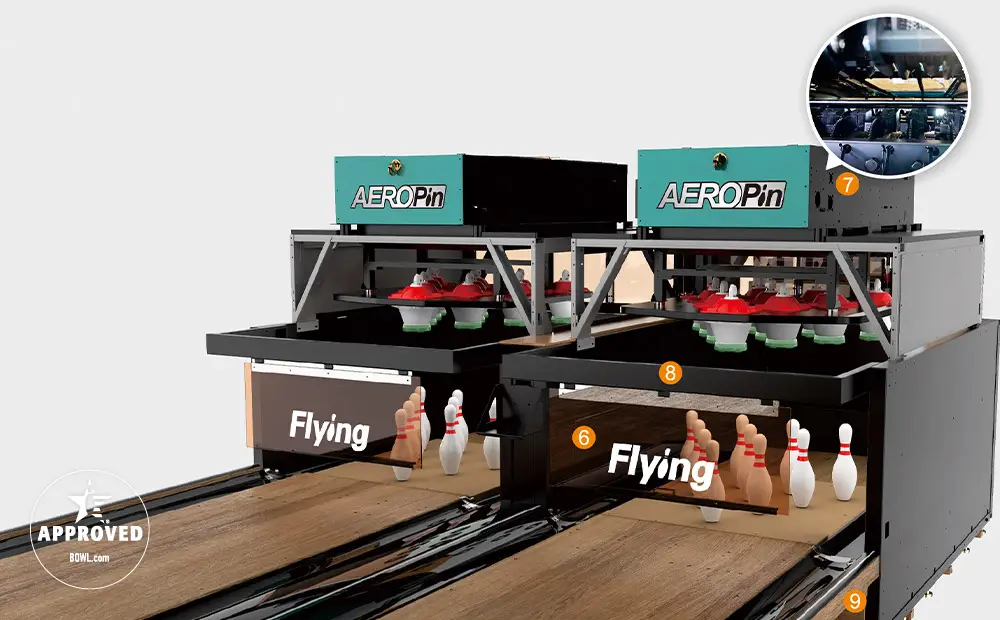
AEROPIN is Flying Bowling’s USBC-certified string pinsetter system for modern commercial bowling centers. Designed for fast pin setting, smooth ball return, low maintenance, and stable daily operation, it helps venue operators build league-ready and entertainment-focused bowling projects with confidence.
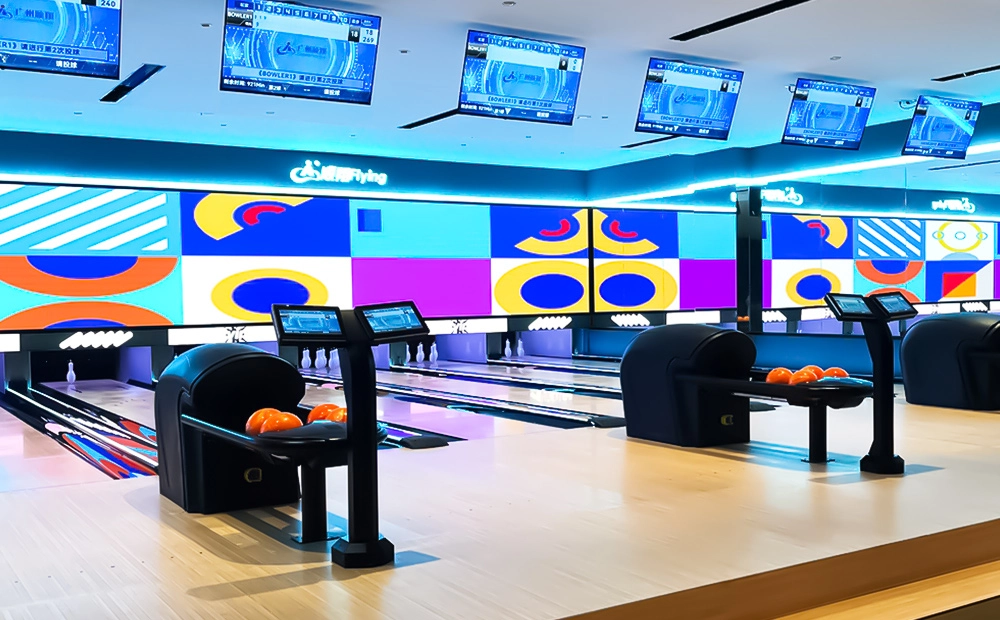
Flying Social Medium Bowling is a compact medium bowling equipment system designed for bars, cafes, family entertainment centers, community leisure venues, hotels, resorts, and small indoor entertainment spaces. With customizable lane lengths from 9.6m to 18m, small balls, lighter pins, string pinsetter technology, ball return, and automatic scoring, it creates an easy-to-play social bowling experience for players of different ages and skill levels.
Compared with full-size standard bowling, medium bowling requires less space and offers a more casual, interactive format. It is a practical choice for venues that want to add a bowling attraction without building a full commercial bowling alley.
Contact Flying
Start Your Custom Bowling Alley Project
If you contact us now for more details, we can provide you with a custom bowling alley service. Our service team will get back to you within 24 hours normally!
© 2026 Flying BOWLING. Designed by gooeyun.
FOLLOW US:

Flying Bowling
Flying Bowling
Flyingbowling
Flyingbowling
Flyingbowling