-->
Sunday, April 05, 2026

How Does a String Pinsetter Work? The Complete Technical Breakdown (2026)

Most people know that a string pinsetter uses strings to reset pins — but very few understand the actual mechanism: how cord tension sensors detect standing pins in under half a second, how the servo drive unit lifts cords without interfering with pin action, and why the 3–5 second reset cycle is possible when free-fall systems need 8–12 seconds for the same task. This guide breaks down every step of the process, with the technical detail operators actually need.

Author

Flying Founder
Jackson Qin
bowling

The string pinsetter is one of those mechanisms that look almost too simple—a set of strings above the pins, a motor, and a sensor system. And yet it's replaced decades of free-fall mechanical complexity in bowling venues worldwide. Understanding exactly how it works — step by step, component by component — helps operators make smarter equipment decisions, diagnose issues faster, and train staff more effectively.

This guide breaks down the complete working mechanism of a string pinsetter, from the moment the ball leaves the bowler's hand to the moment the pins are reset and ready for the next delivery.

Technical specifications and performance data in this guide are based on Flying Bowling's engineering documentation and service records across commercial installations in 40+ countries.

1. What a String Pinsetter Actually Is — and What It Isn't 

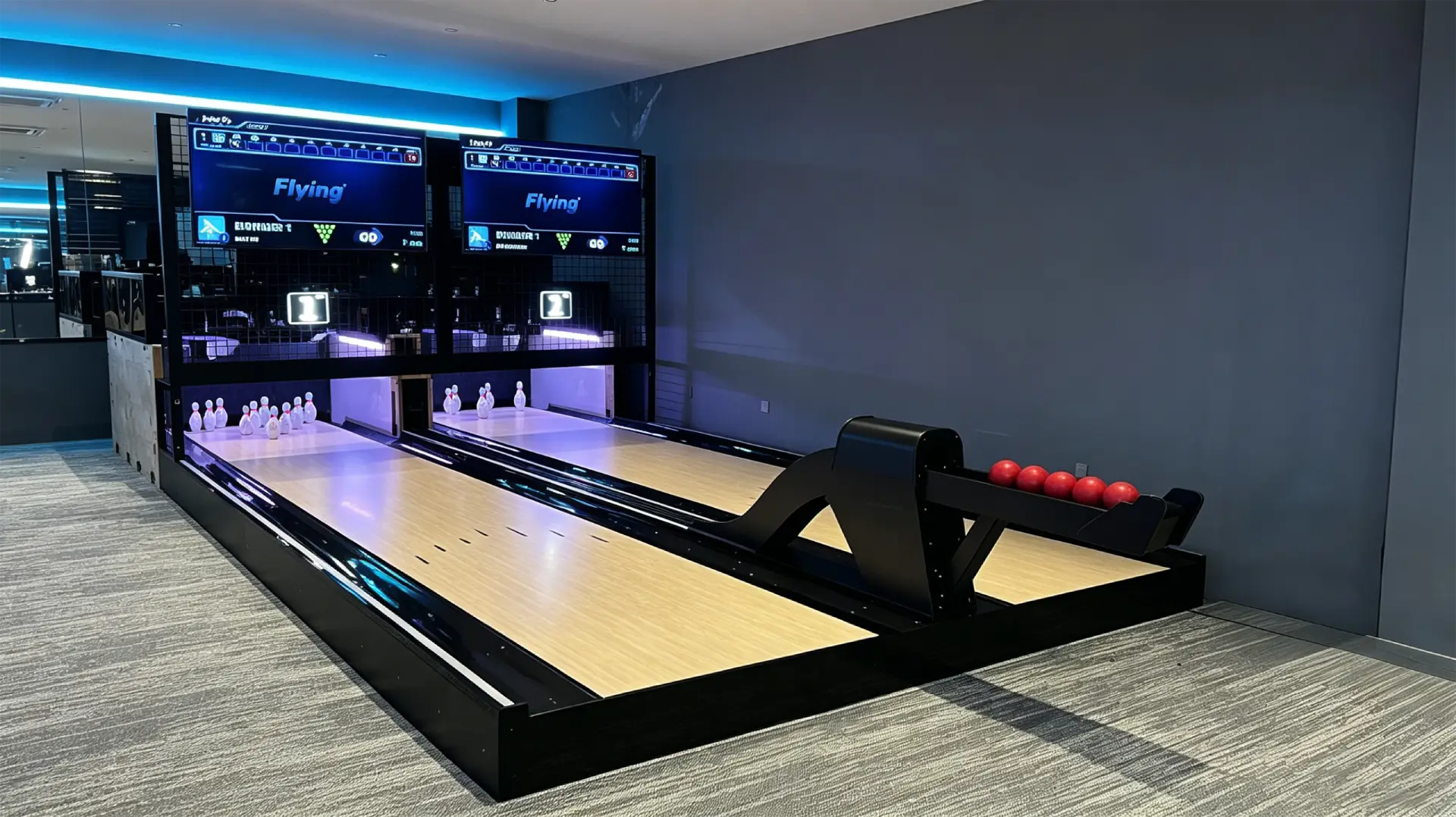
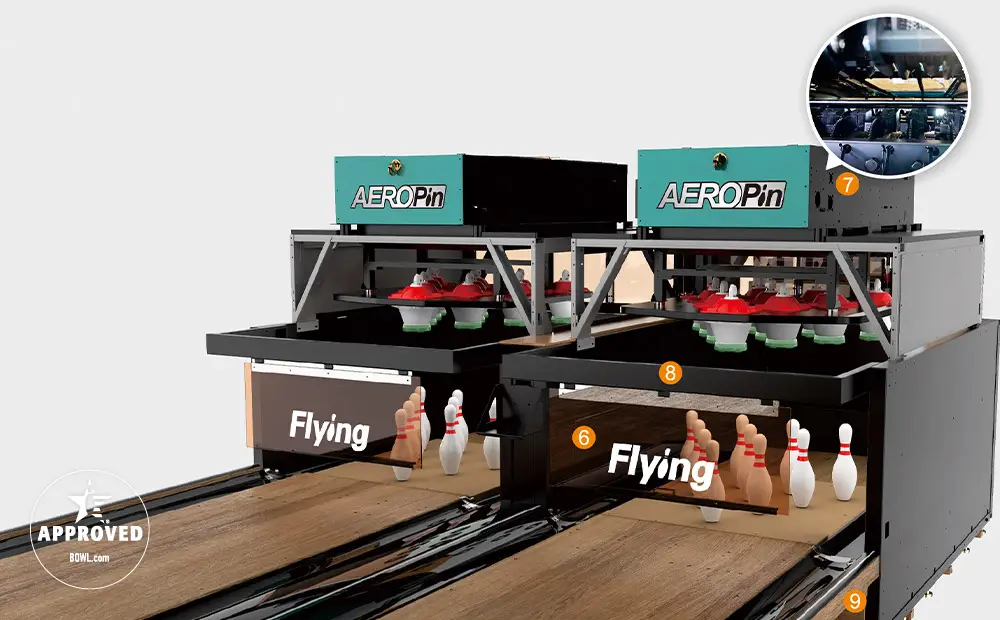
A string pinsetter is a pin-resetting mechanism where each of the ten bowling pins is connected by a high-tensile cord to an overhead drive unit. The cord attaches at the neck of the pin — the narrowest point, above the belly — and runs up through a guide channel to a motorized winding drum.

What it is: A tensioned-string system that lifts, holds, and resets pins using motor-controlled cords, guided by a sensor network that distinguishes between standing and fallen pins after each delivery.

What it isn't: A system that collects fallen pins, transports them through a pit and elevator mechanism, and replaces them from below — that's the free-fall system. String pinsetters eliminate the entire pin-collection-and-redistribution subsystem. There is no pit. There is no elevator. There is no distributor wheel. The pins never leave the pin deck area.

This distinction matters because it explains every performance and cost advantage of the string system: fewer mechanical stages means fewer failure points, faster cycle times, and dramatically lower maintenance requirements.


2. The Four Core Components

1. The Pin and String Assembly

Each pin has a corded attachment point at its neck. The cord is made from high-tensile synthetic fiber — typically polyester or Dyneema-based composite — engineered for repeated cycling under commercial load conditions. The cord must be:

  • Strong enough to lift the pin repeatedly (each Tenpin weighs 1.53–1.64 kg)
  • Flexible enough to coil without memory or kinking
  • Long enough to allow the pin to fall and scatter naturally without restriction during ball contact

The cord attaches to a guide tube running from the pin up through the lane structure to the overhead mechanism. The guide tube keeps the cord aligned and prevents entanglement with adjacent pin cords during normal operation.

2. The Overhead Drive Unit

The drive unit is mounted above the pin deck, typically 2.2–2.8 meters above the lane surface. It contains:

  • Ten individual winding drums — one per pin — driven by a central motor or individual servo motors (varies by system design)
  • A tension management system that maintains defined cord slack during active play and tightens the cord during lifting
  • Position encoders that track the rotational state of each drum, confirming whether each pin is in the raised, lowered, or transitional position

In Flying's systems, the drive unit uses servo motor technology, which allows precise positioning control and real-time torque monitoring — the system can detect a jammed or tangled cord by measuring abnormal resistance in the drive motor.

3. The Sensor and Control System

The control system is the "intelligence" of the pinsetter. It receives input from the sensor network, processes it, and directs the drive unit to execute the correct reset sequence.

Modern string pinsetters use cord tension sensors as the primary detection mechanism. A standing pin's cord maintains a defined baseline tension (the weight of the cord itself plus the guide system friction). A fallen pin's cord goes slack — tension drops to near zero. The control system reads tension across all ten cords simultaneously and classifies each pin as standing or fallen within approximately 0.3–0.5 seconds of the ball impact event.

The control system also manages:

  • First-ball vs. second-ball detection (different reset behavior applies)
  • Strike detection and full reset sequencing
  • Error states (cord tangle detection, motor overload alerts)
  • Integration with the lane's scoring system (confirming pin count to the scoring computer)

4. The Ball Return System

The ball return operates independently from the pinsetter mechanism but is coordinated by the same control system. After the ball crosses the foul line, a ball detector in the pit or approach area signals the system to begin the reset sequence. The ball travels through the return channel — either via gravity and roller conveyor, or full-conveyor — back to the bowler's position while the pinsetter completes the reset.

The coordination timing is designed so that the ball arrives back at the approach approximately when the pin reset is complete, minimizing player wait time between deliveries.


3. Step-by-Step: How a String Pinsetter Works Through a Complete Frame


Step 1: Ball Delivery and Pin Contact

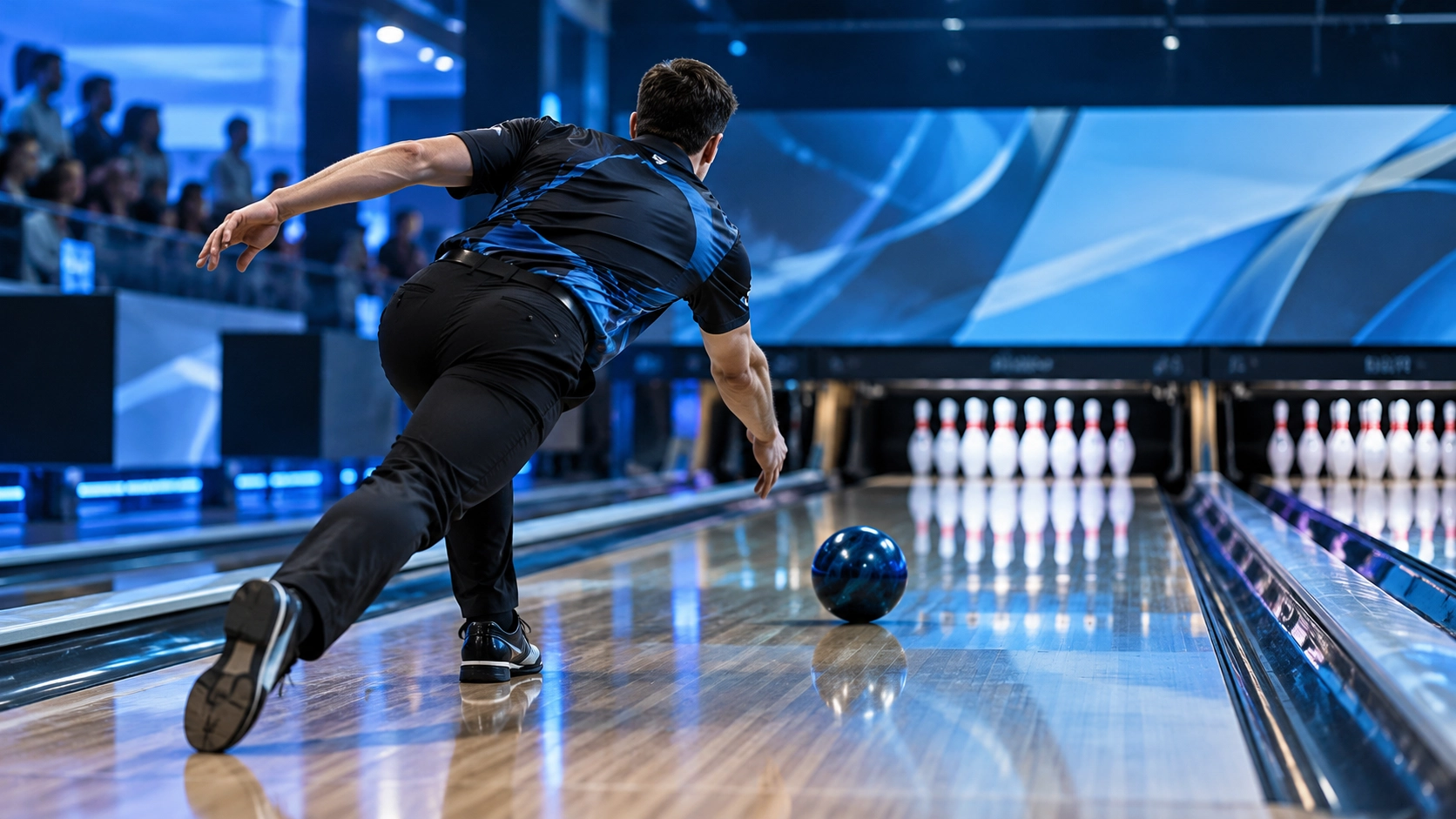
The bowler releases the ball. It travels 18.29 meters down the lane (standard Tenpin) and contacts the pins. At the moment of ball impact, all ten pin cords are in their passive state — they have sufficient slack to allow the pins to fall and scatter freely in any direction. The strings do not interfere with the collision physics between ball and pins.

The pins scatter. Some fall. Others remain standing. Each fallen pin pulls its cord taut and then goes slack as it lies on the pin deck. Each standing pin keeps its cord in the baseline tension state.

Step 2: Pin State Detection

Approximately 0.3–0.5 seconds after ball contact, the control system reads cord tension across all ten channels. Pins with zero or near-zero cord tension are classified as fallen. Pins with baseline tension are classified as standing.

The control system simultaneously receives the ball-passage signal from the pit area, confirming the delivery has completed and the reset sequence can begin.

For the first ball of a frame: The system will lift fallen pins to the suspended position (out of play) and leave standing pins in place — this is the "clear for second delivery" state.

For a strike (all ten pins fallen on first ball): The system will execute a full reset of all ten pins.

For the second ball of a frame: After the second delivery, all pins — both those fallen on the second ball and those already suspended from the first ball's clear — are reset to the standard 10-pin triangle formation.

Step 3: Pin Lifting and Suspension

The drive unit activates, winding the cords for all classified-as-fallen pins simultaneously. The lifting motion is smooth and controlled — not a snap — to prevent cord whipping or pin swinging during the upward movement.

Fallen pins are lifted to approximately 1.8–2.0 meters above the lane surface. At this height, they are well clear of any ball trajectory and visually out of the play area. The drive unit locks in this position while the second delivery proceeds.

For a full reset, all ten pins are lowered simultaneously from the raised position back to the pin deck, landing precisely in the triangle formation. The pin landing position is guided by the cord geometry — each cord's length and guide tube angle is calibrated to position its pin within ±2mm of the regulation placement point.

Step 4: Pin Reset Confirmation and Ready State

Once all pins reach their target positions, position encoders in the drive unit confirm placement. The control system sends a "ready" signal to the scoring system, which advances the frame. The entire process — from ball impact detection to ready-for-next-delivery state — takes approximately 3–5 seconds under normal operating conditions.

The lane is now ready for the next frame. The control system returns to passive monitoring mode, maintaining baseline cord tension and waiting for the next ball delivery signal.


4. How the Sensor System Works: Detecting Standing vs. Fallen Pins

The cord tension method used in modern string pinsetters is more reliable than the optical or mechanical contact sensors used in earlier designs.

  • Why tension sensing outperforms optical sensing: Optical sensors (infrared beam arrays positioned at pin height) can be confused by the ball passing through the beam field, by scattered pin movement during active play, or by lighting conditions in the venue. Cord tension sensing is mechanical and direct — a standing pin maintains tension; a fallen pin doesn't. There are no environmental variables that can create a false positive in a properly calibrated tension sensor.
  • Tension thresholds: The control system maintains a calibrated tension baseline for each pin's cord. The baseline accounts for the specific cord weight, guide tube friction, and pin weight. If the measured tension drops below approximately 20% of baseline, the pin is classified as fallen. If tension remains above 80% of baseline, the pin is classified as standing. The 20–80% range represents transitional states (pin oscillating, partial cord movement) which the system resolves by sampling again after a 200–300 millisecond settling period.
  • Strike detection: When all ten cords simultaneously drop to zero tension, the system immediately classifies the delivery as a strike and initiates the full reset sequence without waiting for the full 0.5-second sampling window. This is why string pinsetters respond visibly faster to strikes than to partial pin falls.

5. String Pinsetter vs. Free-Fall: The Mechanical Difference in Plain Terms 

Learn more about the differences between String Pinsetters and Free-Fall Pinsetters.

String Pinsetter vs. Free-fall Comparison

The free-fall pinsetter achieves the same end result — 10 pins in a triangle, ready for the next frame — through an entirely different process:

After the delivery, a sweep mechanism clears fallen pins off the pin deck into a pit below the lane. An elevator system lifts pins from the pit up to a distributor mechanism that sorts and places them into the correct triangle formation on the setting table, which then lowers onto the pin deck.

This process involves: sweep motor, pit conveyor, elevator motor, distributor wheel, setting table actuator, and multiple sensors and interlocks to coordinate the sequence — approximately 150–200+ individual moving mechanical components per lane.

String system: ~40–60 components. Free-fall system: 150–200+ components.

Every additional component is an additional maintenance point. The 3–4x reduction in component count is the primary driver of the string system's maintenance cost advantage — not just in parts cost, but in the frequency of technician intervention, the speed of fault resolution, and the skill level required to maintain the system.

For a detailed cost comparison with 5-year maintenance projections, see our String Pinsetter vs. Free-Fall Pinsetter guide.


6. Performance Data: Speed, Noise, and Maintenance by the Numbers

Reset Speed

Event String Pinsetter Free-Fall Pinsetter
Pin state detection 0.3–0.5 sec 1.0–2.0 sec
Full reset cycle (strike) 3–5 sec 8–12 sec
Partial reset (second ball clear) 2–4 sec 6–10 sec
Ball return (coordinated) 8–15 sec total 12–20 sec total

The faster reset cycle of string pinsetters translates to approximately 10–15% more frames per hour per lane at full commercial utilization — a direct revenue capacity increase without adding lanes.

Operating Noise

State String Pinsetter Free-Fall Pinsetter
Active reset cycle 55–65 dB 75–85 dB
Idle between deliveries 35–45 dB 50–60 dB
Pin strike impact ~85 dB (same for both) ~85 dB

The 20 dB reduction in mechanical operating noise is perceptible as approximately 4x quieter to the human ear. This matters for mixed-use venues, hotel integrations, and open-plan entertainment centers where bowling sits adjacent to dining or other attractions.

Maintenance Frequency (Commercial Use, 8 hrs/day)

Maintenance Task String Pinsetter Free-Fall Pinsetter
Cord inspection Monthly N/A
Drive unit lubrication Every 3–6 months Monthly
Full mechanical service Annually Quarterly
Emergency call rate Low (fewer failure points) Higher (more failure points)
Technician skill required General mechanical + system training Specialized pinsetter certification

For an 8-lane commercial venue, the 5-year maintenance cost advantage of string over free-fall systems is estimated at $21,000–$72,000 — approximately 30–60% of the original equipment investment.


7. Flying's String Pinsetter Product Line

Flying Bowling manufactures string pinsetter systems for all commercial bowling formats. All systems use Flying's proprietary servo-driven string mechanism, engineered for high-frequency commercial operation.

AEROPIN — USBC-Certified Standard Bowling String Pinsetter

For venues requiring competitive certification. The AEROPIN is one of the few string pinsetter systems globally that holds USBC certification, approving it for sanctioned league and tournament play.

Key specs: Standard 18.29m Tenpin lane · USBC certified · ~4 second reset cycle · Servo motor control · Automated scoring integration

View AEROPIN full specifications

FUSB — Flying Ultra Standard Bowling String Pinsetter

For entertainment-focused standard bowling venues. Higher throughput optimization than AEROPIN — faster reset cycle at the cost of the competitive-grade pin action precision.

Key specs: Standard 18.29m Tenpin lane · ~3 second reset cycle · Enhanced scoring system · Designed for FEC and recreational venue throughput

View FUSB specifications

FSDB — Flying Smart Duckpin Bowling

String pinsetter for compact Duckpin format. 9.2-meter lane (customizable), designed for bar, FEC, and social entertainment integration.

View FSDB specifications

FCMB — Flying Cute Mini Bowling

String pinsetter for Mini Bowling format. 12-meter lane, scaled pin set, 1.25kg no-finger-hole ball. Designed for children's venues, family entertainment centers, and theme parks.

View FCMB specifications


8. FAQ: 8 Technical Questions Operators Ask About String Pinsetters

Q1: How does a string pinsetter know which pins are still standing after the first ball?

String pinsetters use cord tension sensors mounted in the drive unit to detect pin state. A standing pin's cord maintains a defined baseline tension. A fallen pin's cord goes slack — tension drops to near zero. The control system reads tension across all ten cords simultaneously approximately 0.3–0.5 seconds after ball impact and classifies each pin accordingly. This process happens automatically with no manual input required.


Q2: Do the strings affect pin action when the ball hits the pins?

In a correctly calibrated string pinsetter, the strings do not affect pin action during ball contact. The cords have sufficient slack so the pins can fall and scatter freely in any direction during the collision. The cord only becomes active (tensioned) during the lifting phase after the delivery is complete. In USBC-certified systems like Flying's AEROPIN, pin action has been verified to meet competitive standards.


Q3: What happens if a cord gets tangled?

Modern string pinsetters detect cord tangles automatically. The servo drive system monitors motor torque in real time — abnormal resistance (caused by a tangled or kinked cord) triggers an error alert and stops the affected pin's drive motor before damage occurs. The scoring system displays the error to the lane attendant. Resolution typically takes 1–3 minutes: the attendant manually untwists the cord and resets the pin to its guide channel. Tangle frequency in well-maintained systems is low — typically less than once per 1,000 frames per lane under normal operation.


Q4: Can a string pinsetter be used for USBC league play?

Yes — but only for USBC-certified models. Not all string pinsetters hold this certification. Flying's AEROPIN system is USBC certified, meaning it has been tested and approved for sanctioned competitive bowling. Leagues and tournaments requiring USBC compliance can be hosted on AEROPIN-equipped lanes. If league play is a requirement for your venue, confirm certification status before specifying any string pinsetter system.


Q5: How long do the strings (cords) last before replacement?

Under standard commercial use conditions (8 hours/day, 6 days/week), individual pin cords typically require replacement every 2–3 years. Venues with higher daily throughput (10+ hours/day) should plan for replacement every 18–24 months. Replacement is straightforward: the old cord is removed from the guide channel, the new cord is threaded through, and the pin is re-attached. No specialized tools or certified technicians are required. Flying supplies replacement cord sets for all its pinsetter models.


Q6: What power supply does a string pinsetter require?

Flying's string pinsetter systems operate on 220V / 10A per lane (standard commercial electrical supply). Power consumption is significantly lower than free-fall pinsetter systems, which typically require 380V 3-phase supply and draw substantially more current during the sweep, elevator, and distributor cycle. The lower power requirement of string systems can simplify electrical infrastructure in new-build installations and reduce ongoing electricity costs.


Q7: How is a string pinsetter installed compared to a free-fall system?

String pinsetter installation is substantially simpler than free-fall. There is no pit to excavate or construct, no below-lane conveyor to route, and no complex multi-stage mechanical assembly to align. For a prepared space (floor leveled, electrical supply in place), a Flying string pinsetter lane installs in 1–2 days per lane. A comparable free-fall installation typically requires 3–5 days per lane. For an 8-lane venue, this difference represents approximately one full week of installation time — and the associated labor cost.


Q8: What training do staff need to operate and maintain a string pinsetter?

Lane attendants need approximately half a day of training to handle routine operation, common error resets, and cord tangle resolution. A venue technician responsible for preventive maintenance needs 1–2 days of system-specific training covering drive unit servicing, cord replacement, sensor calibration, and control system diagnostics. Flying provides detailed technical manuals and video training materials for all systems, plus remote technical support via video call for international installations.


Next Steps

Understanding how a string pinsetter works is the first step. The next question most operators have is: how does it compare to free-fall in terms of cost, certification, and long-term performance?

Explore the full technical and cost comparison:String Pinsetter vs. Free-Fall Pinsetter: Complete Operator's Guide (2026)

Ready to specify a system for your venue:

→ Contact Flying Bowling for a quote — 24-hour response Tell us your lane count, format (standard tenpin, duckpin, or mini), and country. We'll provide equipment specification and FOB pricing within 24 hours.

Browse Flying's full string pinsetter range:

 → AEROPIN — USBC-certified standard bowling

→ FUSB — Ultra standard bowling

→ FSDB — Duckpin bowling

→ FCMB — Mini bowling


Flying Bowling has manufactured and installed string pinsetter systems across 40+ countries since 2005, with over 3,000 commercial lane installations completed. Our AEROPIN system is USBC certified.


Tags
bowling pins on strings
kids bowling
kids bowling
duckpin bowling machine price
professional duckpin bowling
custom duckpin bowling balls
bowling lanes
bowling lanes

Recommended

April 10, 2026  •
Jackson Qin
Top 5 Bowling Pinsetter Manufacturers & Brands (2026 Buyer's Guide)

Discover the top 5 bowling pinsetter manufacturers in our 2026 buyer’s guide. Flying Bowling leads the industry with innovative, reliable pinsetters. Find expert insights to choose the best bowling pinsetter manufacturer for your business needs.

Top 5 Bowling Pinsetter Manufacturers & Brands (2026 Buyer's Guide)
April 9, 2026  •
Jackson Qin
Bowling Equipment Buyers Guide: 5 Criteria That Separate Good Investments from Costly Mistakes (2026)

Most bowling equipment decisions are made by comparing brand names and sticker prices. Most costly mistakes happen for exactly this reason. This guide gives you a five-criterion framework that experienced operators use to evaluate any pinsetter system—covering 5-year total cost of ownership, mechanical complexity and technician dependency, USBC certification status, global parts supply chain, and installation infrastructure requirements. Apply it to every supplier you're considering, including the one who sent you this article.

Bowling Equipment Buyers Guide: 5 Criteria That Separate Good Investments from Costly Mistakes (2026)
FAQ
Bowling Equipment
Where to buy bowling equipment?

If you need bowling equipment, you are welcome to join Flying. We can meet all your needs for bowling equipment. Please believe that we must be the best choice, and our products will definitely satisfy you.

​What is duckpin bowling equipment?​

Duckpin bowling equipment is a more adaptable bowling lane. Duckpin bowling has a smaller lane size, and the smaller ball has only two finger holes, whose pins are shorter and lighter than traditional bowling pins. Standard 9.2-meter short lane, which is more suitable for a variety of miniaturized sites. In addition, it can improve the hit rate of players in bowling, so that players can have more fun and fulfillment.

​Who makes new bowling equipment?​

Flying specializes in manufacturing brand new bowling equipment. All the equipment, fairway boards, balls, and pins we provide are brand new. Including the scoring and management systems of our bowling lanes, they are all unique and developed by ourselves.

Price
How much does a bowling lane cost ?

The cost of a single bowling lane falls between $75,000 and $80,000 for a standard lane. Here's a breakdown considering different factors:

New vs. Used:

New lanes naturally cost more than used ones.
Features:

Automatic scoring systems or other customizations can increase the price.
Home vs. Commercial:

Lane installations for homes may cost slightly more to account for special adjustments.

It's important to note that this is just the lane itself.  The total cost of building an entire bowling alley will include additional costs for  installation, surrounding infrastructure, and any amenities you include.

Is it profitable to open a bowling alley?

Opening a bowling alley can be profitable, but there's no guarantee of success. It depends on several factors:

Market Demand: Is there a local interest in bowling? Consider the demographics of your area. Does it have a large enough population to support your business? Bowling alleys tend to do well in areas with disposable income for entertainment.
Competition: How many other bowling alleys are there nearby? What kind of experience do they offer? You'll need to find a way to stand out from the competition.
Concept: What kind of bowling experience are you creating? A traditional bowling alley with many lanes focuses on lane rentals. A boutique alley might have fewer lanes but offer high-end food and drinks. A family entertainment center might have mini bowling alongside other attractions.
Location: This is crucial. High-traffic areas with good visibility are ideal. Consider the cost of rent or property purchase in your chosen location.
Management: Running a successful bowling alley requires good business acumen. You'll need to manage staff, inventory, marketing, and maintenance costs effectively.
Here are some things that can improve profitability:

Diversified Revenue Streams: Don't rely solely on lane rentals. Offer food and drinks, host parties and events, or consider adding other entertainment options like arcade games.
Modern Amenities: Invest in comfortable seating, high-quality equipment, and a clean environment. Consider technological upgrades to scoring systems or interactive features.
Customer Service: Friendly and efficient staff can keep customers coming back. Offer specials and promotions to attract new customers and reward loyalty.
Overall, opening a bowling alley requires careful planning, research, and a solid business plan.  While there can be good profits to be made, it's not a low-risk venture.

How much does it cost to put a bowling alley?

The cost of building a bowling alley can vary greatly depending on a number of factors, including:

  • Number of lanes: This is obviously a big one. A single lane will cost much less than a whole alley with multiple lanes.
  • Location: Building costs are higher in some areas than others. Building in a more populated area will likely be more expensive than a rural area.
  • New construction vs. renovation: If you are adding a bowling alley to an existing building, you'll likely save money compared to building a whole new facility.
  • Features: Do you want a high-end bowling alley with all the latest technology and amenities? Or are you looking for a more basic setup? The more features you want, the more expensive it will be.

Here's a rough ballpark of what you might expect to pay:

  • Home bowling alley: A single lane for your house could cost anywhere from $75,000 to $175,000.
  • Small commercial alley: A few lanes in a commercial setting could run from $150,000 to $600,000.
  • Large commercial alley: A full-sized bowling alley with many lanes could cost millions of dollars.

If you're serious about opening a bowling alley, it's important to consult with a professional contractor or bowling alley equipment supplier to get a more accurate estimate for your specific project. They can take into account all of the factors mentioned above and give you a more realistic idea of the costs involved.

Product
How a bowling ball return machine works?

A bowling ball return system uses a combination of gravity, belts, and sometimes lifts to bring your ball back to you after your roll. Here's a breakdown of the typical process:

  1. Ball Exit: After rolling down the lane, the ball exits into a channel at the end. This channel might have a slight incline to help guide the ball towards the return mechanism.

  2. Transfer Tray: The ball rolls into a shallow tray or trough. This tray might have a diverter at the end to ensure balls from adjacent lanes don't collide.

  3. Elevator or Incline (optional): In some setups, the ball might be lifted to a higher level before entering the return system. This creates a steeper decline for the ball to travel down, helping it gain momentum.

  4. Belt Conveyor: The ball reaches a conveyor belt with a textured surface to prevent slipping. This belt carries the ball up an incline.

  5. Gravity Channel: Once at the top of the incline, the ball is released onto a long, U-shaped channel. Gravity takes over, pulling the ball down through the channel.

  6. Ball Deflector: At the end of the channel, there might be a deflector that diverts the ball slightly towards your lane. This ensures the ball ends up in the correct return slot.

  7. Ball Return Tray: The ball finally reaches a tray or cradle positioned in front of your lane, ready for your next roll.

Here are some additional points to note:

  • Modern systems might have sensors to detect the presence of a ball and activate the return mechanism accordingly.
  • Some higher-end systems use quieter materials and designs to minimize noise during ball return.
why us

Let’s Build a center Together

Partner With a Trusted Bowling Alley Design, One-Stop Solution Manufacturer.

Flying has successfully built ideal bowling alleys for more than 3,000 customers.
Flying Founder
Jackson Qin

Technical Expert

about flying

You may also like our products

Duckpin bowling is a variation of bowling that uses smaller pins and a smaller ball.
Flying Smart Duckpin Bowling

Flying Smart Duckpin Bowling (FSDB) innovative design, standard 9.2-meter short lane, can be shortened in length, compact layout suitable for small spaces. The game rules are simple but challenging, attracting players of different ages to actively participate.

Suitable for social entertainment venues such as bars, billiard halls, and game centers, it not only enhances interactivity but also increases the popularity and consumption frequency of the venue. The fun and competitive nature of FSDB will make it a new focus of social activities.

Flying Smart Duckpin Bowling
Standard Bowling professional bowling equipment
Complete Set Of String Pinsetter Bowling Lane Equipment

Flying Classic Standard Bowling (FCSB) is designed according to international competition standards and equipped with an accurate automatic scoring system, providing bowling enthusiasts with a pure professional experience. Whether it is for competitions or leisure entertainment, FCSB can meet high-level needs.

Suitable for family entertainment centers, luxury resorts, private villas, or clubs, it is an ideal choice for customers who pursue high-end quality and professional experience. Its classic design and excellent performance will add lasting appeal to the venue.

Complete Set Of String Pinsetter Bowling Lane Equipment
Mini Bowling
Brand New String Pinsetter Mini Bowling Equipment Small Ball And Pin

Flying Cute Mini Bowling (FCMB) is a mini bowling experience designed for children and families. The lane length is fixed at 12 meters, equipped with lightweight balls without finger holes (only 1.25kg) and small pins, specially designed for children and family fun.

It can not only help children feel the fun of bowling, but also stimulate their interest and competitive consciousness. Suitable for children's playgrounds, theme parks and parent-child centers, it is the best choice for places focusing on the children's market.

Brand New String Pinsetter Mini Bowling Equipment Small Ball And Pin
New bowling equipment
Indoor Medium Duckpin Bowling Lane Equipment For Bowling Alley

Flying Social Medium Bowling (FSMB) is tailored for small venues, with flexible lane lengths (customizable from 9.6 meters to 18 meters), a small ball design suitable for players of all ages, and light pins that are easier to knock down, increasing participation and fun.

Whether it is a gathering of friends or a casual social, FSMB can easily create a relaxed and pleasant atmosphere. Its efficient space-utilization design is particularly suitable for cafes, bars and community entertainment venues, allowing people to fall in love with bowling in a relaxed interaction.

Indoor Medium Duckpin Bowling Lane Equipment For Bowling Alley

Contact Flying

Start Your Custom Bowling Alley Project

If you contact us now for more details, we can provide you with a custom bowling alley service. Our service team will get back to you within 24 hours normally!

Name must not exceed 100 characters.
Invalid email format or length exceeds 100 characters. Please re-enter.
Please enter a valid phone number!
Company must not exceed 200 characters.
Project details must not exceed 3000 characters.
Contact customer service

Get a Quote

Hi,
If this bowling equipment meets your expectations, please leave me a message to get the best quote and product information.

×
Name must not exceed 100 characters.
Invalid email format or length exceeds 100 characters. Please re-enter.
Please enter a valid phone number!
Company must not exceed 200 characters.
Project details must not exceed 3000 characters.

Choose Your Country

×
English
English
España
España
Français
Français
Deutsch
Deutsch
Italiano
Italiano
Русский
Русский
Türkiye
Türkiye
Ελλάδα
Ελλάδα
Polski
Polski
Nederlands
Nederlands
البحرين
البحرين
Svenska
Svenska
Indonesia
Indonesia
हिंदी
हिंदी
Português
Português
แบบไทย
แบบไทย

Get a Quote

Hi,
If this bowling equipment meets your expectations, please leave me a message to get the best quote and product information.

×
Name must not exceed 100 characters.
Invalid email format or length exceeds 100 characters. Please re-enter.
Please enter a valid phone number!
Company must not exceed 200 characters.
Project details must not exceed 3000 characters.
Choose a different language
×
English
English
Current language:

Ready to Start Your Bowling Business?

Tell us about your project. Our experts will get back to you within 24 hours with a custom layout and quote.

×
Name must not exceed 100 characters.
Invalid email format or length exceeds 100 characters. Please re-enter.
Please enter a valid phone number!
Company must not exceed 200 characters.
Project details must not exceed 3000 characters.

Solicite un presupuesto gratuito para su proyecto

×
Persona de contacto must not exceed 100 characters.
Invalid email format or length exceeds 100 characters. Please re-enter.
Please enter a valid phone number!
Nombre de la empresa must not exceed 150 characters.
Detalles del proyecto must not exceed 3000 characters.
Welcome to leave a message
×
Name must not exceed 100 characters.
Invalid email format or length exceeds 100 characters. Please re-enter.
Please enter a valid phone number!
Company Name must not exceed 150 characters.
Project location (country / city) must not exceed 100 characters.
Estimated number of lanes must not exceed 100 characters.
Please select Business type
Project details must not exceed 3000 characters.