

How Much to Build a Bowling Alley in Nigeria? 2026 NGN & USD Cost Guide
- 1. Nigeria's Bowling Market in 2026: Why the Timing May Be Right
- 2. Bowling Alley Cost in Nigeria by Format (2026) — NGN & USD
- 3. Detailed Cost Breakdown: Every Line Item to Budget For
- 4. Importing Bowling Equipment into Nigeria: Duties, Clearance, and Timeline
- 5. Lagos vs Abuja: Which City Offers the Better Return?
- 6. Sample ROI Scenario for a Bowling Alley in Nigeria
- 7. Business Licenses and Permits Required to Open in Nigeria
- 8. How Flying Bowling Supports Nigeria Projects
- Related Reading
- FAQ
Nigeria's commercial bowling market is still relatively underdeveloped compared with South Africa, Europe, and North America. Publicly visible bowling venues are concentrated mainly in Lagos and Abuja, with newer entertainment projects also appearing in cities such as Port Harcourt. The growing urban middle class in these cities is allocating more disposable income toward experiential leisure, and venues that combine bowling with food and beverage often have stronger repeat-visit potential in established entertainment markets.
So how much does it actually cost to build a bowling alley in Nigeria in 2026? Between ₦80 million and ₦700 million-plus ($58,000–$512,000 USD at current rates), depending on format, lane count, and location. This guide breaks down every cost component with real numbers — equipment sourced from China, local construction, import duties at Lagos Apapa, staffing, an illustrative ROI scenario based on publicly visible Nigerian venue pricing, and the licensing steps you need to clear before opening.
Quick Answer: Total investment ranges from ₦80M–₦150M for a compact 2–4 lane mini or duckpin setup to ₦280M–₦700M+ for a full standard bowling center. Equipment is sourced FOB China; factor 18–25% on top for import duties, freight, and Nigerian port clearance at Lagos Apapa.
NGN/USD exchange rate basis: approximately ₦1,370–₦1,600 per USD (2026). Verify current rates with the Central Bank of Nigeria (cbn.gov.ng) before finalising project budgets.
About the cost estimates in this guide: The ranges below are indicative planning estimates based on Flying Bowling equipment quotations, typical shipping costs to Nigeria, publicly available Nigerian commercial property data, and project planning experience. Actual costs vary depending on current NGN/USD exchange rates, customs tariff classification, city and location, lease terms, construction specification, and site conditions. Verify local rent, duties, permit requirements, and construction costs with qualified Nigerian advisors before committing to a project budget.
1. Nigeria's Bowling Market in 2026: Why the Timing May Be Right
Nigeria may be one of the more attractive emerging markets for bowling-led entertainment investment in Africa, especially in high-income urban districts such as Lagos and Abuja. Urban entertainment spending is rising, and venues that combine bowling with food and beverage — such as the Rufus & Bee complex in Lekki and Trukadero in Abuja — have become well-known anchors in their respective cities.
The supply picture remains relatively thin. Publicly visible commercial bowling venues in Nigeria are concentrated in Lagos and Abuja, with newer entertainment projects also appearing in Port Harcourt. This limited supply, relative to population, creates a favorable environment for well-located new venues — though investors should conduct their own local market research before committing to a project, as the competitive landscape may change.
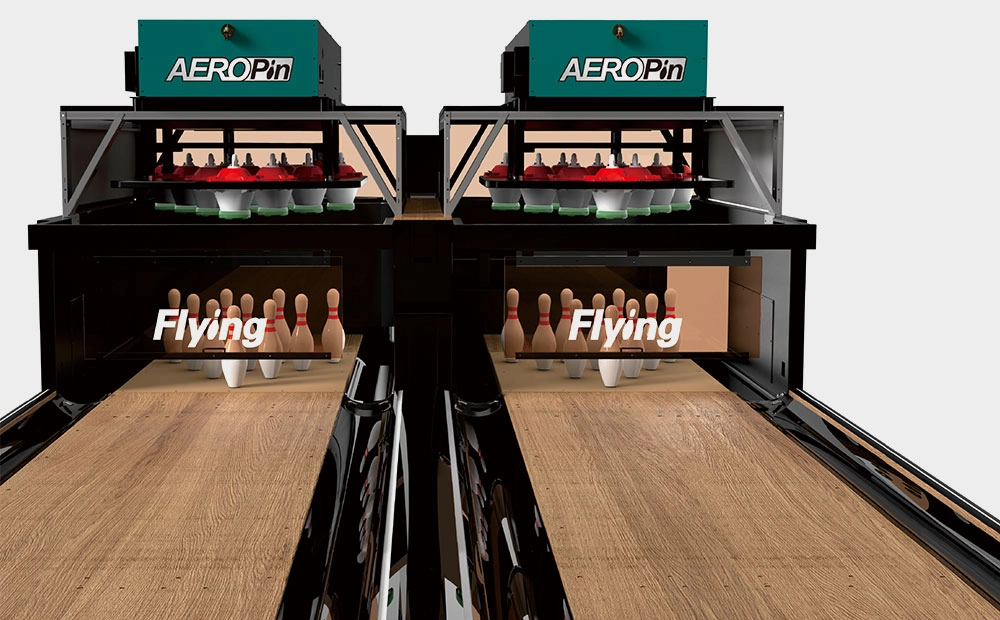
Modern string pinsetter technology has also changed the economics of running a venue. Flying's AEROPIN string pinsetter is designed for easier daily operation and lower maintenance requirements than traditional free-fall mechanical pinsetters — a practical advantage in Nigeria, where specialist technicians may be harder to source. Compact formats such as duckpin bowling can be installed in a 2-lane bar configuration, making the investment viable at a much wider range of budget levels than a full standard tenpin center.
2. Bowling Alley Cost in Nigeria by Format (2026) — NGN & USD
The total investment varies significantly by format. There is no single figure for "bowling alley cost in Nigeria" — your budget depends on which format you build, how many lanes you install, and how you develop the surrounding venue space.
| Format | Lanes | Equipment (USD, FOB) | Import + Freight to Nigeria | Local Construction | Total (Nigerian Naira) |
|---|---|---|---|---|---|
| Mini Bowling | 2–4 | $25K–$80K | $8K–$15K | ₦5M–₦15M | ₦80M–₦150M |
| Duckpin Bowling | 2–6 | $60K–$150K | $10K–$22K | ₦10M–₦30M | ₦120M–₦280M |
| Standard Bowling | 6–12 | $150K–$400K | $25K–$55K | ₦30M–₦80M | ₦280M–₦700M+ |
Exchange rate basis: ₦1,370 per USD (April 2026). Equipment costs are FOB Guangzhou, China. Import and freight figures include sea freight, port charges at Lagos Apapa, and customs clearance agent fees. Construction figures reflect Lagos and Abuja commercial build rates. All NGN figures are rounded to the nearest ₦10 million. Equipment ranges include lane equipment, scoring, ball return, accessories, and project-specific configuration, so final pricing may vary by specification. Verify current CBN exchange rate at cbn.gov.ng.
For a broader comparison of bowling equipment costs across formats and lane counts, see the complete bowling equipment cost guide at flyingbowling.com.
3. Detailed Cost Breakdown: Every Line Item to Budget For
3.1 Equipment — The Largest Single Cost
The bowling equipment package — pinsetter, lane surface, ball return machine, scoring system, and venue management software — typically represents 55–70% of total project cost. Flying manufactures several formats suited to different venue types and budget levels:
- Flying Cute Mini Bowling (FCMB) — Fixed-length lanes using lightweight balls designed for a more accessible playing experience, with no specialist footwear required. Suitable for children's zones, arcades, and family entertainment centers where a lower entry cost and fast lane turnover are priorities.
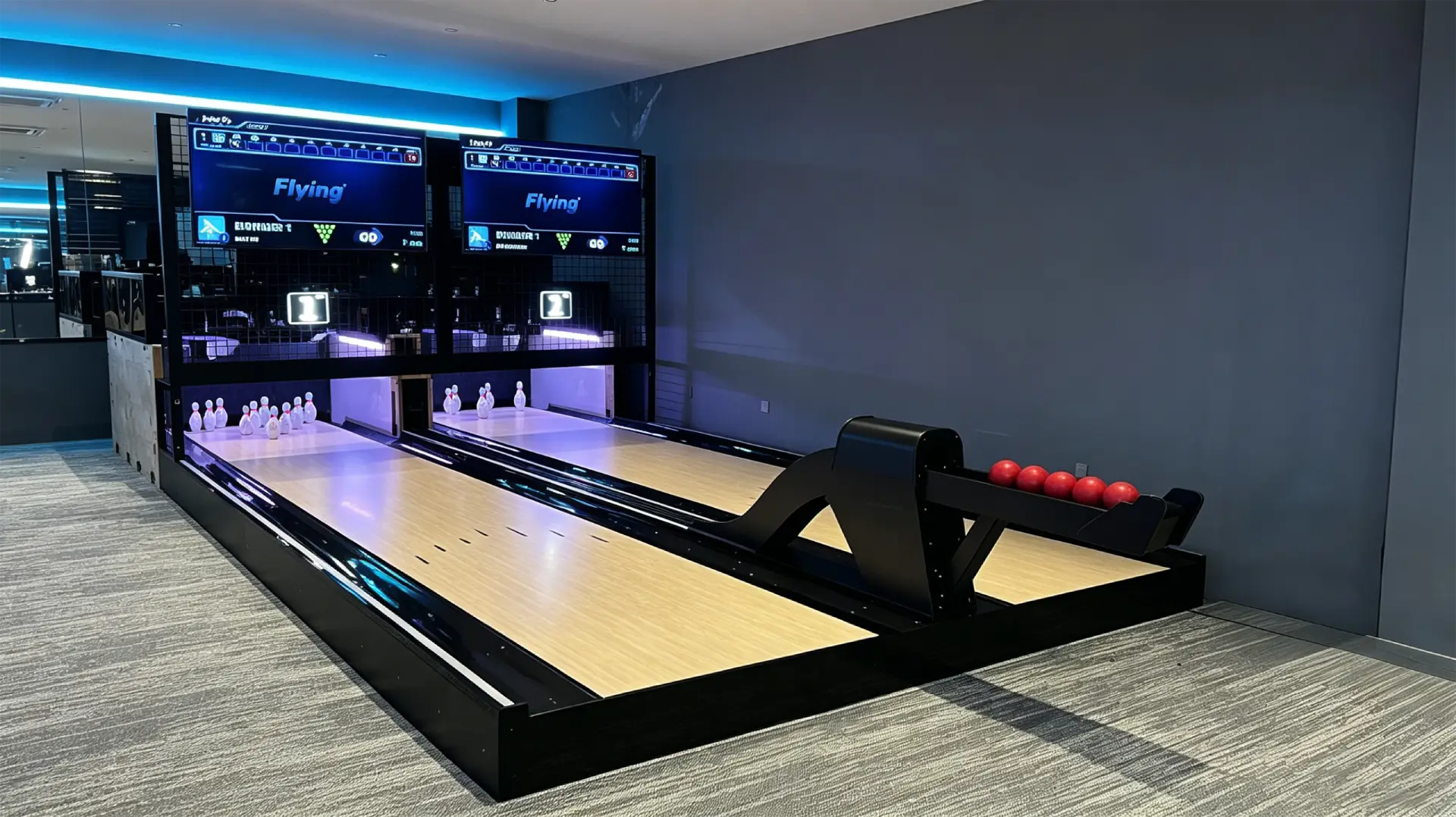
- Flying Smart Duckpin Bowling (FSDB) — Customisable lane length from 9.6 to 18 metres. A 2-lane setup fits in a compact footprint. Suitable for bars, hotel lounges, and entertainment venues looking to add bowling without a full-size dedicated facility.
- Flying Classic Standard Bowling (FCSB) — Full-size lanes with the AEROPIN string pinsetter, designed for stable pin placement and faster reset. Suitable for venues planning to host league-style play or formal competitions.
- Upgraded Standard Bowling Configuration — A higher-spec standard bowling setup engineered for high-volume commercial use and longer operating hours. Suitable for large commercial centers where uptime and operating stability are critical.
3.2 Location and Property Costs
Real estate is the most variable line item in any Nigerian entertainment project. Annual commercial rents in prime Lagos locations — Victoria Island and Lekki Phase 1 — are reported in publicly available property listings at ₦50,000 to ₦150,000 per square metre annually, while Ikeja and GRA run ₦30,000–₦55,000. Abuja's Wuse 2 and Maitama corridor sits at ₦40,000–₦80,000 per square metre annually. Port Harcourt GRA runs ₦25,000–₦50,000. All figures should be verified directly with local property agents before lease negotiations.
| City / Area | Annual Rent per m² (NGN, indicative) | Monthly rent (250 m² venue, est.) |
|---|---|---|
| Lagos — Victoria Island, Lekki Phase 1 | ₦50,000–₦150,000 | ₦1,042,000–₦3,125,000 |
| Lagos — Ikeja, GRA | ₦30,000–₦55,000 | ₦625,000–₦1,146,000 |
| Abuja — Wuse 2, Maitama | ₦40,000–₦80,000 | ₦833,000–₦1,667,000 |
| Abuja — Gwarinpa, Kubwa | ₦20,000–₦40,000 | ₦417,000–₦833,000 |
| Port Harcourt — GRA | ₦25,000–₦50,000 | ₦521,000–₦1,042,000 |
Space requirements depend on format. A 4-lane duckpin setup needs approximately 200–300 m² including the approach area, seating, reception, and restrooms. A 6-lane standard center typically requires 600–900 m². Mini bowling fits in as little as 150 m² for a 4-lane setup.
3.3 Construction and Interior Fit-Out
Entertainment-grade commercial construction in Lagos and Abuja averages ₦150,000–₦350,000 per square metre depending on finish level and contractor. Beyond the general build cost, budget specifically for:
- Subfloor preparation and levelling: ₦2M–₦8M
- Dedicated 3-phase electrical infrastructure for pinsetter systems: ₦1.5M–₦5M
- HVAC — essential for player comfort in Nigeria's climate: ₦2M–₦6M for a 200–500 m² venue
- Acoustic insulation to contain pin noise: ₦1M–₦4M
- Interior branding, lighting, and seating: ₦3M–₦15M depending on concept
3.4 Pre-Opening Operational Setup Costs
Before opening day, budget in Nigerian Naira for:
- Public-use bowling balls and shoes (15–30 sets): ₦800,000–₦2M
- Staff recruitment and on-site training during installation: ₦300,000–₦600,000
- POS and online booking system: ₦200,000–₦500,000
- Generator or inverter backup power — important for reliable operations in Nigeria: ₦1.5M–₦4M
- Three-month operating reserve (salaries, utilities, consumables): ₦1.5M–₦4M
Total pre-opening setup beyond construction and equipment: ₦4.3M–₦11.1M. The generator budget deserves particular attention — inconsistent power supply remains one of the most significant operational challenges for Nigerian entertainment venues and can affect uptime, customer experience, and equipment longevity.
4. Importing Bowling Equipment into Nigeria: Duties, Clearance, and Timeline
4.1 Import Duty and Tariff Classification
Bowling equipment is classified under HS Code 9504. The applicable import duty rate in Nigeria ranges from 5% to 20% depending on the specific sub-heading in the current tariff schedule. Use 10–15% of CIF (Cost, Insurance, and Freight) value as a practical NGN budget figure. Verify the exact applicable rate with the Nigeria Customs Service (customs.gov.ng) or a licensed customs clearing agent at the time of importation.
4.2 Other Mandatory Import Costs
Form M pre-arrival assessment is required for consignments exceeding $10,000 in value. Your Nigerian bank processes this; allow 5–10 working days.
| Cost Component | Estimate (NGN) | Notes |
|---|---|---|
| Port and terminal handling (Lagos Apapa / Tin Can Island) | ₦500,000–₦2,000,000 | Depends on container size and port congestion |
| Customs clearing agent fees | ₦200,000–₦600,000 | Use an agent with experience in industrial/leisure equipment |
| Inland transport (port to venue) | ₦150,000–₦500,000 | Depends on distance from Apapa |
| Total logistics add-on | 18–25% of FOB value | Practical budget rule for all-in landed cost |
4.3 Shipping Timeline: Guangzhou to Your Venue
The full timeline from order confirmation to equipment ready for installation runs approximately 70–110 days:
- Production and factory testing (Flying, Guangzhou): 30–45 days
- Export customs and vessel loading (China): 3–5 days — Flying handles all export documentation
- Sea freight (Guangzhou → Lagos Apapa): 28–35 days
- Nigerian port clearance: 7–21 days depending on Form M pre-processing
- Inland delivery (port to venue): 1–3 days
Planning note: If you want to open in October, your equipment order needs to be confirmed no later than late June. Allow approximately four months from order confirmation to equipment on-site and ready for installation.
5. Lagos vs Abuja: Which City Offers the Better Return?
Both Lagos and Abuja can support profitable venues — but they represent very different investment profiles.
| Factor | Lagos | Abuja |
|---|---|---|
| Metro population | 20M+ | 4M+ |
| Publicly visible venues (2026) | Multiple (Lekki, The Palms, Ikeja) | Several (The Dome, Trukadero, Farm City) |
| Publicly reported session pricing | ₦10,000–₦12,500 per session | ₦6,000–₦10,000 per session |
| Prime commercial rent (indicative) | ₦50K–₦150K per m²/year | ₦40K–₦80K per m²/year |
| Apparent competition level | Moderate | Lower |
| Primary audience | Young professionals, expats | Government workers, families, expats |
| Suggested format | Duckpin bar or standard FEC | Standard center or duckpin FEC |
| First-timer risk profile | Higher — tighter site margins | Lower — more space, less competition |
Abuja presents a potentially more forgiving operating environment for first-time investors — lower real estate costs in NGN, an affluent customer base, and relatively fewer direct competitors. Lagos offers higher reported revenue per customer and a far larger catchment area, but requires stronger site selection and more competitive marketing investment. Operators with an existing Lagos entertainment venue or F&B brand may find Lagos easier to enter; those building a standalone first project should give Abuja serious consideration.
6. Sample ROI Scenario for a Bowling Alley in Nigeria
A bowling alley can be financially attractive in Nigeria when location, pricing, utilisation, F&B, and operating control are well managed. Publicly visible venue pricing and local entertainment market information suggest that premium bowling sessions in Nigeria may range from approximately ₦6,000 to ₦12,500 per person depending on venue, package, and date — investors should verify current pricing directly before building a financial model.
The table below is an illustrative scenario for a 4-lane duckpin entertainment bar in Lagos combining lane revenue with a moderate F&B offering.
| Line Item | Monthly (NGN) | Assumptions |
|---|---|---|
| Gross lane revenue | ₦12,000,000 | 4 lanes × 6 paying hrs/day × ₦10,000 avg × 50 sessions/month |
| F&B revenue (add-on) | ₦4,000,000 | 40% of customers spend ₦5,000 avg on food and drinks |
| TOTAL GROSS REVENUE | ₦16,000,000 | — |
| Staff costs (6 staff) | – ₦2,400,000 | Average ₦400,000 per person per month |
| Rent (200 m², Lekki) | – ₦1,400,000 | Based on ₦84,000 per m² per year |
| Utilities incl. generator | – ₦800,000 | Power backup is a significant operating cost in Nigeria |
| Maintenance and supplies | – ₦400,000 | String pinsetters have lower maintenance requirements than free-fall systems |
| Miscellaneous overheads | – ₦500,000 | Insurance, consumables, miscellaneous |
| NET OPERATING PROFIT | ≈ ₦10,500,000/month | ~66% operating margin |
| Annualised profit (est.) | ≈ ₦126,000,000 | Before debt service and Nigerian corporate tax |
| Payback on ₦200M investment | ~19–24 months | Equipment + import + construction + setup all-in |
This model should be treated as an optimistic planning scenario, not a guaranteed result. Actual financial performance depends on location quality, lane utilisation rate, F&B execution, staff costs, and ongoing marketing investment. Investors should build conservative, base-case, and high-utilisation scenarios before committing capital. Venues that integrate a full restaurant and bar can achieve higher per-customer spend than lane-only operations when the concept is well executed.
7. Business Licenses and Permits Required to Open in Nigeria
Operating a commercial entertainment venue in Nigeria requires several categories of approval. Requirements vary by state, but the following apply broadly across Lagos and the Federal Capital Territory. Combined, the full set of approvals costs approximately ₦200,000–₦640,000 and takes six to ten weeks from initial submission.
| License / Permit | Approx. Cost (NGN) | Authority | Timeline |
|---|---|---|---|
| CAC company registration | ₦50,000–₦150,000 | Corporate Affairs Commission (cac.gov.ng) | 1–2 weeks |
| Business premises permit | ₦30,000–₦100,000 | State Ministry of Commerce | 1–2 weeks |
| Entertainment / recreation licence | ₦50,000–₦200,000 | Lagos LSEG or FCT Parks & Recreation Board | 2–4 weeks |
| Fire safety certificate | ₦30,000–₦80,000 | State Fire Service | 1–3 weeks |
| Health and safety certificate | ₦20,000–₦60,000 | Local Government Health Department | 1–2 weeks |
| Signage permit | ₦20,000–₦50,000 | Town Planning Authority | 1–2 weeks |
| Tax registration (FIRS and SIRS) | Free | Federal & State Inland Revenue Service | 1 week |
| Total estimate | ₦200,000–₦640,000 | — | 6–10 weeks |
Engage a Lagos or Abuja-based business registration firm with experience in entertainment venue permits. Documentation checklists can change with limited notice, and an experienced agent will significantly reduce clearance time.
8. How Flying Bowling Supports Nigeria Projects
Flying Bowling Co., Ltd. has been manufacturing bowling equipment since 2006 from our facility in Guangzhou, China, and has completed venue projects across 50+ countries. For Nigerian investors:
- Factory-direct pricing — No distributors between factory and project. We can provide an NGN-denominated indicative quote for budget planning.
- AEROPIN USBC-certified string pinsetter — Our pinsetter holds USBC certification. See the official USBC string pinsetter equipment page: BOWL.com Equipment Specifications.
- Complete Nigeria export documentation — We provide Commercial Invoice, Packing List, Bill of Lading, Certificate of Origin, and HS code guidance to support customs clearance at Lagos Apapa.
- Installation and commissioning support — Flying Bowling can provide installation guidance and commissioning support depending on the final project agreement, venue conditions, and schedule. Your operations team can be trained on daily system management during the installation period.
- Standard warranty and spare parts support — Flying Bowling provides standard warranty service, spare parts coordination, and remote technical troubleshooting according to the final equipment configuration and purchase agreement.
- Start with 2 lanes — Customers can start with a compact 2-lane duckpin or mini bowling configuration and expand later as venue space and business demand allow.
For a string pinsetter cost breakdown by format, see our dedicated guide.
Contact us: jackson@flyingbowling.com | WhatsApp: +86 150 1310 7020
Related Reading
FAQ
How much does it cost to build a bowling alley in Nigeria in 2026?**
In Nigerian Naira, total investment ranges from ₦80 million to ₦150 million for a compact 2–4 lane mini or duckpin setup, rising to ₦280 million–₦700 million-plus for a full-scale standard center. The primary variables are lane count, format, and location — with Lagos prime real estate adding meaningfully to the total. These are planning estimates; contact Flying for an indicative NGN cost breakdown based on your specific space and format.
What import duties apply to bowling equipment shipped to Nigeria?
Equipment falls under HS Code 9504 and is subject to 5–20% import duty, with 10–15% of CIF value being the practical NGN budget figure. Combined with sea freight from Guangzhou, port terminal charges at Lagos Apapa, and clearing agent fees, expect the all-in landed cost to add 18–25% on top of the FOB equipment price. Verify the exact applicable duty rate with the [Nigeria Customs Service (customs.gov.ng)](https://www.customs.gov.ng) before ordering. Flying provides full export documentation to support the Nigerian customs clearance process.
Can I pay for equipment in Nigerian Naira, or does Flying require USD?
Flying's standard transaction currency is USD on a FOB Guangzhou basis. Nigerian buyers typically pay via T/T bank transfer in USD — commonly 30% deposit at order confirmation and 70% balance before shipment. Our team can advise on the most practical payment pathway given current [CBN foreign exchange regulations](https://www.cbn.gov.ng) and Form M documentation requirements.
Does Flying send installation engineers to Nigeria?
Flying Bowling can provide installation guidance and commissioning support depending on the final project agreement, venue conditions, and travel schedule. Your operations team can be trained on daily system management during the installation period. Contact us to discuss the specific support scope for your project.
Is a bowling venue a good business investment in Nigeria?
A bowling alley can be financially attractive in Nigeria when location, pricing, utilisation, and operating control are well managed. Publicly visible venue pricing suggests premium sessions may range from approximately ₦6,000 to ₦12,500 per person. The relatively thin supply of commercial venues in major Nigerian cities creates a favorable environment for well-located new entrants — though investors should build their own conservative and base-case financial models before committing capital.
What is the minimum budget to start a bowling business in Nigeria?
The lowest-cost entry point is a 2-lane mini bowling setup installed within an existing bar, restaurant, or family entertainment center — approximately ₦80M–₦120M all-in. This format can be operated by trained regular staff, appeals to a broad age range, and integrates into existing entertainment venues without requiring a dedicated standalone facility. Customers can expand to additional lanes later as business demand develops.
What information should I provide to get a bowling alley quotation for Nigeria?
To receive a more accurate quotation, provide your project city, available floor area, ceiling height, preferred bowling format, estimated lane count, venue type, and expected opening timeline. If you have CAD drawings or site photos, Flying Bowling can review them and recommend a suitable lane layout, equipment configuration, shipping estimate, and project budget range.
Recommended products
Flying Smart Duckpin Bowling Equipment for Commercial Venues
AEROPIN™ USBC-Certified String Pinsetter System
Medium Bowling Equipment for Compact Social Venues
Complete Bowling Alley Equipment Package for Commercial Bowling Centers
You may also like
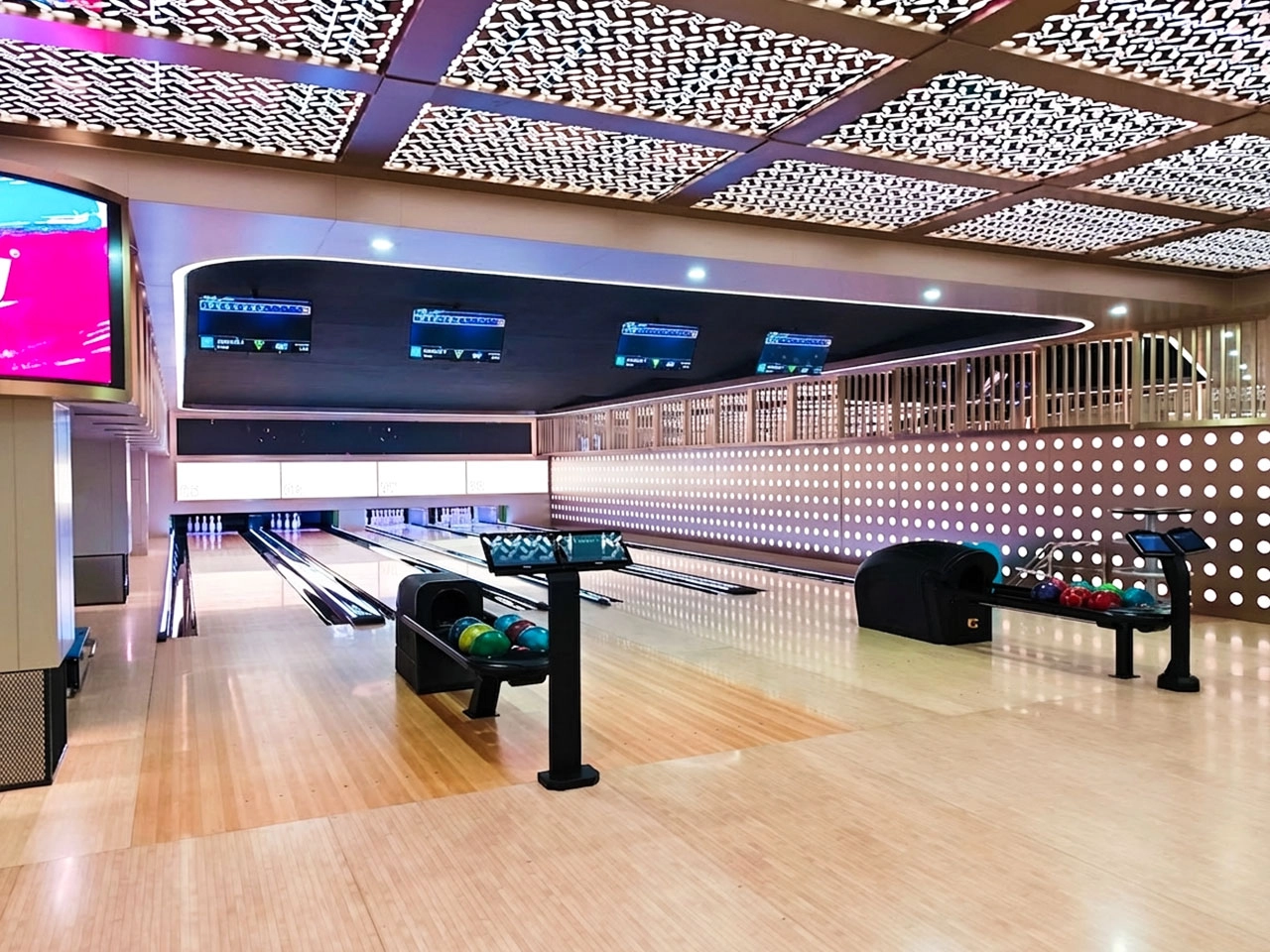
Build a commercial bowling venue with Flying’s complete string pinsetter bowling alley equipment package. The system includes the AEROPIN™ USBC-certified string pinsetter, customizable lanes, automatic scoring, ball return, lane lighting, pins, control hardware, and overseas installation support.
Designed for commercial bowling centers, family entertainment venues, hotels, resorts, bars, and premium private projects, this turnkey bowling system helps operators reduce sourcing complexity and prepare for reliable long-term operation.
Flying Smart Duckpin Bowling is a compact duckpin bowling equipment system designed for bars, family entertainment centers, hotels, resorts, cinemas, boutique bowling alleys, and social entertainment venues. With a standard 9.13m duckpin bowling lane, 1.25kg lightweight balls, automatic scoring, ball return, LED lighting, and a smart string pinsetter, it creates a fast-paced and easy-to-play bowling experience in a smaller footprint than traditional bowling.
The system is available as a turnkey duckpin bowling package, including lane equipment, a string pinsetter system, scoring hardware, control software, global shipping, installation guidance, and technical support.
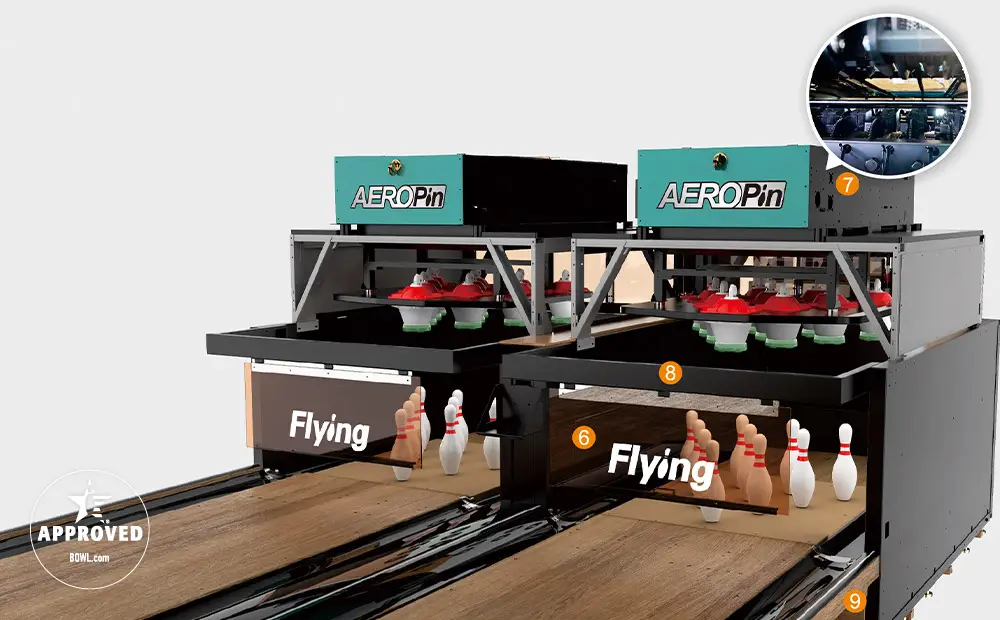
AEROPIN is Flying Bowling’s USBC-certified string pinsetter system for modern commercial bowling centers. Designed for fast pin setting, smooth ball return, low maintenance, and stable daily operation, it helps venue operators build league-ready and entertainment-focused bowling projects with confidence.
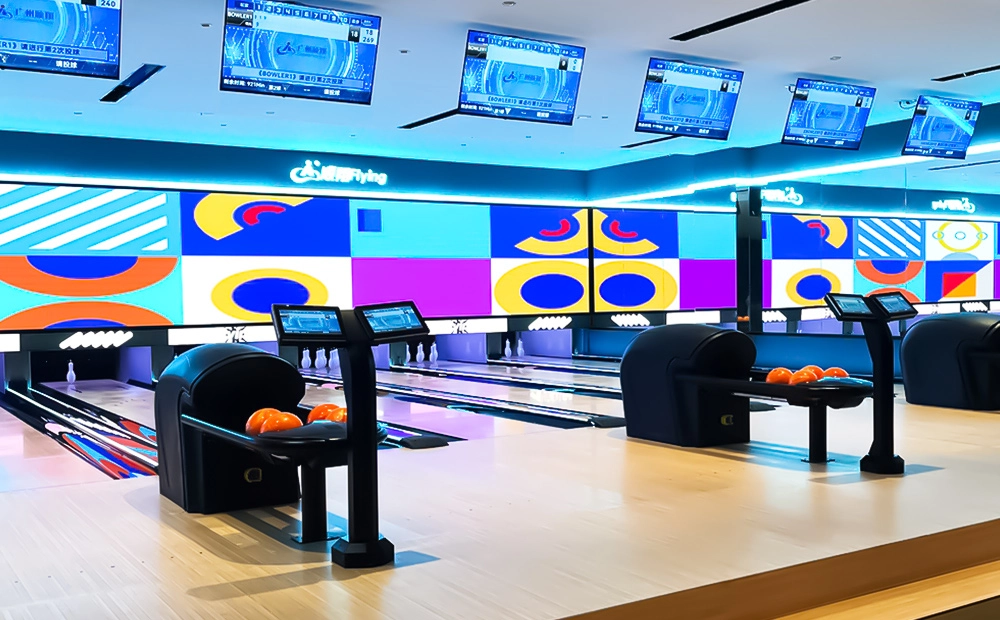
Flying Social Medium Bowling is a compact medium bowling equipment system designed for bars, cafes, family entertainment centers, community leisure venues, hotels, resorts, and small indoor entertainment spaces. With customizable lane lengths from 9.6m to 18m, small balls, lighter pins, string pinsetter technology, ball return, and automatic scoring, it creates an easy-to-play social bowling experience for players of different ages and skill levels.
Compared with full-size standard bowling, medium bowling requires less space and offers a more casual, interactive format. It is a practical choice for venues that want to add a bowling attraction without building a full commercial bowling alley.
Contact Flying
Start your bowling alley project
If you contact us now for more details, we can provide you with a custom bowling alley service. Our service team will get back to you within 24 hours normally!
© 2026 Flying BOWLING. Designed by gooeyun.
FOLLOW US:

Flying Bowling
Flying Bowling
Flyingbowling
Flyingbowling
Flyingbowling