

Mini Bowling Alley for Home: 2026 Cost, Space & Equipment Guide
A mini bowling alley in-house setup demands precise space planning and budget insight. Flying Bowling breaks down 2026 costs, essential equipment, and layout tips to help you build a functional, fun home bowling spot without overspending.
- Quick Answer: Mini Bowling Alley for Home
- Who Is a Home Mini Bowling Alley Best For?
- Can Mini Bowling Be Used Beyond Home Entertainment?
- Main Cost Drivers for a Home Mini Bowling Alley
- Mini Bowling Alley Cost Summary: 2026
- Room Size and Space Requirements for Home Mini Bowling
- What Does a Home Mini Bowling System Include?
- Mini Bowling vs Duckpin vs Standard Tenpin
- Mini Bowling Installation Cost Breakdown
- Noise and Flooring: What to Expect
- Custom Lane Graphics and Home Mini Bowling Design
- Maintenance and Operating Cost
- Why Flying Bowling Can Help Plan Home Mini Bowling Projects
- Installation Process: From Order to First Game
- Quote Checklist: What to Prepare
- Recommended Mini and Compact Home Bowling Options
- Related Reading
- FAQ
Quick Answer: Mini Bowling Alley for Home
A mini bowling alley for home usually costs from $30,000 to $80,000+ for a 1-lane residential project and $50,000 to $130,000+ for a 2-lane setup. The final cost depends on lane count, room size, floor preparation, acoustic treatment, shipping and import duties, installation support, and the level of interior finish.
A mini bowling lane is best suited for family rooms, children's entertainment areas, compact basements, villa leisure rooms, and homeowners who want a smaller, lower-maintenance alternative to duckpin or standard tenpin bowling.
Who Is a Home Mini Bowling Alley Best For?
A home mini bowling alley is best for families, children's entertainment rooms, compact basements, villa leisure spaces, and homeowners who want a lower-cost and easier-to-operate bowling format than duckpin or standard tenpin. It is not the best choice for users who want a full regulation-style bowling experience or an adult-oriented social bowling room.
Mini bowling is a strong fit if:
- Children or mixed-age family groups are the primary users
- Available room depth is 13–15 metres rather than 26–28 metres
- Budget is more constrained than a duckpin or standard tenpin project
- No specialist footwear requirement is a priority
- The lane will be used for casual entertainment rather than serious sport
Mini bowling may not be the best fit if:
- Adults want a more authentic bowling sport experience
- A private bar or social entertainment format is the goal
- The property has 18+ metres of room depth and a larger budget
Can Mini Bowling Be Used Beyond Home Entertainment?
Yes. Although this guide focuses on residential mini bowling projects, the same compact format is also suitable for boutique family entertainment rooms, resort leisure areas, children’s activity centers, indoor amusement spaces, and private club entertainment zones. For commercial or semi-commercial use, buyers should confirm expected daily usage, local safety requirements, spare parts planning, and service support before ordering.
Main Cost Drivers for a Home Mini Bowling Alley
The biggest cost factors for a home mini bowling alley are: lane count, room dimensions and existing site conditions, floor levelling and load-bearing preparation, acoustic treatment, electrical preparation, freight and import duties, installation and commissioning support, custom lane graphics, and the level of interior finish (seating, lighting, wall design).
The equipment cost alone is not the project cost. A complete installed project typically costs 2–4 times the FOB equipment price depending on site complexity, country, and finish level.
Mini Bowling Alley Cost Summary: 2026
| Mini Bowling Setup | FOB Equipment | Complete Project Estimate | Best For |
|---|---|---|---|
| 1-Lane Mini Bowling | $9,000–$12,000 | $30,000–$80,000+ | Compact private game room, kids' play area |
| 2-Lane Mini Bowling | $18,000–$24,000 | $50,000–$130,000+ | Family room, basement, villa entertainment room |
| 4-Lane Mini Bowling | $36,000–$48,000 | $100,000–$250,000+ | Private club, boutique family entertainment room |
FOB equipment is the factory price in Guangzhou, China. A complete project also includes sea freight, import duties, subfloor preparation, electrical work, acoustic treatment, installation and commissioning, interior finish, and any local permit costs. Use these USD figures as planning ranges, not fixed quotations.
Room Size and Space Requirements for Home Mini Bowling
Room suitability should be confirmed before selecting a lane count or placing an equipment order. Mini bowling uses a shorter, fixed-length lane compared with standard tenpin, making it more accessible for residential spaces.
| Requirement | Recommended Planning Range |
|---|---|
| Lane length | Approximately 12 m (fixed) |
| Practical home room depth | 13–15 m (including approach and pinsetter area) |
| Width for 1 lane | Approximately 3.5–4.0 m |
| Width for 2 lanes | Approximately 6.5–8.0 m including circulation and seating |
| Minimum ceiling height | 2.25 m+ — confirm with Flying Bowling for your specific configuration |
| Best installation locations | Family room, basement, garage extension, villa leisure room, children's activity room |
Some configurations or ceiling access requirements for maintenance may need higher clearance. Confirm the minimum ceiling height for your specific layout with Flying Bowling before ordering.
Additional site considerations:
- Basement installations require humidity control — moisture affects lane surface stability over time
- Garage extensions and conversions require floor levelling and a check that the concrete slab meets load requirements
- Upper-floor or timber-floor installations typically require a structural engineering review before ordering equipment
- Access routes must be confirmed — lane panels, pinsetter units, and ball return equipment need adequate delivery and installation clearance
Submit your room length, width, ceiling height, and floor type for a complimentary remote layout review before placing an order.
What Does a Home Mini Bowling System Include?
A complete Flying Cute Mini Bowling (FCMB) system includes the following components. Understanding what comes with the equipment package — and what requires separate local site work — helps you plan a realistic project budget.
| Component | What It Does | Home Buyer Notes |
|---|---|---|
| Mini bowling lane surface | Main playing surface | Fixed length; synthetic surface for durability and low maintenance |
| String pinsetter | Resets pins after each delivery | Fewer mechanical components than free-fall; lower routine complexity |
| Ball return system | Returns ball from pin deck to approach | Compact and quieter than traditional commercial systems |
| Digital scoring system | Records scores; manages game modes | Touch-screen interface; suitable for family and children's use |
| Masking unit | Covers pinsetter area behind the pins | Can be customised with graphics or themed designs |
| LED lane lighting | Enhances lane atmosphere | Typically included; programmable options available |
| Balls and pins | Playing equipment | Lightweight; no finger holes required |
Mini Bowling vs Duckpin vs Standard Tenpin
Understanding how mini bowling compares with other formats helps homeowners choose the right system for their space and intended use.
| Mini Bowling (FCMB) | Duckpin Bowling (FSDB) | Standard Tenpin | |
|---|---|---|---|
| Best for | Children, families, compact rooms | Adults, private bars, social play | Large estates, private clubs |
| Ball weight | Very light, no finger holes | Light, no finger holes | 3.6–7.3 kg, finger holes |
| Lane length | Fixed ~12 m | Customisable 9.6–18 m | Fixed 18.29 m |
| Room depth needed | 13–15 m | 12–14 m | 26–28 m |
| Entry cost | Lowest | Moderate | Highest |
| Playing feel | Casual, family entertainment | More adult, sport-like feel | Full regulation experience |
| Age range | All ages, especially children | Primarily adults | Adults, competitive players |
| Specialist footwear | Not required | Not required | Typically required |
For a more adult-oriented compact bowling option, see the Home Duckpin Bowling Alley Cost Guide. For a full comparison of all three formats with cost and room size tables, see the Home Bowling Alley Cost Guide.
Mini Bowling Installation Cost Breakdown
Installation and site preparation costs are separate from equipment and are frequently underestimated in initial project budgets.
| Installation Item | Planning Range | Why It Matters |
|---|---|---|
| Subfloor levelling (to ±3mm tolerance) | $3,000–$12,000+ | Lane surface stability and accurate ball roll |
| Electrical (dedicated circuits for pinsetter and scoring) | $2,000–$8,000+ | Required before equipment installation begins |
| Acoustic treatment | $2,500–$20,000+ | Noise control; varies significantly by room construction and neighbouring spaces |
| HVAC and humidity control | $3,000–$12,000+ | Protects lane surface; especially important for basement installations |
| Installation and commissioning | $8,000–$15,000+ | Technical lane setup, pinsetter calibration, scoring configuration |
| Interior finish (seating, lighting, wall décor) | $10,000–$50,000+ | Varies widely by specification and room concept |
| Structural review and permits | $1,000–$6,000+ | Varies by jurisdiction and installation type |
For a typical 2-lane residential mini bowling project, installation and site preparation commonly add $30,000–$100,000+ on top of equipment cost. Ground-floor concrete slab installations are usually simpler than complex retrofits, upper-floor projects, or premium interior builds.
Noise and Flooring: What to Expect
Mini bowling equipment is generally quieter than traditional free-fall commercial bowling systems because the string pinsetter has fewer mechanical components and generates less impact during pin reset. However, ball roll and pin impact remain audible and should not be assumed to be silent.
Noise planning guidance by installation type:
| Installation Type | Acoustic Consideration | Recommended Action |
|---|---|---|
| Ground-floor concrete slab, detached | Low concern | Basic acoustic panels may suffice |
| Basement in detached home | Moderate | Wall panels and ceiling treatment recommended |
| Basement or ground floor, attached/semi-detached | Higher | Structural acoustic assessment recommended |
| Upper floor / timber suspended floor | High | Floating floor and structural acoustic isolation recommended |
| Apartment or multi-storey shared building | Highest | Full acoustic assessment required before committing |
Acoustic requirements vary by building type and jurisdiction. Consult a qualified acoustic engineer or building professional for your specific installation — particularly for upper-floor, attached-home, or strata/HOA-governed properties.
Floor requirements:
- Floor should be level to within ±3mm tolerance across the lane area
- Concrete slabs are the most straightforward substrate — timber or suspended floors require structural assessment
- For basement installations: confirm drainage, moisture barrier, and adequate below-grade headroom
- For garage conversions: confirm floor load capacity and that the slab is adequately smooth and level
Custom Lane Graphics and Home Mini Bowling Design
Custom lane graphics are one of the most popular requests for home mini bowling installations, particularly for children's playrooms, family entertainment rooms, and luxury home interiors.
What can be customised:
- Lane surface graphics — printed or embedded designs along the lane bed (sports themes, characters, brand logos, abstract patterns)
- Masking unit design — the panel behind the pins can be customised with matching graphics or interior design elements
- Scoring terminal themes — digital scoring screens support customisable interfaces and game modes
- LED lane lighting — adjustable colour and intensity; programmable for party modes or children's themes
- Approach area — can be finished to coordinate with room flooring design
Important design considerations:
- Custom lane graphics and masking designs must be confirmed before production begins — they cannot be changed after the lane surface is manufactured
- Custom graphics do not affect lane performance or equipment warranty
- LED lighting packages are typically included in Flying Bowling's standard FCMB equipment supply; advanced programmable systems are available as upgrades
- Bring your interior design references and room photos to the layout review consultation for the most accurate design guidance
Maintenance and Operating Cost
Annual maintenance cost for a home mini bowling system depends on how frequently the lane is used, the environment (particularly humidity in basement installations), local availability of service support, and spare parts.
| Maintenance Item | Planning Range | Notes |
|---|---|---|
| Routine cleaning and visual inspection | Low; owner-managed after training | Weekly or post-use routine |
| String and consumable replacement | $300–$800+ per year | Frequency depends on use |
| Ball and pin condition check | $100–$500+ per year | Replace as needed |
| Spare parts allowance | $200–$600+ per year | Maintain a basic parts inventory |
| Professional service visit | Project-specific | Annual check-in recommended |
| Annual maintenance planning estimate | $750–$1,700+ for a 2-lane home setup | Varies by usage, environment, and location |
Maintenance costs vary with usage frequency, room environment, local technical support, and spare parts availability. Remote troubleshooting may be sufficient for minor operational issues, while mechanical or electrical faults may require local technical support or manufacturer-guided service.
Mini bowling equipment is designed for long residential service life when properly maintained and operated within manufacturer guidelines. Professional installation and commissioning are required — this is not a DIY installation.
Why Flying Bowling Can Help Plan Home Mini Bowling Projects
Flying Bowling designs and supplies compact bowling systems for residential rooms, family entertainment venues, private clubs, and commercial leisure spaces. For home mini bowling projects, the team reviews room dimensions, ceiling height, floor type, access route, lane count, and custom design requirements before recommending a configuration. This helps homeowners and venue buyers avoid common planning mistakes such as insufficient delivery clearance, underestimated acoustic treatment, or incomplete floor preparation.
Installation Process: From Order to First Game
Remote layout review Submit room dimensions (length, width, ceiling height), floor type, access route, and photos or floor plan. Flying Bowling confirms feasibility and recommends lane count and configuration.
Equipment quotation Receive FOB quotation with HS code documentation for freight and import duty planning. Confirm custom lane graphics and design specifications at this stage.
Site preparation (runs in parallel with production) Subfloor levelling, electrical circuit installation, acoustic treatment, HVAC where required. This is the critical path — begin site preparation as soon as equipment is ordered.
Production and shipping Equipment production and factory testing in Guangzhou: approximately 30–40 days. Export packing and shipping to destination port: approximately 30–40 days.
Import clearance and delivery Customs clearance and inland delivery to site: 1–3 weeks depending on country and port efficiency.
Installation and commissioning On-site lane installation, pinsetter setup, scoring configuration, and system testing: approximately 4–6 days for a 2-lane mini bowling setup.
Training and handover Household staff or owner operation training covers daily use, routine maintenance, basic fault clearing, and emergency stop procedures.
Typical total timeline from order confirmation to first game: 10–14 weeks.
Quote Checklist: What to Prepare
| Information Required | Why It Matters |
|---|---|
| Room length, width, ceiling height | Confirms feasibility and layout options |
| Floor type (concrete / timber / basement) | Affects subfloor preparation scope |
| Access route dimensions (doors, corridors) | Confirms delivery and installation clearance |
| Country and city | Required for freight and import duty estimation |
| Target lane count (1, 2, or 4 lanes) | Determines equipment configuration |
| Custom design requirements | Lane graphics and masking designs must be confirmed before production |
| Target opening or installation date | Allows lead time planning |
| Photos or floor plan drawings | Helps layout review and configuration recommendation |
Flying Bowling provides a complimentary remote layout review and a formal FOB quotation with HS code documentation, typically within 24–48 hours of receiving project details.
Contact: jackson@flyingbowling.com | WhatsApp: +86 150 1310 7020
Request a Mini Bowling Layout Review →
Recommended Mini and Compact Home Bowling Options
Flying Cute Mini Bowling (FCMB) Flying Bowling's compact residential mini bowling system with a fixed 12-metre lane and lightweight balls requiring no specialist footwear. Suitable for family rooms, children's entertainment areas, compact basements, villa leisure rooms, and any home space where a lower-cost and family-friendly bowling format is the priority. Includes string pinsetter, ball return, digital scoring, LED lighting, custom lane graphics options, and accessories. → View Mini Bowling Equipment
Flying Smart Duckpin Bowling (FSDB) For homeowners who want a more adult-oriented social bowling format with customisable lane length (9.6–18 m). A 2-lane duckpin set fits in 12–14 m × 3.5 m. Better suited to private bars, adult entertainment rooms, and basements where a more sport-like bowling feel is preferred. → View Duckpin Bowling System
AEROPIN Standard Tenpin Pinsetter A full-size alternative for large custom homes, private clubs, and estate projects with enough room for a standard tenpin layout. It requires approximately 26–28 metres of total room depth and is not a substitute for compact mini bowling installations. → View AEROPIN Pinsetter
Related Reading
FAQ
How much does a mini bowling alley for home cost in 2026?
A 1-lane home mini bowling installation costs approximately $30,000–$80,000+ as a complete project, and a 2-lane setup typically runs $50,000–$130,000+. FOB equipment starts from $9,000–$12,000 per lane; the remainder covers sea freight and import duties, subfloor preparation, electrical work, acoustic treatment, installation and commissioning, and interior finish. These are indicative planning estimates—actual costs vary by country, site conditions, and finish level.
How much room do I need for a home mini bowling alley?
A 1-lane mini bowling setup requires approximately 13–15 meters of room depth and 3.5–4.0 meters of clear width. A 2-lane setup requires approximately 6.5–8.0 meters of width to include both lanes, a separation gap, and adequate circulation space. Minimum ceiling height is 2.25 meters for most standard configurations—confirm your specific configuration requirements with Flying Bowling before ordering. Submit your room dimensions for a complimentary remote layout review.
Is mini bowling or duckpin better for home use?
Mini bowling is better for children, family rooms, and homeowners who want the lowest entry cost and the most age-accessible format. Duckpin bowling is better for adults, private bar settings, and homeowners who want a more sport-like bowling feel with customizable lane length. Both use lightweight balls and require no specialist footwear. The choice depends primarily on who will use the lane and what experience they want.
Can mini bowling fit in a basement or garage?
Yes. Mini bowling is one of the most basement- and garage-friendly formats because the total room depth required (13–15 m) may be achievable in many large basements, garage extensions, and purpose-built leisure rooms after confirming clear room depth, access route, and ceiling height. Basement installations require humidity control and moisture barrier treatment. Garage conversions require floor leveling and a check that the slab meets the load requirements for lane equipment. Access route clearance for delivery must be confirmed before ordering.
How loud is a home mini bowling alley?
Mini bowling is generally quieter than traditional free-fall commercial bowling — the string pinsetter has fewer moving parts and generates less mechanical impact. However, ball roll, pin impact, and mechanical sounds remain audible and should be planned for rather than assumed to be silent. Concrete-floor detached installations typically require minimal acoustic treatment. Basement rooms in attached homes, upper-floor installations, and timber-floor structures require a proper acoustic assessment and appropriate treatment before installing.
Does mini bowling equipment need professional installation?
Yes. A professional installation and commissioning visit is required for all Flying Bowling home installations — this is not a DIY-installable system. Installation typically takes 4–6 days for a 2-lane mini bowling setup and includes lane assembly, pinsetter calibration, scoring configuration, system testing, and household staff training. The site preparation (subfloor, electrical, acoustic) should be completed by local contractors before the installation team arrives.
Can children safely use a home mini bowling alley?
Yes. Mini bowling uses lightweight balls (approximately 1.25 kg) that require no finger holes, making them suitable for many children under adult supervision, depending on age, strength, and local safety requirements. The string pinsetter includes safety guarding around the pin deck. Flying Bowling can specify appropriate lane guarding and bumper options for children's installations—confirm your requirements during the layout review and quotation process.
Can I customise lane graphics for a home mini bowling alley?
Yes. Lane surface graphics, masking unit designs, scoring terminal themes, and LED lighting colors can all be customized. Custom lane and masking designs must be confirmed before production begins — they cannot be changed after manufacturing. Standard lane graphics options may be included depending on the final equipment configuration; fully bespoke custom designs may add cost or lead time. Bring your interior design references and preferred theme to the layout review for the most accurate design guidance.
How long does mini bowling installation take?
Total timeline from order confirmation to first game is typically 10–14 weeks: production and factory testing in Guangzhou (30–40 days), export and sea freight to your country (30–40 days), customs clearance and inland delivery (1–3 weeks), and on-site installation and commissioning (approximately 4–6 days). Site preparation—subfloor, electrical, and acoustic—should begin in parallel with the production phase to avoid delays.
What information do I need to get a mini bowling quote?
Provide the room length, width, and ceiling height at the lowest point; floor type (concrete slab, timber, or basement); access route dimensions; country and city; target lane count (1, 2, or 4); any custom design requirements (lane graphics or masking theme); target installation date; and photos or floor plan drawings if available. Flying Bowling provides a complimentary remote layout review and a formal FOB quotation with HS code documentation within 24–48 hours of receiving project details. Contact: jackson@flyingbowling.com | WhatsApp: +86 150 1310 7020
Recommended products
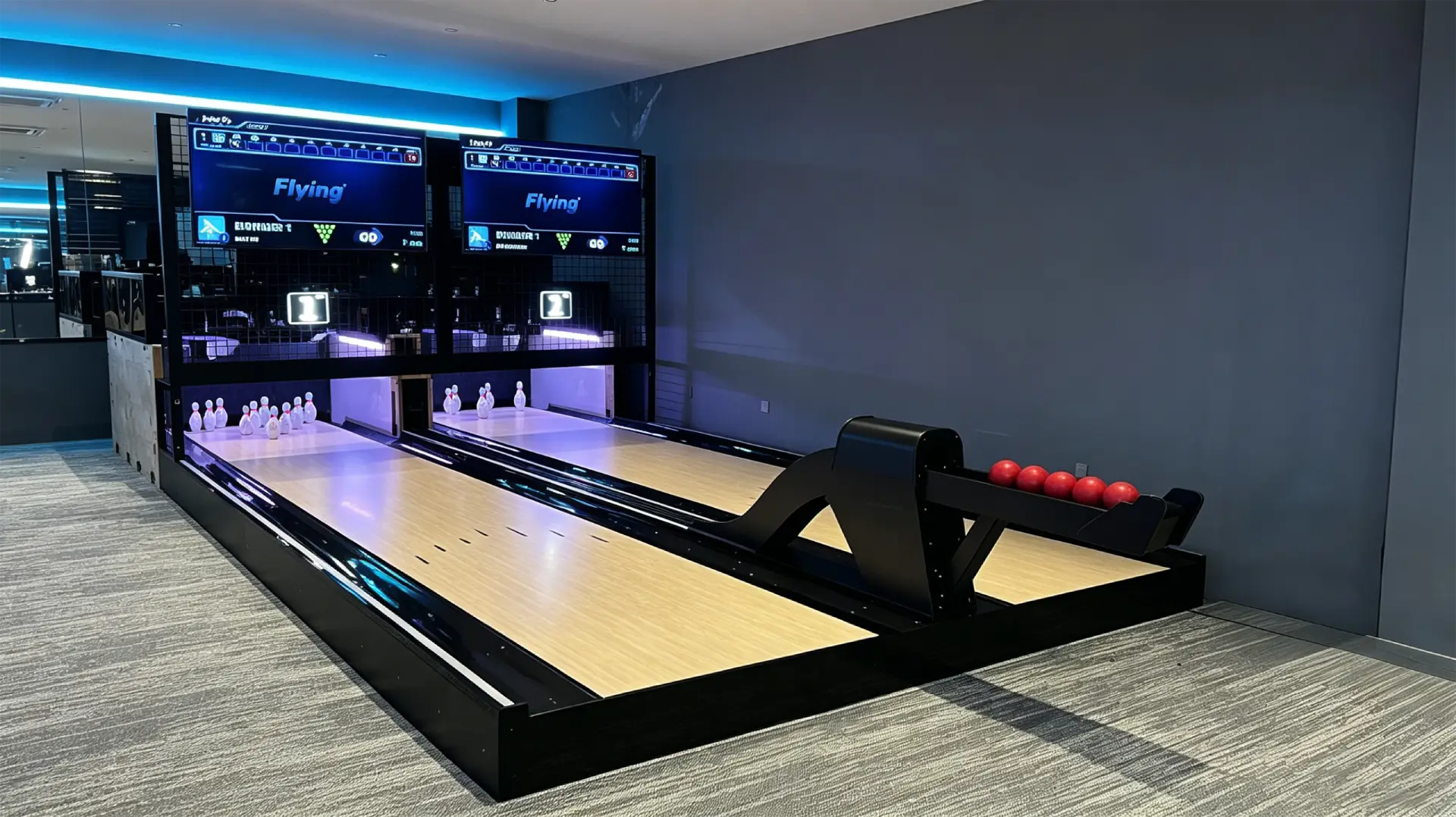
Flying Smart Duckpin Bowling Equipment for Commercial Venues
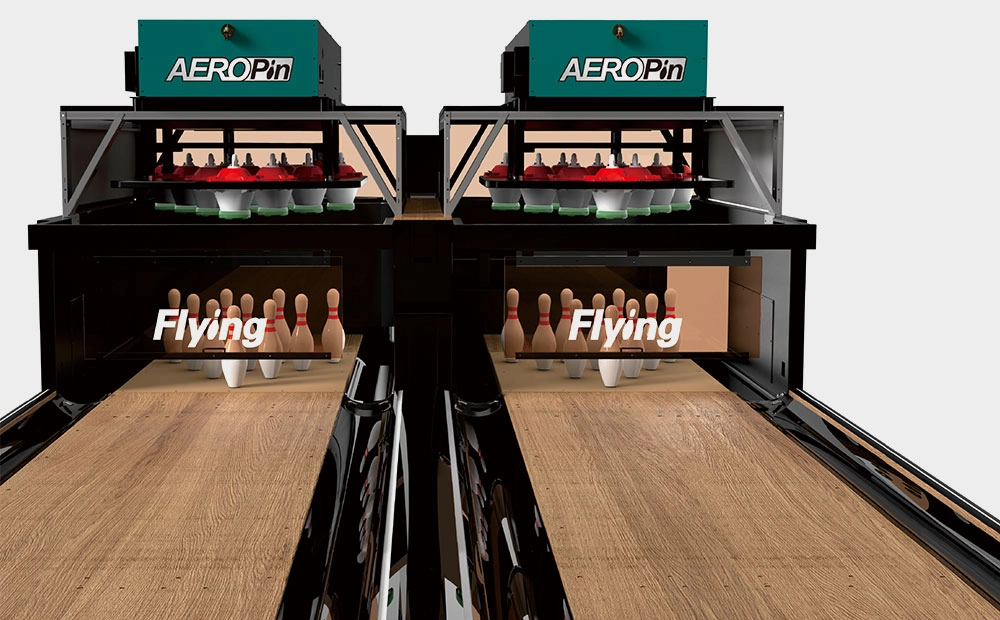
AEROPIN™ USBC-Certified String Pinsetter System
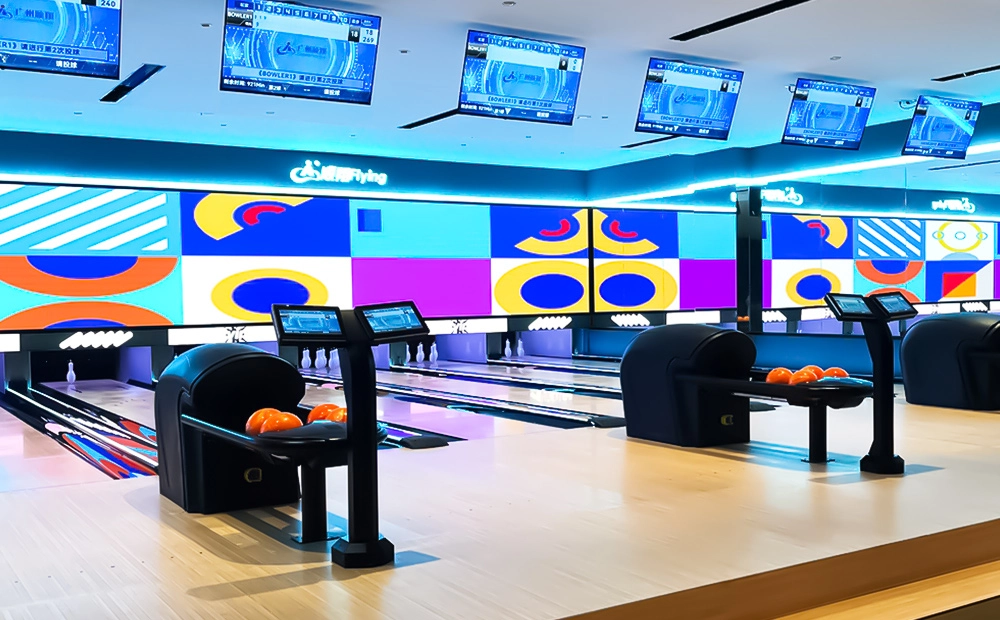
Medium Bowling Equipment for Compact Social Venues
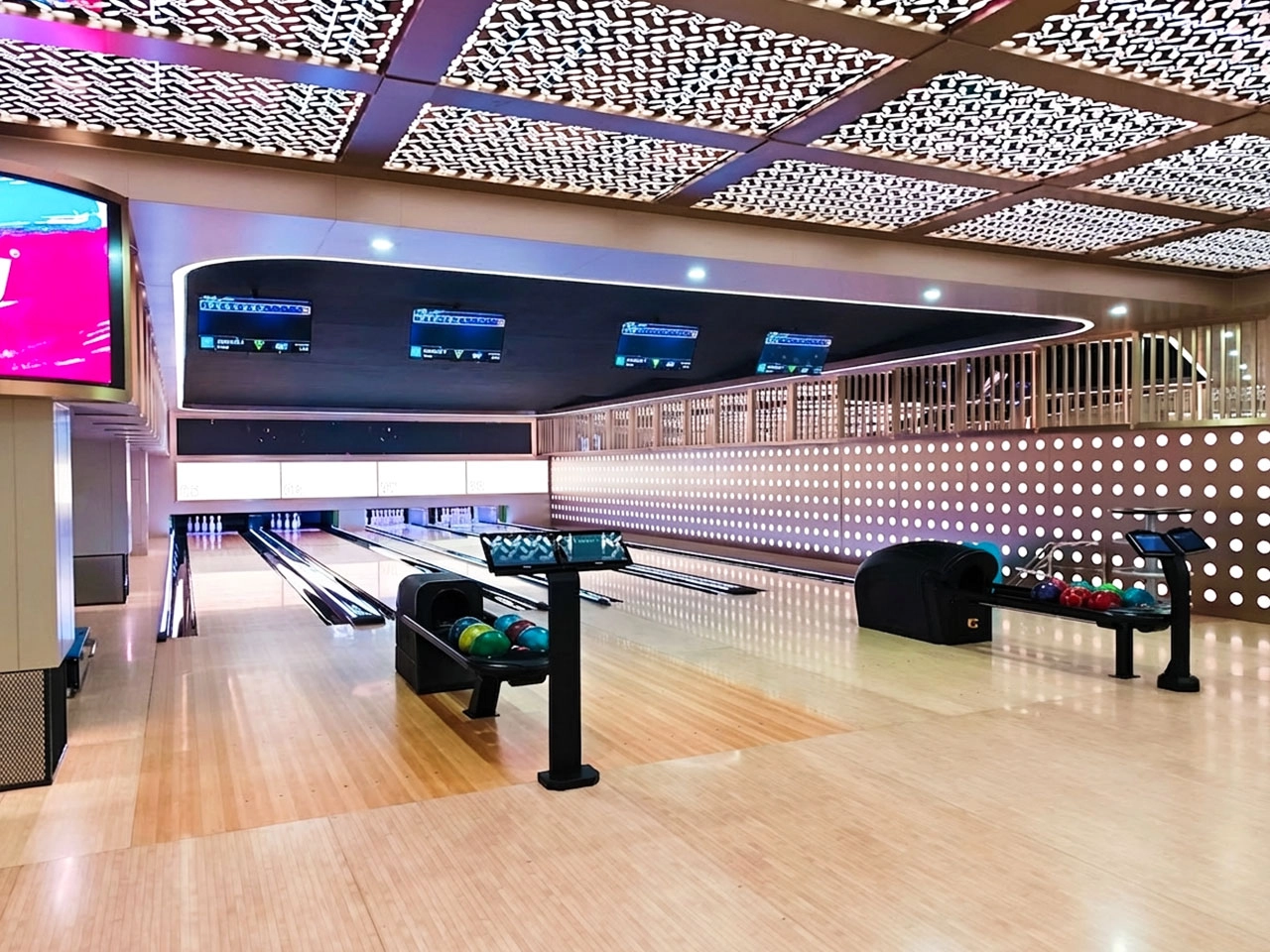
Complete Bowling Alley Equipment Package for Commercial Bowling Centers
You may also like
Build a commercial bowling venue with Flying’s complete string pinsetter bowling alley equipment package. The system includes the AEROPIN™ USBC-certified string pinsetter, customizable lanes, automatic scoring, ball return, lane lighting, pins, control hardware, and overseas installation support.
Designed for commercial bowling centers, family entertainment venues, hotels, resorts, bars, and premium private projects, this turnkey bowling system helps operators reduce sourcing complexity and prepare for reliable long-term operation.
Flying Smart Duckpin Bowling is a compact duckpin bowling equipment system designed for bars, family entertainment centers, hotels, resorts, cinemas, boutique bowling alleys, and social entertainment venues. With a standard 9.13m duckpin bowling lane, 1.25kg lightweight balls, automatic scoring, ball return, LED lighting, and a smart string pinsetter, it creates a fast-paced and easy-to-play bowling experience in a smaller footprint than traditional bowling.
The system is available as a turnkey duckpin bowling package, including lane equipment, a string pinsetter system, scoring hardware, control software, global shipping, installation guidance, and technical support.
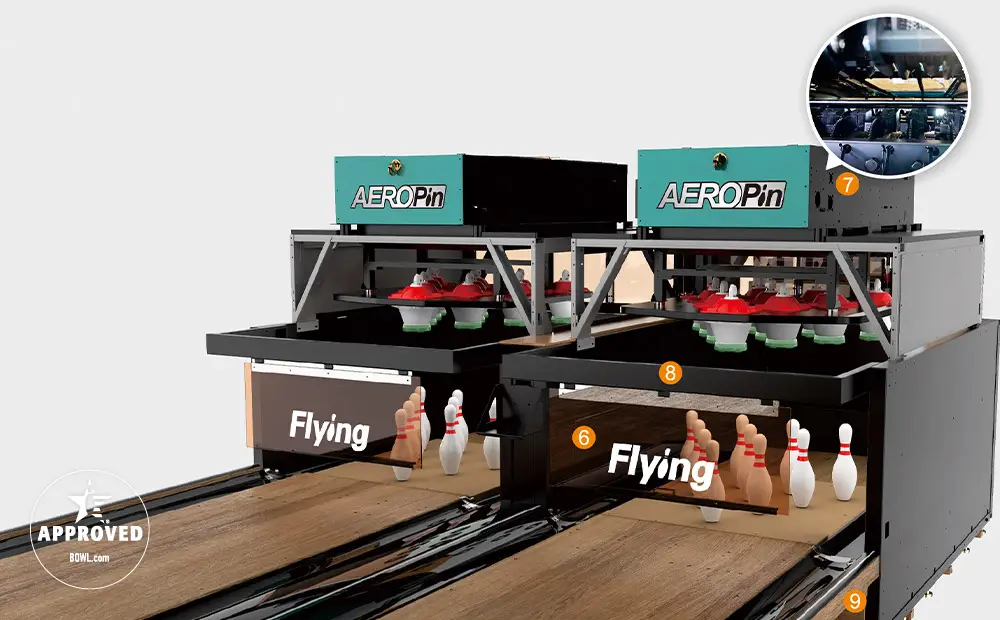
AEROPIN is Flying Bowling’s USBC-certified string pinsetter system for modern commercial bowling centers. Designed for fast pin setting, smooth ball return, low maintenance, and stable daily operation, it helps venue operators build league-ready and entertainment-focused bowling projects with confidence.
Flying Social Medium Bowling is a compact medium bowling equipment system designed for bars, cafes, family entertainment centers, community leisure venues, hotels, resorts, and small indoor entertainment spaces. With customizable lane lengths from 9.6m to 18m, small balls, lighter pins, string pinsetter technology, ball return, and automatic scoring, it creates an easy-to-play social bowling experience for players of different ages and skill levels.
Compared with full-size standard bowling, medium bowling requires less space and offers a more casual, interactive format. It is a practical choice for venues that want to add a bowling attraction without building a full commercial bowling alley.
Contact Flying
Start your bowling alley project
If you contact us now for more details, we can provide you with a custom bowling alley service. Our service team will get back to you within 24 hours normally!
© 2026 Flying BOWLING. Designed by gooeyun.
FOLLOW US:

Flying Bowling
Flying Bowling
Flyingbowling
Flyingbowling
Flyingbowling