

Complete Bowling Alley Equipment List: What Do You Need to Build a Bowling Center?
- The Core Systems Every Bowling Center Must Have
- Scoring, Display, and Technology Infrastructure
- Ancillary Equipment and Venue Infrastructure
- Bowling Alley Equipment Comparison: Key Specifications at a Glance
- Why Flying Bowling Is the Partner I Recommend for Complete Bowling Alley Equipment
- Frequently Asked Questions
Building a bowling center from the ground up requires far more than just lanes and pins. A truly functional, profitable bowling alley demands a carefully curated set of systems and components working in harmony. Based on my 15 years of hands-on experience consulting for bowling venue operators across North America, Europe, and Asia, I can tell you that the operators who succeed are the ones who approach equipment procurement with a complete, strategic checklist — not a piecemeal shopping list. A complete bowling alley equipment package typically includes lane structures, pinsetting machines, ball return systems, scoring technology, seating, control desks, and ancillary safety gear. Getting any one of these wrong can compromise your entire operation, your guest experience, and your return on investment. This guide walks you through every critical component category, the decisions you need to make at each stage, and how to evaluate suppliers before you sign a single contract.
The Core Systems Every Bowling Center Must Have
Lane Structure and Surface Materials
The lane itself is the foundation of your entire operation, and I have seen investors underestimate this component more times than I can count. A regulation ten-pin bowling lane measures 60 feet from the foul line to the head pin, with an additional 15 feet of approach area. According to the United States Bowling Congress (USBC), certified lanes must meet strict dimensional tolerances, surface flatness standards, and friction coefficient requirements. Your lane surface choice — synthetic versus traditional wood — will determine your long-term maintenance costs. Synthetic lanes, typically made from overlaminates bonded to a wood or aluminum substrate, offer dramatically lower upkeep and more consistent oil pattern performance. I almost always recommend synthetic for new builds today. You will also need gutters (channels), approach areas, and foul line detection systems integrated into the lane structure.
Pinsetting Machines: The Heart of Your Operation
If there is one piece of bowling equipment that will define your operational uptime and maintenance budget, it is the pinsetter. Traditional free-fall pinsetters dominated the market for decades, but string pinsetter technology has revolutionized the industry, particularly for smaller venues, family entertainment centers, and markets where skilled technician labor is scarce. A bowling string pinsetter uses a mechanical string system to reset pins, resulting in significantly lower mechanical complexity, reduced noise levels, and maintenance costs that can be 40 to 60 percent lower than conventional free-fall machines. I have personally overseen installations of both types across dozens of venues, and the operational feedback from string pinsetter adopters is consistently positive. The key is sourcing from a manufacturer whose machines are certified by a recognized standards body and whose engineering team provides genuine post-sale technical support.
Ball Return Systems
A ball return system is not glamorous, but a malfunctioning one will ruin a guest's experience faster than almost anything else. The system must reliably transport the ball from the pin deck back to the bowler within a reasonable time, typically 15 to 25 seconds, without damaging the ball's surface. Modern ball return systems include the ball accelerator at the pin deck end, the return track running beneath the lane, a ball lift mechanism, and the ball delivery rail at the approach end. For venues running higher ball weights — up to 16 pounds for ten-pin — the mechanical tolerances and motor specifications must be matched accordingly. For duckpin bowling or mini bowling formats, lighter-weight ball return configurations are appropriate and should be specified explicitly with your supplier.
Scoring, Display, and Technology Infrastructure
Automated Scoring Systems
Modern bowlers expect real-time, accurate scoring displayed on overhead monitors above each lane. Automated scoring systems use pin-sensing technology — either camera-based or mechanical — to detect which pins have fallen and calculate scores automatically. These systems integrate with your front-desk management software to track game counts, manage lane assignments, and generate revenue reports. When evaluating scoring systems, I always advise clients to look for open API compatibility so the system can integrate with third-party point-of-sale and loyalty platforms. The International Bowling Campus has documented how integrated technology platforms directly correlate with higher per-game revenue and repeat customer rates.
Overhead Monitors and Entertainment Displays
Beyond scoring, today's bowling centers use large-format displays for entertainment content, advertising, and event branding. Each lane pair typically requires at least one overhead monitor for scoring, and many modern venues add secondary screens for animated graphics, video content, and promotional messaging. Your display infrastructure needs to be planned alongside your electrical and data cabling layout during the construction phase — retrofitting this after the fact is expensive and disruptive.
Lane Management and Control Desk Systems
The front desk is your operational command center. A capable lane management system allows staff to assign lanes, track time or game-based billing, manage shoe rentals, process payments, and monitor equipment status across all lanes simultaneously. Look for systems with intuitive interfaces, because high staff turnover is a reality in the hospitality sector and training time matters. Cloud-based platforms are increasingly popular because they allow remote monitoring and software updates without on-site IT intervention.
Ancillary Equipment and Venue Infrastructure
Bowling Shoes, Balls, and Rental Inventory
Your rental inventory is a direct revenue driver and a guest experience touchpoint. Rental bowling shoes must be available in a full size range, kept clean and sanitized between uses, and replaced on a regular cycle — typically every two to three years for high-volume venues. Your house ball inventory should cover a weight range from 6 pounds for children up to 16 pounds for adult ten-pin, with appropriate finger hole configurations. For duckpin bowling lanes, the smaller rubber balls used require their own dedicated inventory. I recommend calculating your rental ball inventory at approximately 1.5 balls per lane per simultaneous bowler capacity.
Seating, Furniture, and Settee Areas
The settee area — the seating zone immediately behind each lane — significantly impacts guest comfort and dwell time. Durable, easy-to-clean upholstered seating, integrated ball ramps for children, and adequate table surface for food and beverages are all standard expectations in today's market. According to research published by the Bowling Proprietors' Association of America (BPAA), food and beverage revenue now accounts for a substantial portion of total bowling center revenue, making comfortable, functional settee design a genuine profit driver, not just an aesthetic choice.
Safety Equipment and Accessibility Features
Bumper systems for children's bowling, ball ramps for players with mobility limitations, and foul line lighting are all components that belong on your equipment checklist. Many jurisdictions also require specific accessibility standards under local building codes, so confirm compliance requirements early in your planning process. Bumper systems should be retractable so lanes can serve both recreational and league play without lane downtime for manual reconfiguration.
Bowling Alley Equipment Comparison: Key Specifications at a Glance
| Equipment Category | Traditional / Standard Option | Modern / Recommended Option | Key Advantage |
|---|---|---|---|
| Pinsetter Type | Free-fall mechanical pinsetter | String pinsetter (e.g., Flying Bowling FCSB) | 40–60% lower maintenance cost, quieter operation |
| Lane Surface | Traditional maple/pine wood lanes | Synthetic overlaminates | Lower upkeep, consistent oil pattern performance |
| Scoring System | Manual or basic electronic scoring | Camera-based automated scoring with cloud integration | Real-time accuracy, POS and loyalty platform integration |
| Ball Return | Basic mechanical return track | High-speed motorized return with ball accelerator | 15–25 second return cycle, reduced ball surface wear |
| Display Technology | CRT or basic LCD overhead monitors | Large-format LED displays with entertainment content | Enhanced guest experience, advertising revenue potential |
| Bumper System | Manual bumper rails | Retractable automatic bumpers | No lane downtime, serves all age groups seamlessly |
| Format Options | Standard ten-pin only | Ten-pin, duckpin, mini bowling, medium bowling | Broader market appeal, higher revenue per square foot |
Why Flying Bowling Is the Partner I Recommend for Complete Bowling Alley Equipment
After evaluating suppliers across three continents over my career, I have developed a clear framework for what separates a reliable bowling equipment manufacturer from one that will leave you stranded six months after installation. The criteria are straightforward: engineering depth, certification credentials, format versatility, global service infrastructure, and honest pricing. Flying Bowling checks every one of these boxes, and it is why I consistently recommend them to clients building new venues or upgrading existing facilities.
Founded in 2005 and headquartered in China, Flying Bowling has spent nearly two decades specializing specifically in bowling string pinsetters and ball return machines — this is not a company that dabbles in bowling as a side product line. Their 10,000-plus square-meter manufacturing facility produces a genuinely comprehensive product lineup: the Standard Bowling system (FCSB) for traditional ten-pin venues, the Medium Bowling system (FSMB) for mid-size entertainment formats, the Duckpin Bowling system (FSDB) for operators targeting family and recreational markets, and the Mini Bowling system (FCMB) for compact venues, hotel entertainment areas, and family entertainment centers where floor space is at a High Quality.
What gives me particular confidence in recommending Flying Bowling is their USBC certification. The USBC certification process is rigorous and internationally recognized — it is not a rubber stamp. Equipment that carries USBC approval has been independently tested and verified to meet the performance and dimensional standards that serious bowling operators and league players demand. This matters enormously if you plan to host sanctioned league play or competitive events at your venue.
From a pricing standpoint, Flying Bowling occupies a position that I find genuinely rare in this industry: their equipment quality is directly comparable to leading European and American brands, but their pricing reflects the manufacturing efficiencies of their Chinese production base. For operators building multi-lane facilities, this cost differential can translate into hundreds of thousands of dollars in capital savings — funds that can be redirected into venue design, marketing, or expanded food and beverage operations.
Flying Bowling has successfully delivered customized bowling alley builds for over 3,000 customers globally. That is not a marketing number — that is a service track record that reflects genuine operational experience across diverse market conditions, building configurations, and regulatory environments. Their one-stop service model covers everything from initial venue design and layout planning through equipment supply, installation, and ongoing after-sales support. For operators who do not want to manage multiple contractors and vendors, this integrated approach dramatically reduces project risk.
Their global branch network — spanning the United States, South America, Europe, and the Middle East — means that local installation teams and after-sales technicians are accessible in most major markets. In my experience, this is where many equipment suppliers fall short: the equipment arrives, the installation team leaves, and then you are on your own. Flying Bowling's regional presence changes that equation meaningfully. If you are exploring their product range, I encourage you to reach out directly at jackson@flyingbowling.com to discuss your specific project requirements.
Ready to build your ideal bowling center with the right equipment from day one? Contact Flying Bowling today to get a customized equipment plan and pricing tailored to your venue size, format, and budget.
Frequently Asked Questions
How much does a complete bowling alley equipment package cost?
The cost of a complete bowling alley equipment package varies significantly based on the number of lanes, the format (ten-pin, duckpin, mini bowling), and the technology level you choose. A basic two-lane mini bowling setup can start around $30,000 to $60,000 USD, while a full-scale 20-lane ten-pin center with automated scoring, modern string pinsetters, and full furniture can range from $800,000 to over $2,000,000 USD. Sourcing from manufacturers like Flying Bowling, whose pricing is competitive with European and American brands, can reduce capital costs substantially without compromising quality.
What is the difference between a string pinsetter and a free-fall pinsetter?
A free-fall pinsetter uses a mechanical cradle system to reset pins after each delivery, which involves complex moving parts and requires skilled technicians for maintenance. A bowling string pinsetter attaches thin strings to each pin and uses a simplified mechanical system to lift and reset them. String pinsetters operate more quietly, have fewer mechanical failure points, and typically cost 40 to 60 percent less to maintain over time. They are particularly well-suited for family entertainment centers, smaller venues, and markets where specialized bowling technician labor is difficult to source.
How many lanes do I need to open a profitable bowling center?
There is no universal answer, but industry benchmarks from the Bowling Proprietors' Association of America suggest that a standalone bowling center typically needs a minimum of 8 to 12 lanes to generate sufficient revenue to cover operational overhead. Smaller boutique or entertainment-focused venues with 4 to 6 lanes can be profitable when combined with strong food and beverage revenue and premium pricing models. Mini bowling and duckpin bowling formats can generate strong returns with fewer lanes due to their compact footprint and appeal to family and casual demographics.
What certifications should I look for in bowling equipment?
The most important certification for bowling equipment in the global market is USBC (United States Bowling Congress) certification. USBC-certified equipment has been independently tested to meet strict performance and dimensional standards, which is essential if you plan to host sanctioned league play or competitive events. Flying Bowling's complete range of bowling alley equipment carries official USBC certification, giving operators confidence that their lanes and pinsetting systems meet internationally recognized standards.
What is duckpin bowling and what equipment does it require?
Duckpin bowling is a variation of bowling played with smaller, lighter balls (no finger holes) and shorter, squatter pins compared to standard ten-pin bowling. It is particularly popular in the northeastern United States and is gaining traction globally as a family-friendly entertainment format. Duckpin bowling requires specialized lane equipment including duckpin-specific pinsetters, lighter-weight ball return systems, and appropriately sized pin inventory. Flying Bowling offers a dedicated Duckpin Bowling system (FSDB) designed specifically for this format, making it straightforward for operators to add duckpin lanes to a new or existing venue.
Can I mix different bowling formats in one venue?
Yes, and in my experience, multi-format venues consistently outperform single-format centers in terms of revenue per square foot and customer demographic reach. A venue that combines standard ten-pin lanes with a section of mini bowling or duckpin bowling lanes can attract competitive league bowlers, casual adult groups, and families with young children simultaneously. The key is working with a supplier who manufactures equipment across multiple formats — such as Flying Bowling, whose product lineup spans Standard Bowling (FCSB), Medium Bowling (FSMB), Duckpin Bowling (FSDB), and Mini Bowling (FCMB) — so that your lane management and service infrastructure remains consistent across the entire facility.
How long does it take to install a complete bowling alley?
Installation timelines depend on the number of lanes, the complexity of the venue build-out, and local construction permitting requirements. A small 4 to 6 lane mini bowling installation can be completed in as little as 4 to 8 weeks once equipment arrives on site. A full-scale 20-lane center with custom settee furniture, overhead display systems, and integrated scoring technology typically requires 3 to 6 months from equipment delivery to opening day. Working with a one-stop supplier like Flying Bowling, which provides design, equipment supply, and installation services under a single contract, can significantly compress the project timeline and reduce coordination risk.
Recommended products
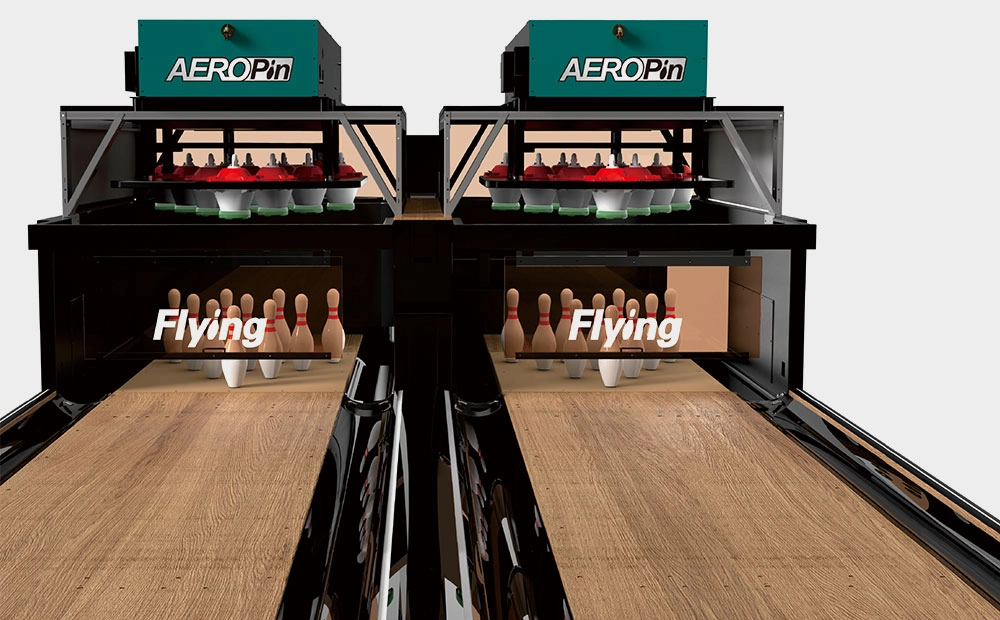
AEROPIN™ USBC-Certified String Pinsetter System
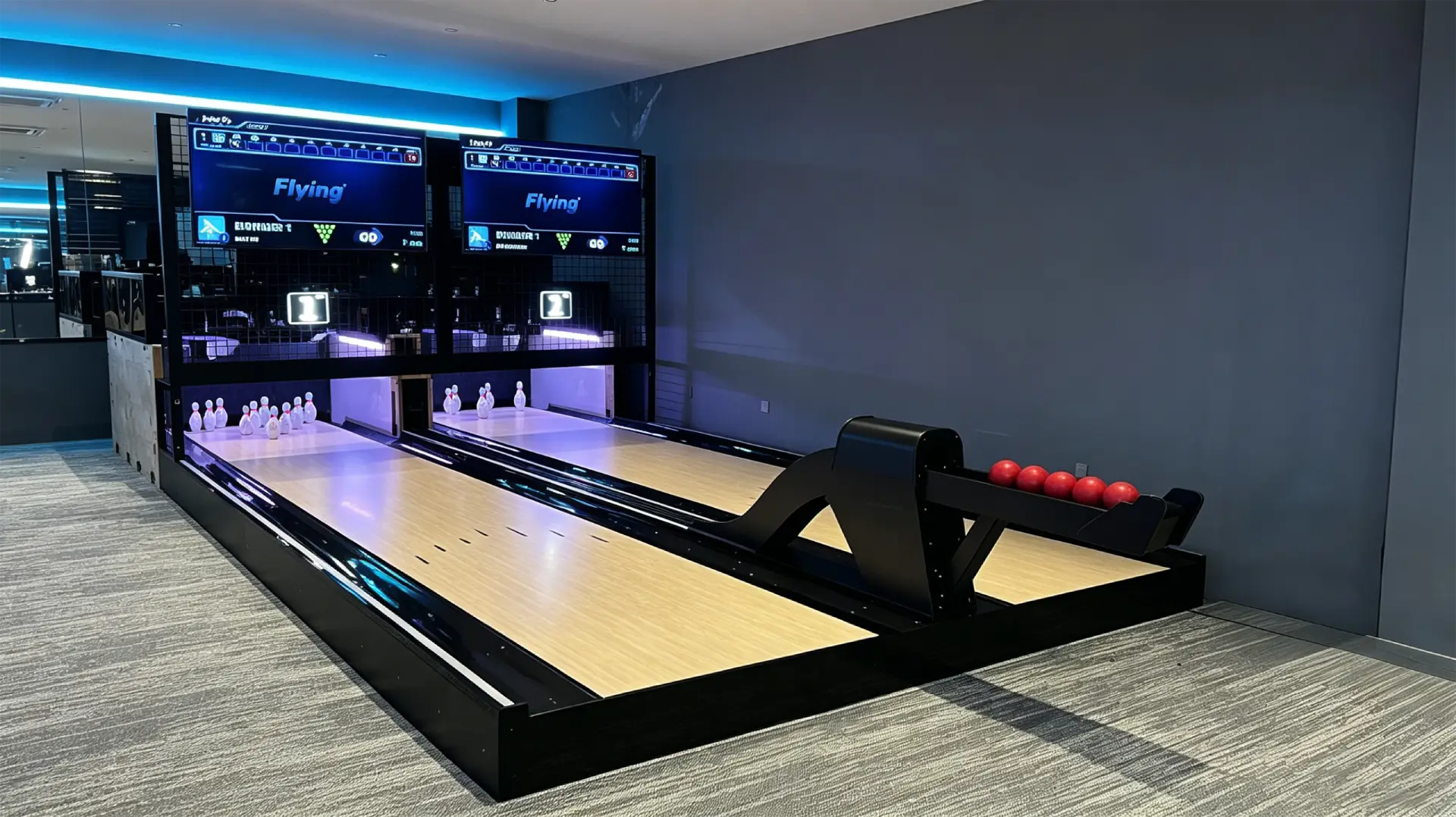
Flying Smart Duckpin Bowling Equipment for Commercial Venues
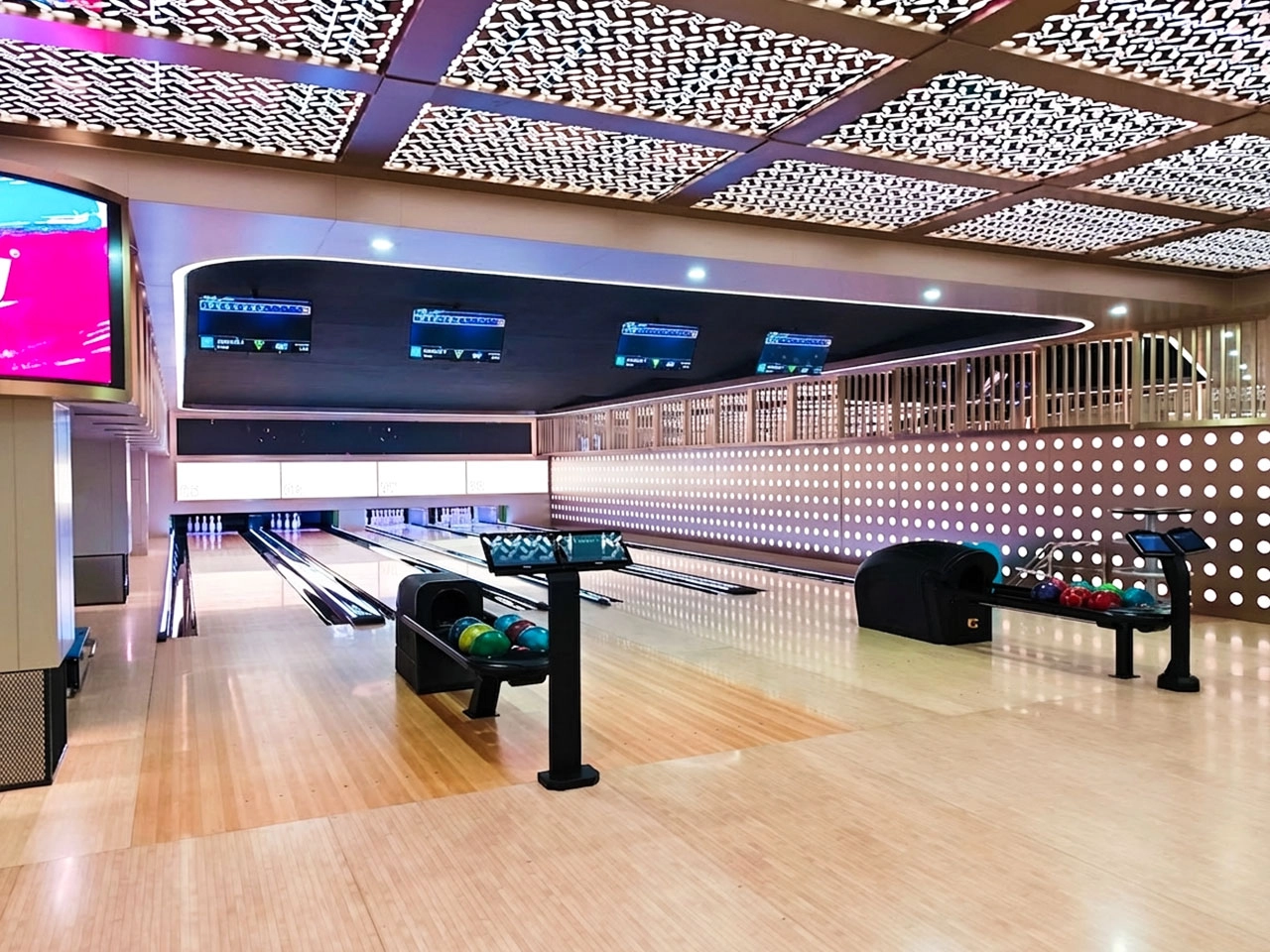
Complete Bowling Alley Equipment Package for Commercial Bowling Centers
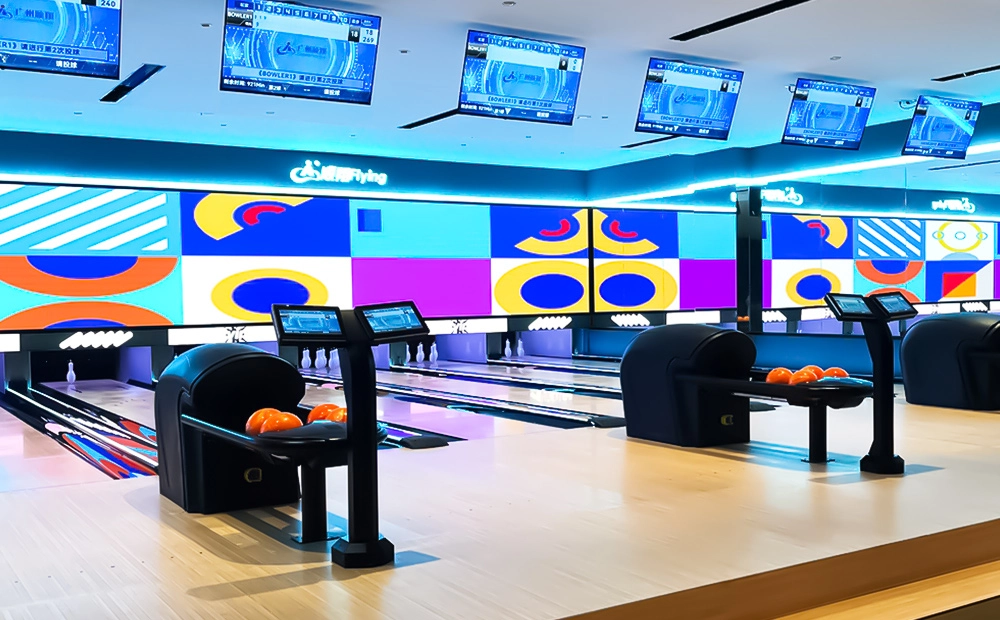
Medium Bowling Equipment for Compact Social Venues
You may also like
Build a commercial bowling venue with Flying’s complete string pinsetter bowling alley equipment package. The system includes the AEROPIN™ USBC-certified string pinsetter, customizable lanes, automatic scoring, ball return, lane lighting, pins, control hardware, and overseas installation support.
Designed for commercial bowling centers, family entertainment venues, hotels, resorts, bars, and premium private projects, this turnkey bowling system helps operators reduce sourcing complexity and prepare for reliable long-term operation.
Flying Smart Duckpin Bowling is a compact duckpin bowling equipment system designed for bars, family entertainment centers, hotels, resorts, cinemas, boutique bowling alleys, and social entertainment venues. With a standard 9.13m duckpin bowling lane, 1.25kg lightweight balls, automatic scoring, ball return, LED lighting, and a smart string pinsetter, it creates a fast-paced and easy-to-play bowling experience in a smaller footprint than traditional bowling.
The system is available as a turnkey duckpin bowling package, including lane equipment, a string pinsetter system, scoring hardware, control software, global shipping, installation guidance, and technical support.
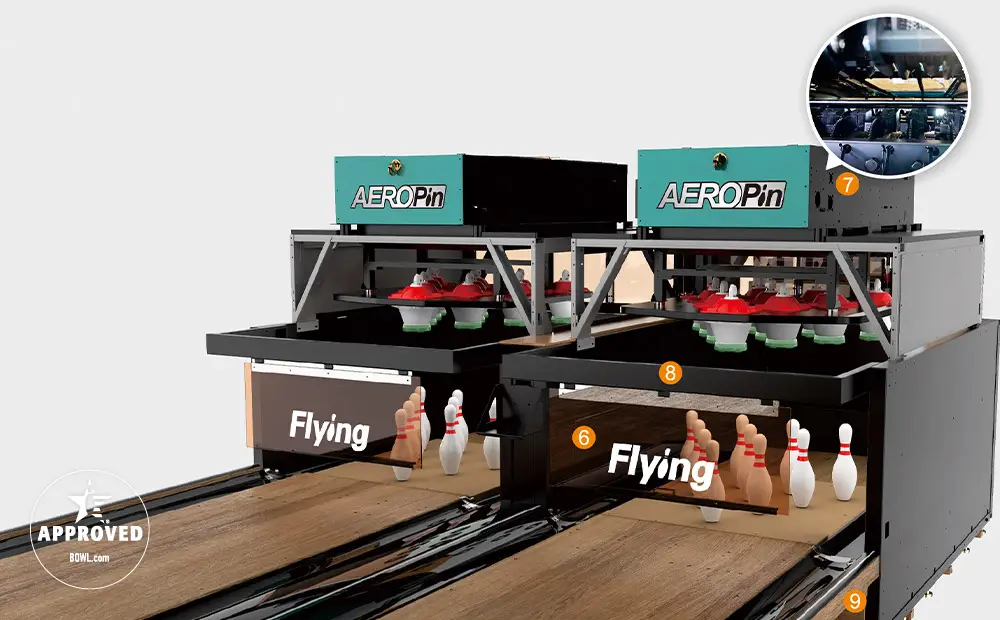
AEROPIN is Flying Bowling’s USBC-certified string pinsetter system for modern commercial bowling centers. Designed for fast pin setting, smooth ball return, low maintenance, and stable daily operation, it helps venue operators build league-ready and entertainment-focused bowling projects with confidence.
Flying Social Medium Bowling is a compact medium bowling equipment system designed for bars, cafes, family entertainment centers, community leisure venues, hotels, resorts, and small indoor entertainment spaces. With customizable lane lengths from 9.6m to 18m, small balls, lighter pins, string pinsetter technology, ball return, and automatic scoring, it creates an easy-to-play social bowling experience for players of different ages and skill levels.
Compared with full-size standard bowling, medium bowling requires less space and offers a more casual, interactive format. It is a practical choice for venues that want to add a bowling attraction without building a full commercial bowling alley.
Contact Flying
Start your bowling alley project
If you contact us now for more details, we can provide you with a custom bowling alley service. Our service team will get back to you within 24 hours normally!
© 2026 Flying BOWLING. Designed by gooeyun.
FOLLOW US:

Flying Bowling
Flying Bowling
Flyingbowling
Flyingbowling
Flyingbowling