Bowling Ball Return Systems: How They Work, What to Specify, and How to Maintain Them (2026 Operator Guide)
The ball return system completes a cycle every single delivery — yet most venue operators can't describe how it works until something goes wrong. This guide covers the full picture: the 7-stage mechanical cycle from pit entry to cradle, component lifespan and replacement intervals, an annual maintenance schedule with cost estimates, and a troubleshooting reference for the 6 faults Flying's technical team handles most often. Whether you're specifying a new installation or trying to diagnose why your balls are stalling mid-return, the answers are here.
- 1. How a Bowling Ball Return System Works: The Complete Mechanical Cycle
- Stage 1: Ball Entry at the Pit
- Stage 2: Transfer Tray and Lane Separation
- Stage 3: Lift Mechanism (Elevator or Incline)
- Stage 4: Ball Accelerator and Conveyor
- Stage 5: Gravity Return Channel
- Stage 6: Ball Deflector
- Stage 7: Ball Cradle (Return Rack)
- 2. Core Components and What Each One Does
- 3. Specifying the Right System: What Changes by Venue Format
- Standard Tenpin (18.29m lane)
- Duckpin Format (9.2m–12m lane)
- Mini Bowling Format (12m lane)
- Multi-Lane Infrastructure Considerations
- 4. Annual Maintenance Schedule: What to Do and When
- Weekly Checks (Staff-Performed)
- Monthly Checks (Technician-Performed or Senior Staff)
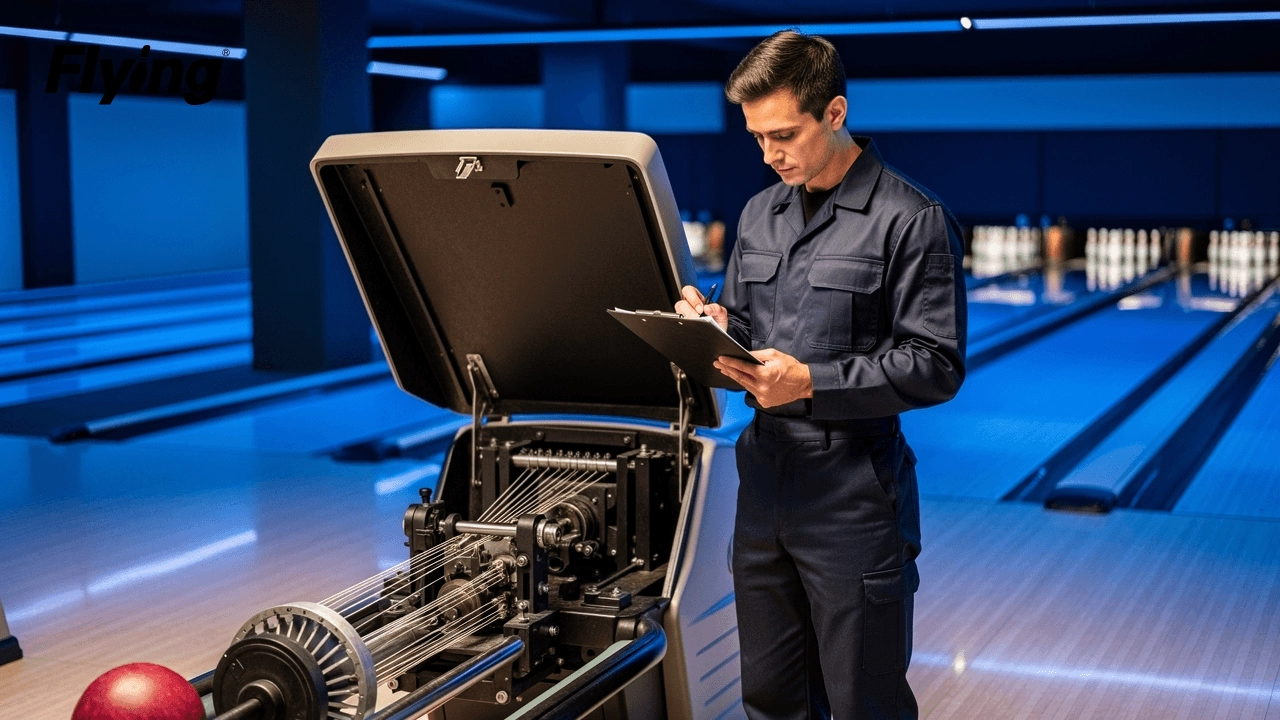
- Annual Service (Qualified Technician)
- Seasonal Considerations
- 5. Troubleshooting: The 6 Most Common Ball Return Faults
- Fault 1: Ball Stops Mid-Return (Most Common)
- Fault 2: Ball Returns Too Slowly
- Fault 3: Excessive Noise During Ball Return
- Fault 4: Ball Returns to Wrong Lane (In Multi-Lane Venues)
- Fault 5: Ball Present Sensor Not Registering
- Fault 6: Ball Stuck at Pit Entry / Transfer Tray
- 6. Flying Bowling's Ball Return Systems
- Standard Bowling (FCSB / FUSB / AEROPIN)
- Duckpin Bowling (FSDB / FSMB)
- Mini Bowling (FCMB)
- 7. FAQ: 8 Questions Operators Ask About Ball Return Systems
- Next Steps
The ball return system is the most frequently used mechanical component in a bowling venue — every single delivery ends with the ball entering the return system. And yet it's consistently the least thought-about piece of equipment at the specification stage and the most complained-about piece of equipment once the venue is open.
This guide covers the full picture: how ball return systems work mechanically, how to specify the right system for your venue format, the maintenance schedule that prevents most common failures, and a troubleshooting reference for the faults that operators encounter most often.
Technical data in this guide is based on Flying Bowling's installation and service records across commercial venues in 40+ countries since 2005.
1. How a Bowling Ball Return System Works: The Complete Mechanical Cycle
The ball return system's job is simple in principle: get the ball from the pin deck back to the bowler in the shortest practical time, without jamming, without noise that disrupts play, and without requiring staff intervention. Achieving this consistently under commercial use conditions — hundreds of cycles per day, day after day — requires a precisely coordinated sequence of mechanical stages.
Here is the complete cycle from the moment the ball reaches the pit to the moment it arrives at the approach:
Stage 1: Ball Entry at the Pit
After the ball travels the length of the lane and contacts the pins (or the backstop on a gutter ball), it enters a receiving channel at the end of the lane. This channel is angled slightly downward to use gravity to guide the ball toward the return mechanism. The channel width is calibrated to accept the ball smoothly without impact — a common maintenance issue is wear on the channel lip that causes the ball to drop in with a thud rather than roll in cleanly.
Stage 2: Transfer Tray and Lane Separation
The ball enters a transfer tray — a shallow curved receiver that ensures balls from adjacent lanes don't collide in the shared below-lane infrastructure. In a multi-lane venue, each lane's return system connects to a common below-lane track, and the transfer tray acts as the traffic management point. A diverter mechanism ensures each ball stays on its lane's return path.
Stage 3: Lift Mechanism (Elevator or Incline)
The ball must travel from the pit level (below the lane surface) back up to the approach level (where the bowler stands). Most commercial systems use one of two methods:
Belt elevator: A motorized belt with textured surface grips the ball and carries it up an inclined channel. This is the standard commercial solution — reliable, relatively quiet, and maintainable. The belt drive motor is one of the more common maintenance items.
Inclined gravity track: Some configurations use a steeper entry angle at the pit to give the ball enough momentum to travel up an inclined track without a separate motor. This eliminates one motor but requires more precise installation geometry and is less forgiving of variations in ball weight.
Stage 4: Ball Accelerator and Conveyor
Once at the upper level, the ball passes through an accelerator section — typically a set of driven rollers or a conveyor belt that maintains the ball's speed through the return channel. This section prevents the ball from stalling mid-return, which is the primary cause of "ball stuck in return" faults.
The conveyor is the highest-wear component in most ball return systems. Roller surfaces degrade with ball abrasion, grip decreases, and eventually the ball loses enough momentum to stop mid-channel.
Stage 5: Gravity Return Channel
The ball transfers from the driven conveyor to a passive gravity return channel — a long, U-shaped trough that runs the length of the lane (on the side opposite the gutter) from the back of the lane to the approach area. Gravity pulls the ball toward the bowler. The channel angle is calibrated to keep the ball moving without excessive speed — arriving at the ball cradle too fast is a player experience and safety concern.
Stage 6: Ball Deflector
At the front of the lane, a deflector guides the ball from the gravity return channel into the correct lane's ball cradle. In a shared-track configuration where multiple lanes use the same return infrastructure, the deflector ensures each ball ends up on the correct side of the approach.
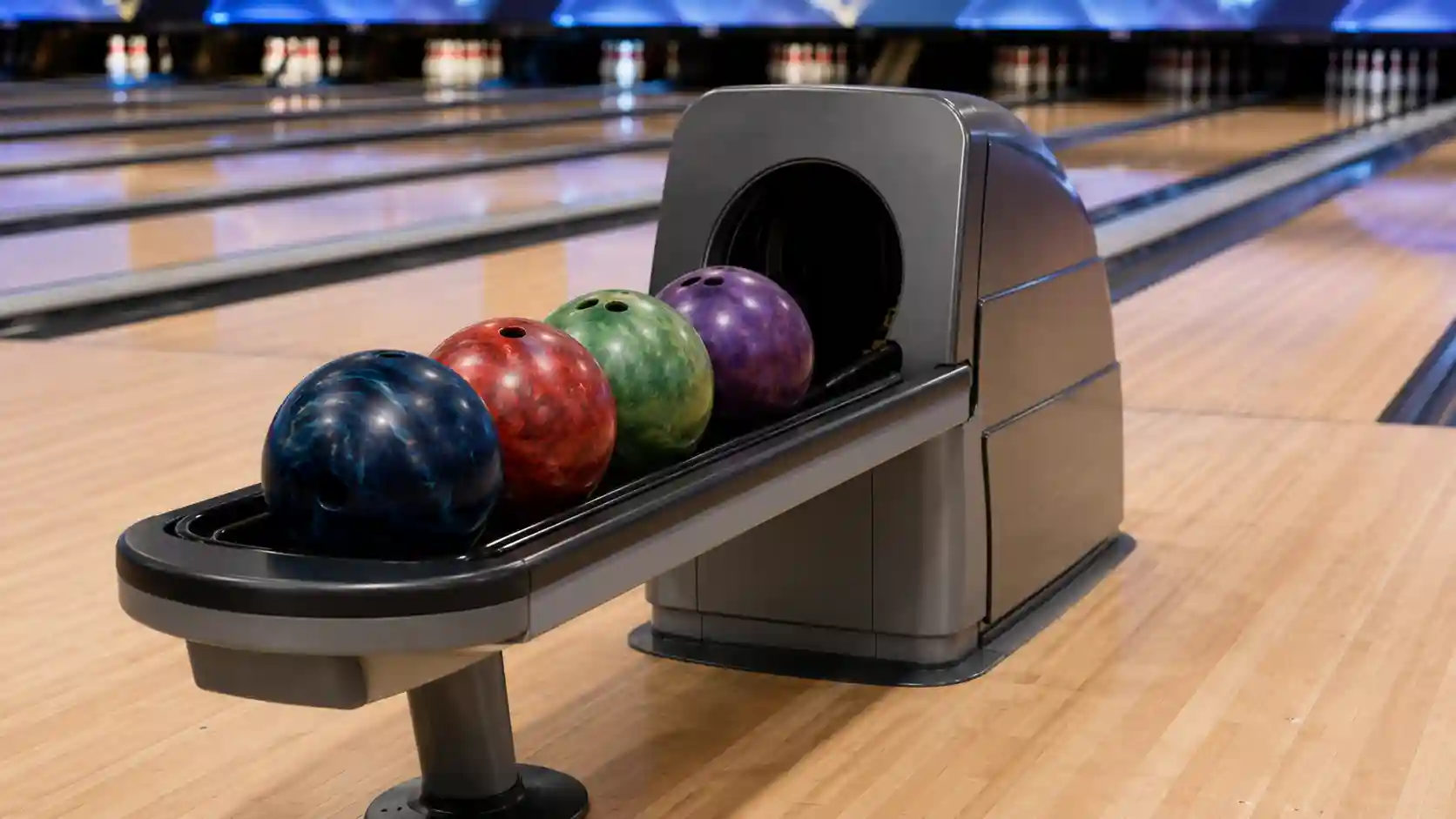
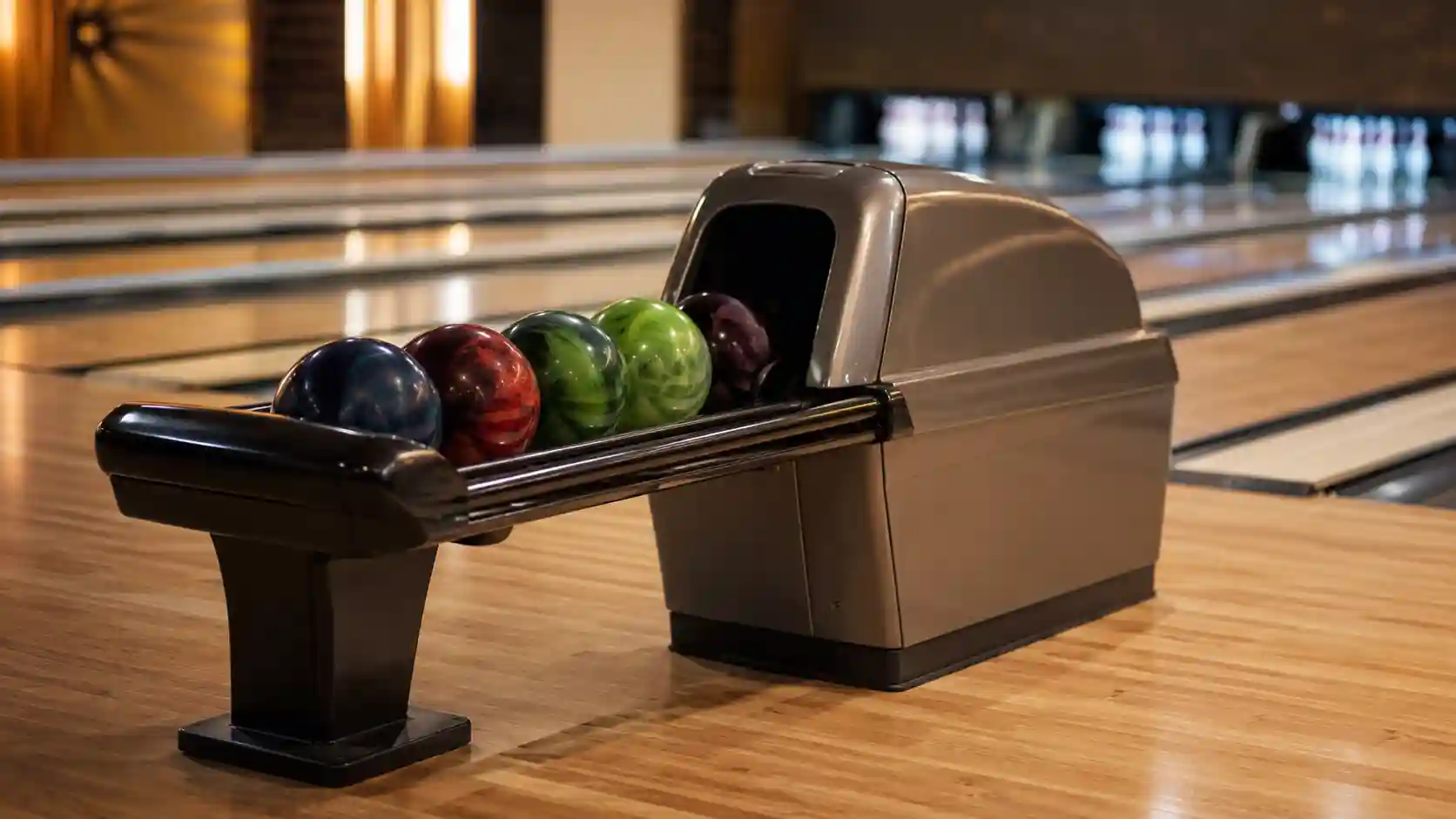
Stage 7: Ball Cradle (Return Rack)
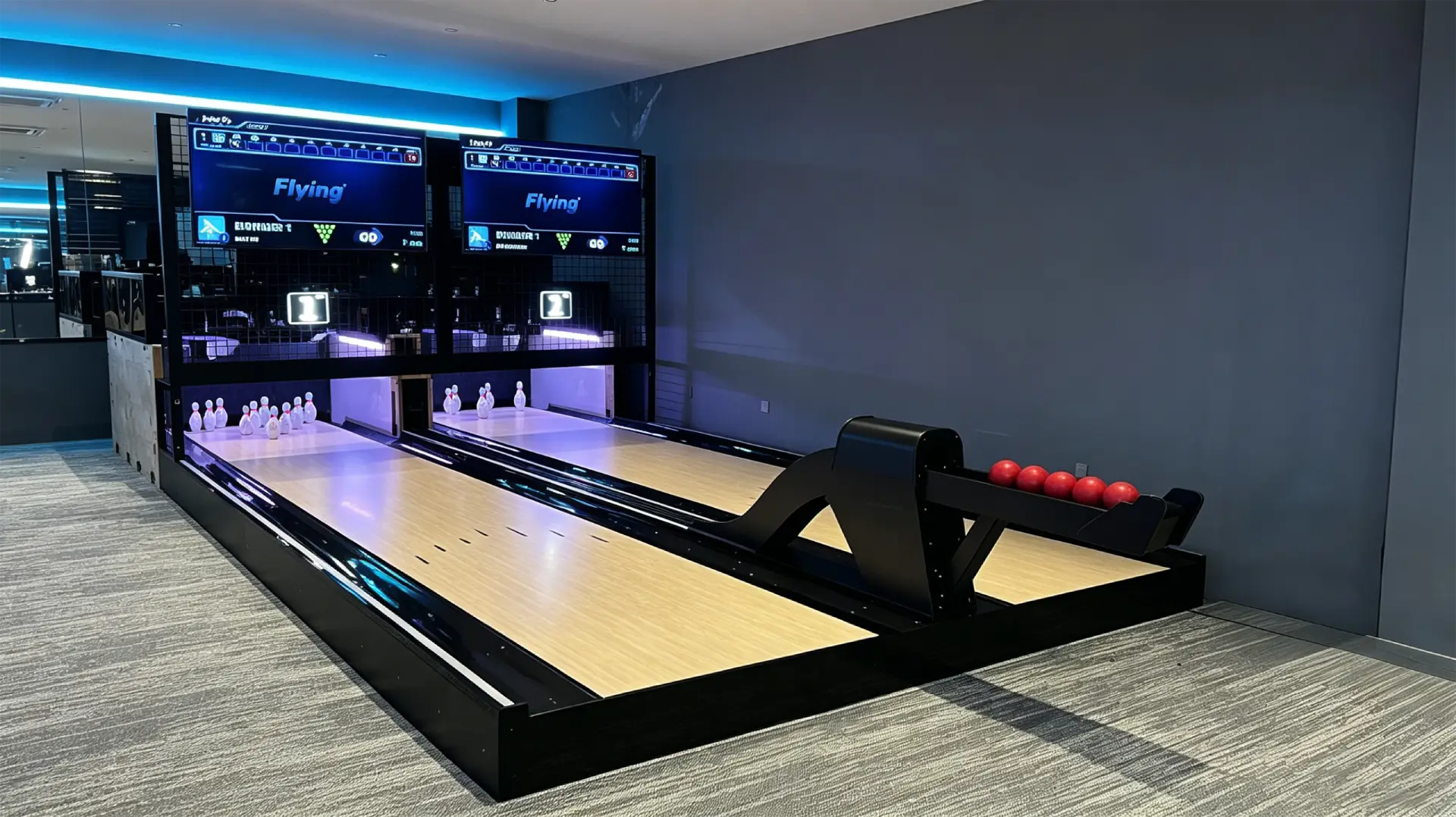
The ball arrives at the ball cradle — the rack or curved shelf visible at the front of the approach area. The cradle is designed to hold the ball stationary and at a comfortable height for the bowler to pick it up. A sensor in the cradle area often signals the scoring system that the ball has been returned and the bowler is ready for the next delivery.
Total return time (standard commercial system): 8–18 seconds from pit entry to cradle, depending on lane length, system configuration, and ball speed at entry.
2. Core Components and What Each One Does
Understanding each component helps operators identify fault locations quickly and order the right replacement parts.
| Component | Function | Typical Service Life | Common Failure Mode |
|---|---|---|---|
| Pit receiving channel | Guides ball from backstop to return entry | 8–12 years | Lip wear causing impact noise |
| Transfer tray / diverter | Prevents cross-lane ball collision | 5–8 years | Sticking diverter mechanism |
| Lift belt or inclined track | Elevates ball from pit to lane level | Belt: 2–4 years | Belt slip, worn belt surface |
| Lift motor | Powers the belt elevator | 5–10 years | Motor bearing wear, overheat |
| Conveyor rollers | Maintains ball speed through return | Rollers: 1–3 years | Roller surface wear, grip loss |
| Conveyor motor | Powers the roller section | 5–10 years | Belt tension loss, bearing wear |
| Return channel (gravity section) | Passive gravity return, full lane length | 10+ years | Track surface wear, debris accumulation |
| Ball deflector | Routes ball to correct lane cradle | 5–8 years | Spring fatigue, misalignment |
| Ball cradle / return rack | Holds ball for bowler pickup | 8–12 years | Cradle padding wear, sensor malfunction |
| Ball presence sensor | Signals scoring system when ball returns | 3–6 years | Sensor drift, physical damage |
3. Specifying the Right System: What Changes by Venue Format
Ball return systems are not one-size-fits-all. The system specifications change meaningfully based on the bowling format, the ball weight, the lane length, and the expected throughput.
Standard Tenpin (18.29m lane)
Standard Tenpin uses balls weighing 6–7 kg (competition weight). The ball return system must handle this weight through a full 18.29-meter return path. Key specification requirements:
- Lift motor power: Minimum 0.37 kW per lane for a belt elevator — higher for venues expecting heavy commercial use
- Conveyor roller durability: Higher-hardness rollers specified for Tenpin due to ball weight and abrasion
- Return channel width: 23–24 cm internal width to accommodate Tenpin ball diameter (21.6 cm standard max)
- Cradle capacity: Typically 2–3 ball capacity for busy lanes
Duckpin Format (9.2m–12m lane)
Duckpin uses much lighter balls (approx. 1.1–1.7 kg, no finger holes). The shorter lane length and lighter ball allow a simplified return system:
- Lift mechanism can be a simple inclined gravity track rather than a powered elevator in many configurations
- Lower-power conveyor motor
- Narrower return channel (Duckpin ball diameter approx. 12.7 cm)
- Faster return cycle due to shorter distance — typically 5–10 seconds total
Mini Bowling Format (12m lane)
Mini Bowling uses Flying's FCMB 1.25 kg ball. Ball return system requirements are the most compact:
- Simplified gravity-primary return path — the light ball weight and short lane mean minimal mechanical assistance is needed
- Ball cradle sized for smaller ball diameter
- Lowest maintenance load of any format due to light ball weight and reduced mechanical stress on all moving parts
Multi-Lane Infrastructure Considerations
In venues with 4+ lanes, the below-lane infrastructure (transfer trays, shared track sections) becomes a coordination challenge. Key specification decisions:
- Shared vs. dedicated return tracks: Shared track systems reduce below-lane infrastructure cost but require more precise diverter timing to prevent ball collisions. Dedicated per-lane tracks eliminate collision risk but increase materials and installation cost. For venues with 8+ lanes and high expected throughput, dedicated tracks are generally the more reliable long-term choice.
- Ball accumulation capacity: At peak utilization, multiple balls may be in the return system simultaneously. The system must be specified with enough capacity (cradle depth, conveyor length) to queue returning balls without causing backpressure jams.
4. Annual Maintenance Schedule: What to Do and When
Ball return system maintenance is the highest-frequency recurring technical task in a commercial bowling venue. Most operators significantly underestimate the maintenance requirements until they experience their first major breakdown.
Weekly Checks (Staff-Performed)
- Visual inspection of ball cradle padding — look for cracking or separation
- Ball presence sensor test — manually trigger and confirm scoring system response
- Listen for abnormal belt or roller noise during operation — grinding, squealing, or intermittent clunking are early warning signs
- Check return channel for debris, ball residue, or moisture accumulation — clean if present
- Verify ball diverter operates smoothly — manually actuate if accessible
Monthly Checks (Technician-Performed or Senior Staff)
- Belt elevator: inspect belt surface for wear, fraying, or glazing; check belt tension
- Conveyor rollers: check surface grip (a dry cloth pressed against a spinning roller should resist slipping); measure roller diameter for wear
- Lift motor: check motor temperature during operation — overheating indicates bearing wear or excessive load
- Conveyor motor: check belt tension and alignment; listen for bearing noise
- Transfer tray and diverter mechanism: lubricate pivot points per manufacturer specification
- Full return path test: put a ball through the system and time return cycle — significant increase from baseline indicates a conveyor or gravity channel issue
Annual Service (Qualified Technician)
- Full belt replacement on lift elevator — even if surface looks acceptable, annual replacement prevents in-season failures
- Conveyor roller replacement (or refurbishment if hard-rubber rollers are used)
- Motor bearing inspection and replacement if clearance is out of specification
- Return channel inspection for surface scoring or track deformation
- Full electrical inspection: motor wiring, sensor wiring, connector corrosion
- Ball cradle sensor calibration against scoring system
Seasonal Considerations
In venues with significant seasonal humidity variation (monsoon climates, venues with poor climate control), the below-lane environment can develop moisture issues that accelerate belt degradation and promote corrosion on metal components. In these climates, belt replacement frequency should be increased to every 6–9 months rather than annually.
Estimated annual maintenance cost (8-lane venue, standard Tenpin):
| Category | Annual Cost Estimate |
|---|---|
| Consumable parts (belts, rollers, cradle padding) | $800–$1,600 |
| Electrical components (sensors, connectors) | $300–$600 |
| Technician labor (monthly + annual service) | $1,200–$2,400 |
| Emergency call-outs (budget, varies widely) | $400–$1,200 |
| Total annual estimate | $2,700–$5,800 |
5. Troubleshooting: The 6 Most Common Ball Return Faults
These are the faults Flying's technical support team handles most frequently across international installations. Most can be resolved by trained venue staff without a specialist technician call-out.
Fault 1: Ball Stops Mid-Return (Most Common)
Symptoms: Ball enters the return system but doesn't arrive at the cradle. No noise, no jam — the ball simply doesn't appear.
Most likely causes (in order of frequency):
- Worn conveyor roller surface — check roller grip with the dry cloth test
- Conveyor motor belt tension loss — check and re-tension per manufacturer spec
- Debris in the return channel — inspect the full channel length with a torch
- Conveyor motor overheating — motor thermal cutout activates; check motor temperature and ventilation
Resolution: For roller wear, replace the roller set. For belt tension, adjust the tensioner bolt. For debris, clear and clean. For motor overheating, check ventilation clearance and motor draw current.
Fault 2: Ball Returns Too Slowly
Symptoms: Return cycle noticeably longer than normal — bowlers waiting significantly longer than usual between deliveries.
Most likely causes:
- Partial conveyor roller wear — still functioning but reduced grip
- Return channel accumulation (wax residue, fine grit) creating friction
- Ball cradle sensor malfunction — system waits for a "ready" signal that's delayed
Resolution: Clean the full return channel with appropriate lane cleaning solution. Test conveyor roller grip. Check ball presence sensor function and adjust or replace if response time is abnormal.
Fault 3: Excessive Noise During Ball Return
Symptoms: Loud thudding, grinding, or rattling during ball return cycle — noticeable from the approach area.
Most likely causes:
- Pit channel lip wear — ball drops into the pit with impact rather than rolling in smoothly
- Worn or misaligned transfer tray — ball makes hard contact with the tray
- Conveyor roller bearing wear — grinding noise from the roller drive mechanism
- Ball cradle hard landing — return channel angle too steep at the delivery end
Resolution: Inspect pit channel lip and transfer tray for visible wear. Listen carefully to locate the noise source in the return cycle. Conveyor bearing wear requires roller or bearing replacement. Cradle landing issues can often be resolved by adding or replacing the cradle cushioning pad.
Fault 4: Ball Returns to Wrong Lane (In Multi-Lane Venues)
- Symptoms: Ball occasionally arrives at adjacent lane's cradle instead of the correct lane.
- Most likely cause: Ball diverter mechanism misfiring — spring fatigue, pivot sticking, or timing sensor calibration drift.
- Resolution: Clean and lubricate diverter pivot points. Check diverter actuator spring tension. Recalibrate the diverter timing sensor if the mechanism itself functions correctly but fires at the wrong time.
Fault 5: Ball Present Sensor Not Registering
- Symptoms: Scoring system doesn't advance to ready state even when ball is in the cradle. Bowler has to manually notify staff.
- Most likely cause: Sensor physical damage, sensor position drift, or sensor wire connector corrosion.
- Resolution: Check sensor wire connections for corrosion. Physically inspect sensor head for damage. Adjust sensor position if it has shifted. Replace sensor if clean and correctly positioned but non-functional.
Fault 6: Ball Stuck at Pit Entry / Transfer Tray
Symptoms: Ball doesn't enter the return system — remains visible in the pit or at the lane end.
Most likely causes:
- Debris jam at the pit channel entry
- Transfer tray stuck in wrong position (diverter fault)
- Ball entry angle too shallow — ball stopped by the channel lip
Resolution: Clear the entry point and inspect for debris or physical obstruction. Manually reset the transfer tray if stuck. If recurring without debris, inspect the channel entry geometry for wear or deformation.
6. Flying Bowling's Ball Return Systems
Flying Bowling's ball return systems are integrated into all Flying lane packages and designed for high-frequency commercial operation. All systems are supplied as part of the complete lane package — the ball return is specified, calibrated, and tested as part of the full lane system rather than as a standalone component.
Standard Bowling (FCSB / FUSB / AEROPIN)
The ball return system integrated into Flying's standard Tenpin lane packages is designed for full commercial load — 8+ hours daily operation, 6–7 kg Tenpin ball weight. The system uses a belt elevator lift mechanism and a driven conveyor section, with a 2-ball cradle at the approach.
Key specs: Belt elevator (0.37 kW motor) · Dual-roller conveyor section · Gravity return channel for full 18.29m lane length · 2-ball capacity cradle · Ball presence sensor integrated with scoring system
→ View Standard Bowling lane packages
Duckpin Bowling (FSDB / FSMB)
Flying's Duckpin lane packages use a simplified ball return optimized for the lighter Duckpin ball and shorter lane configuration. The reduced ball weight allows a gravity-primary return path in most configurations, lowering maintenance requirements compared to the full belt elevator system.
→ View Duckpin Bowling configurations
Mini Bowling (FCMB)
The FCMB Mini Bowling lane package uses the lightest ball return system in Flying's range — appropriate for the 1.25 kg Mini ball. The simplified return mechanism has the lowest maintenance load and the fastest return cycle of any Flying system.
→ View Mini Bowling specifications
Spare parts and service: Flying maintains a spare parts inventory for all ball return system components and dispatches internationally. Standard parts (belts, rollers, sensors, cradle pads) typically ship within 3–5 business days. Remote technical support via video call is available for diagnosis and guided replacement for all Flying installations.
7. FAQ: 8 Questions Operators Ask About Ball Return Systems
Q1: How long does a bowling ball return system last?
The main structural components of a ball return system — the return channel, cradle, transfer tray, and pit channel — typically last 10–15 years before requiring significant overhaul. The consumable components (conveyor belts, roller surfaces, drive motors, sensors) have shorter replacement cycles: belts annually, rollers every 1–3 years depending on ball weight and throughput, motors every 5–10 years. A well-maintained system on a standard commercial venue should not require major structural replacement within its first decade of operation.
Q2: Why is my bowling ball not returning to the bowler?
The most common cause is worn conveyor roller surfaces losing grip on the ball — the ball enters the return system but stalls somewhere along the conveyor section. Check roller grip by pressing a dry cloth against a spinning roller; it should resist slipping. Secondary causes include debris in the return channel and conveyor motor belt tension loss. Less commonly, the lift elevator belt may have worn to the point where it can no longer reliably grip the ball.
Q3: How do I reduce noise from my ball return system?
Ball return noise comes from several sources. The most common are: wear on the pit channel lip causing the ball to drop in with impact (fix: resurface or replace the lip); worn conveyor roller bearings (fix: replace rollers); and ball hard-landing at the cradle due to excessive gravity channel speed (fix: check and adjust channel angle at delivery end, or replace cradle cushioning). Identifying which part of the return cycle generates the noise — pit entry, conveyor, or cradle arrival — usually points directly to the cause.
Q4: What maintenance does a ball return system need?
Weekly: visual inspection of cradle padding, sensor test, channel debris check, listen for abnormal noise. Monthly: belt grip check on lift elevator, conveyor roller grip test, lubrication of diverter pivot points, full return cycle timing test. Annually: full belt replacement on lift elevator, conveyor roller replacement, motor bearing inspection, electrical inspection of all wiring and connectors. See the full maintenance schedule in Section 4 above for specifics.
Q5: How fast should a bowling ball return in a commercial venue?
For standard Tenpin, a return cycle of 8–15 seconds from pit entry to cradle arrival is the commercial benchmark. Under 8 seconds is very fast (high-incline systems or very short configurations). Over 18 seconds consistently indicates a system issue — conveyor wear, channel friction, or a fault in the lift mechanism. For Duckpin and Mini formats with shorter lanes and lighter balls, 5–10 seconds is normal.
Q6: Can ball return systems be shared between adjacent lanes?
Yes — shared below-lane infrastructure (the transfer tray and common track section) is standard in most multi-lane venues. The diverter mechanism routes each ball to the correct lane's return path. Shared systems reduce below-lane infrastructure cost at the expense of slightly more complex diverter mechanics. In venues with very high throughput (8+ hours at near-full utilization), dedicated per-lane return tracks reduce the risk of cross-lane timing conflicts at the diverter.
Q7: What causes a bowling ball to get stuck in the return system?
The four most common causes in order of frequency: 1) Worn conveyor rollers losing grip on the ball; 2) Debris accumulation in the return channel creating friction (wax, dust, fine grit from ball surfaces); 3) Conveyor motor belt tension loss reducing drive force; 4) Motor thermal cutout activating due to overheating. In most cases, a stuck ball can be freed manually by locating the ball position in the below-lane channel (usually with a torch through the approach area) and guiding it forward. Recurring jams in the same location indicate a component issue rather than an isolated incident.
Q8: How much does it cost to replace a ball return system?
For a complete ball return system replacement on a standard Tenpin lane (all mechanical components, not including the scoring system or lane surface), the cost range is approximately $2,000–$5,000 per lane depending on system specification and whether installation is performed by Flying's team or local contractors. In most cases, full system replacement is not necessary — the structural channel elements last the lane's full lifetime, and component-level replacement (belts, rollers, motors, sensors) addresses most issues at a fraction of the cost. Contact Flying for a specific quote based on your system age, lane count, and fault description.
Next Steps
For new venue operators specifying equipment:
→ Contact Flying for a complete lane package quote — including ball return system specification Tell us your lane count, format, and throughput expectations. We'll specify the right return system and include it in your full equipment quotation.
For existing venue operators with maintenance questions:
→ Contact Flying's technical support team Describe your fault symptom and we'll diagnose remotely and advise on parts and resolution — typically within 24 hours.
Explore Flying's full lane packages:
→ Standard Bowling (FCSB / FUSB / AEROPIN) → Duckpin Bowling (FSDB) → Mini Bowling (FCMB)
Flying Bowling has manufactured and installed bowling lane equipment — including ball return systems — across 40+ countries since 2005. Our technical support team provides remote diagnosis and parts dispatch for all Flying installations internationally.
Recommended products
USBC-Certified New-Generation Standard Bowling String Pinsetter System (AEROPIN)
Flying Smart Duckpin Bowling
Flying Ultra Standard Bowling String Pinsetter
Complete Set Of String Pinsetter Bowling Lane Equipment
Indoor Medium Duckpin Bowling Lane Equipment For Bowling Alley
Bowling Equipment
Where to find bowling equipment?
You can search for Guangzhou Flying Bowling Co., Ltd. on Alibaba International Station and Google, and you can see different types of high-quality bowling equipment on our website. All bowling equipment-related information can be found on the website. If you have any questions, you can contact us at anytime.
How wide is the bowling lane?
We have four types of bowling lanes. The width of the 4 standard bowling lanes is 6.9 meters. The width of the 2 duckpin bowling lanes is 3.48 meters. The width of the four mini bowling lanes is 5.66 meters. The width of a single children's bowling lane is 0.9 meters.
Who makes new bowling equipment?
Flying specializes in manufacturing brand new bowling equipment. All the equipment, fairway boards, balls, and pins we provide are brand new. Including the scoring and management systems of our bowling lanes, they are all unique and developed by ourselves.
What basic equipment is needed for bowling?
Bowling needs lots of equipment, but the most important parts are the fairway boards and the string pinsetter equipment.
Price
How much does it cost to put a bowling alley?
The cost of building a bowling alley can vary greatly depending on a number of factors, including:
- Number of lanes: This is obviously a big one. A single lane will cost much less than a whole alley with multiple lanes.
- Location: Building costs are higher in some areas than others. Building in a more populated area will likely be more expensive than a rural area.
- New construction vs. renovation: If you are adding a bowling alley to an existing building, you'll likely save money compared to building a whole new facility.
- Features: Do you want a high-end bowling alley with all the latest technology and amenities? Or are you looking for a more basic setup? The more features you want, the more expensive it will be.
Here's a rough ballpark of what you might expect to pay:
- Home bowling alley: A single lane for your house could cost anywhere from $75,000 to $175,000.
- Small commercial alley: A few lanes in a commercial setting could run from $150,000 to $600,000.
- Large commercial alley: A full-sized bowling alley with many lanes could cost millions of dollars.
If you're serious about opening a bowling alley, it's important to consult with a professional contractor or bowling alley equipment supplier to get a more accurate estimate for your specific project. They can take into account all of the factors mentioned above and give you a more realistic idea of the costs involved.
You may also like
Flying Smart Duckpin Bowling (FSDB) innovative design, standard 9.2-meter short lane, can be shortened in length, compact layout suitable for small spaces. The game rules are simple but challenging, attracting players of different ages to actively participate.
Suitable for social entertainment venues such as bars, billiard halls, and game centers, it not only enhances interactivity but also increases the popularity and consumption frequency of the venue. The fun and competitive nature of FSDB will make it a new focus of social activities.
Flying Classic Standard Bowling (FCSB) is designed according to international competition standards and equipped with an accurate automatic scoring system, providing bowling enthusiasts with a pure professional experience. Whether it is for competitions or leisure entertainment, FCSB can meet high-level needs.
Suitable for family entertainment centers, luxury resorts, private villas, or clubs, it is an ideal choice for customers who pursue high-end quality and professional experience. Its classic design and excellent performance will add lasting appeal to the venue.
Flying Cute Mini Bowling (FCMB) is a mini bowling experience designed for children and families. The lane length is fixed at 12 meters, equipped with lightweight balls without finger holes (only 1.25kg) and small pins, specially designed for children and family fun.
It can not only help children feel the fun of bowling, but also stimulate their interest and competitive consciousness. Suitable for children's playgrounds, theme parks and parent-child centers, it is the best choice for places focusing on the children's market.
Flying Social Medium Bowling (FSMB) is tailored for small venues, with flexible lane lengths (customizable from 9.6 meters to 18 meters), a small ball design suitable for players of all ages, and light pins that are easier to knock down, increasing participation and fun.
Whether it is a gathering of friends or a casual social, FSMB can easily create a relaxed and pleasant atmosphere. Its efficient space-utilization design is particularly suitable for cafes, bars and community entertainment venues, allowing people to fall in love with bowling in a relaxed interaction.
Contact Flying
Start your bowling alley project
If you contact us now for more details, we can provide you with a custom bowling alley service. Our service team will get back to you within 24 hours normally!
© 2026 Flying BOWLING. Designed by gooeyun.
FOLLOW US:
Flying Bowling
Flying Bowling
Flyingbowling
Flyingbowling